Content Craft
Comparison Carousels: Loan Programs and Strategies Side by Side
Borrowers often face choices: Should I do a conventional or FHA loan? Refinance now or wait? Buy a primary or investment property? Comparison carousels answer these questions by showing trade-offs in plain language. A comparison carousel doesn't pick a winner—it empowers borrowers to choose based on their situation.
Why Comparison Carousels Convert
Borrowers often don't realize there are options. Showing them a side-by-side comparison of FHA vs. conventional or '15-year vs. 30-year' answers questions they didn't know to ask. Comparison carousels feel neutral and helpful (not salesy), which builds trust. Plus, borrowers save these because they're reference material for future conversations.
- Comparisons answer 'what are my options?' without bias
- Borrowers save these to reference later or share with spouses
- Neutral tone (no 'best' winner) is more credible than promotional language
- Comparison carousels are evergreen—timeless reference content
Loan Program Comparisons
Compare FHA vs. conventional, jumbo vs. conforming, fixed vs. ARM. Use a 2-column layout: program name on top, then rows for down payment, credit score requirement, closing timeline, and who it's best for. Keep it factual and avoid claiming one is 'better'—they're better for different people.
- Column 1: Program A (e.g., FHA). Column 2: Program B (e.g., Conventional)
- Rows: Down payment, credit score, timeline, income docs, who it's for
- Avoid 'better'—use 'best for' (e.g., 'FHA is best for first-time buyers')
- Include a final slide: 'Which is right for you? DM to talk through your situation.'
Timeline Comparisons
Compare 'Pre-approval timeline' vs. 'Final approval timeline' or 'Purchase timeline' vs. 'Refi timeline.' Show how long each takes, what happens at each stage, and where bottlenecks usually occur. Borrowers worry about timelines; a clear comparison sets expectations.
- Side-by-side timeline comparison with realistic day counts
- Highlight the longest or most variable step (appraisal, underwriting)
- Note seasonal variations ('Busier in spring, takes 3 extra days')
- CTA: 'Tell me your timeline so we can plan accordingly'
Financial Comparisons
Compare payment differences at different rates, down payments, or loan terms. '15-year at $250k = $1,861/month vs. 30-year = $1,193/month. You save $200k in interest but pay $668 more per month.' Borrowers want to see the dollar trade-off. Use realistic numbers from your lending environment but no specific rates (say 'at today's rates' instead).
- Use realistic numbers and scenarios (your actual market rates)
- Show total interest paid, monthly payment, and break-even point
- Don't use exact current rates (say 'at today's rates' or 'rate-dependent')
- CTA: 'Want to see your exact numbers? Let's calculate your scenario.'
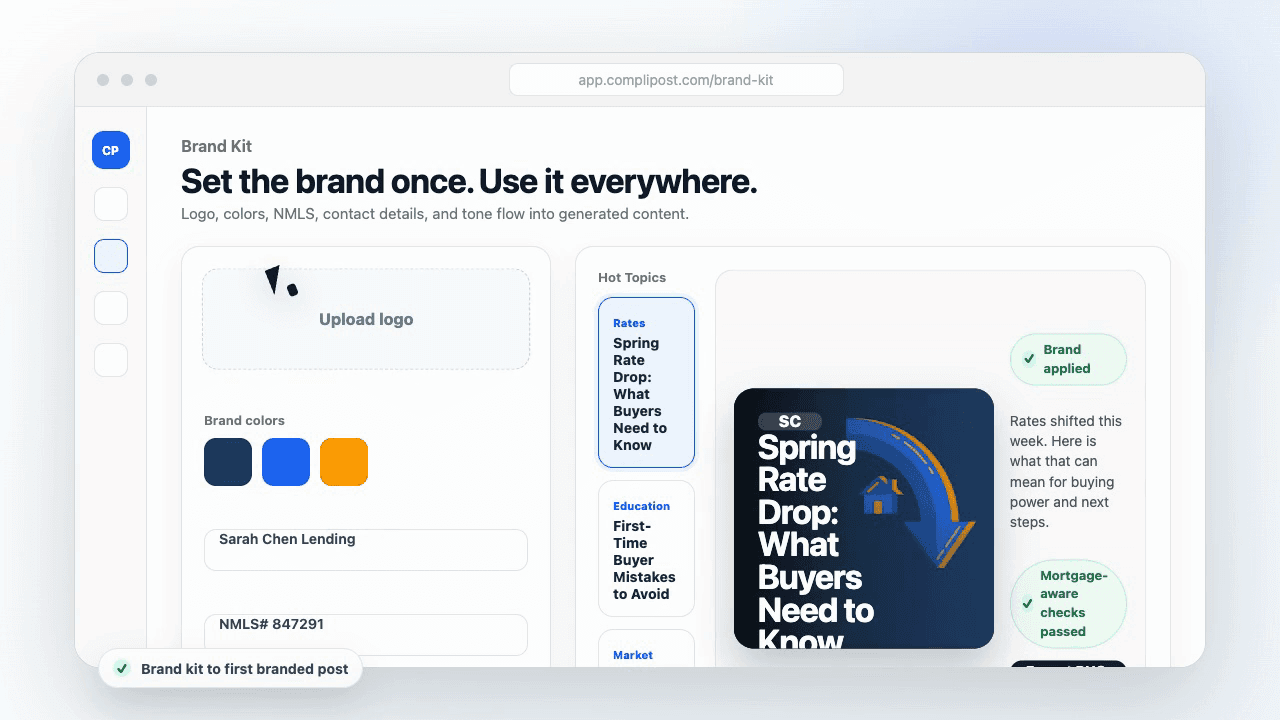
Product workflow
From blank page to export-ready mortgage content
- Start with a borrower topic
- Generate copy and a visual direction
- Review, save, and export the finished asset
These previews reflect the core CompliPost workflow: create, review, save, and export assets for use in your own channels.
Workflow comparison
| Content approach | What happens | Why it matters |
|---|---|---|
| Random posting | One-off ideas created when there is spare time | Inconsistent visibility and weak reuse |
| Template-only posting | Faster design but still requires rewriting and review | Helpful starting point, but not a full system |
| CompliPost workflow | Plan, generate, review, save, and export from one place | Better consistency with mortgage-aware review context |
| Done-for-you service | Someone else creates much of the content | Useful for some teams, but less control and less immediate reuse |
Who this guide helps
This guide is for loan officers working on solo loan officers who need a repeatable mortgage content workflow. The goal is to turn a broad mortgage topic into one borrower question, one useful takeaway, and one asset that can be reviewed before it is shared.
- You need content that sounds like a loan officer, not a generic brand account
- You want examples that can become captions, graphics, GIFs, or PDFs
- You need a clear place to review claims before export
- You want finished work saved for reuse, not lost in a chat thread
A practical workflow for this use case
Start with a narrow scenario, then move through planning, drafting, visual creation, review, and export. For comparison carousel mortgage, that means the topic should be specific enough that a borrower or referral partner can immediately understand what decision the content helps with.
- Choose the borrower type, loan topic, or platform before generating copy
- Draft the caption and visual together so the asset feels cohesive
- Use the federal baseline review aid to flag claims and disclosure gaps
- Export the finished asset and save the post as a reusable starting point
What makes the content stronger
Strong mortgage content is usually specific, plain-spoken, and calm. It explains tradeoffs without pretending one answer fits every borrower. That is especially important on public social channels, where a short post can be interpreted without the full context of a loan conversation.
- Name the borrower question in the first line
- Explain one decision or tradeoff instead of covering everything
- Use examples without implying approval, savings, or rate outcomes
- End with a soft next step, checklist, or guide rather than pressure
Compliance-aware review notes
CompliPost should be treated as a review aid, not a compliance approval system. The public page, generated draft, graphic, and exported asset should all stay honest about that boundary.
- Review specific payment, APR, rate, savings, and qualification language
- Avoid “best,” “lowest,” “guaranteed,” “free,” and urgency claims unless approved
- Check NMLS, Equal Housing, company, and state-specific requirements
- Use company or legal review for anything outside the federal baseline
How this connects to the rest of CompliPost
A focused guide should leave you with a usable next step. After you understand the topic, you can turn it into a calendar slot, a reviewed social post, a downloadable guide, or a platform-specific version for the channel where your audience already spends time.
- Use the content calendar to turn the idea into a weekly plan
- Use the compliance page when claims or disclosures need a slower pass
- Use lead magnets when the topic deserves a deeper PDF guide
- Use platform pages to adapt the same idea for LinkedIn, Facebook, or Instagram
Recommended next steps
Instagram content hub
Create visual mortgage education for carousels, reels, and stories.
Carousel Structures That Convert
Comparison carousels use a 'side-by-side' structure.
Carousel Audience Targeting
Different borrower types care about different comparisons.
Carousel Ideas for Every Loan Type
Pre-written comparison carousel ideas organized by program.
Examples
FAQ
Should I show specific numbers or say 'depends on your situation'?+
Show realistic numbers using 'at today's rates' or your typical market rates. But never claim a specific rate for a specific borrower—rates depend on credit, down payment, and dozens of other factors. Give examples, not promises.
What if my company prefers one program over another?+
Be honest. If your company only offers FHA and conventional (not jumbo), compare those two. A carousel titled 'FHA vs. Conventional: Which is right for you?' is credible. A carousel that omits programs you offer would be misleading.
Can I compare my services to competitors?+
Not explicitly. Comparing 'Your LO service' vs. 'Competitors' is unprofessional. Instead, compare programs or strategies: 'Build equity faster (15-year) vs. lower payments (30-year).' Focus on borrower choices, not company comparisons.
How do I handle comparisons when one option is clearly worse?+
Don't force false balance. If ARMs are risky and fixed rates are stable, you can note that. But frame it as 'best for different risk tolerances' rather than claiming one is objectively better. Honesty builds credibility.
Create mortgage content with a calmer workflow
CompliPost helps you plan, generate, review, save, and export useful mortgage content without pretending compliance or social distribution is automatic.
Start free