Specialist marketing
Reverse mortgage specialist content that rebuilds trust with senior homeowners
Reverse mortgage specialists face a unique content challenge: the product carries more misconceptions than almost any other loan type, and the audience — senior homeowners and their adult children — is particularly sensitive to feeling misled. Content that corrects myths honestly and explains the HECM program accurately earns the specialist-level trust this niche demands.
Why myth-correction content is the foundation of reverse mortgage specialist marketing
The reverse mortgage product has accumulated decades of misconceptions — the bank takes the house, heirs lose everything, it's only for desperate seniors, it's predatory. None of those are accurate descriptions of the current HECM program, but they persist because a large portion of the adult population formed an impression from outdated reporting or secondhand accounts. A reverse mortgage specialist who publishes consistent, accurate myth corrections is not just marketing — they are doing genuine financial education work that serves the senior homeowner community. Content that directly names the misconception, explains what is actually true, and cites the program's consumer protections builds the kind of credibility that earns referrals from estate attorneys, financial advisors, and the adult children who are often the first to research on behalf of a parent.
- The "bank takes the house" myth: what actually happens to ownership in a HECM and what heirs can do
- The "only for desperate seniors" framing: how financial planners increasingly discuss the HECM as a retirement tool
- Mandatory counseling: explaining the HUD-approved counseling requirement honestly as a consumer protection
- Surviving spouse protections: what current HECM rules actually say for non-borrowing spouses
Content that speaks to the adult-child audience
Reverse mortgage decisions are rarely made by the senior homeowner alone. Adult children who are involved in a parent's financial planning are a critical audience — and they are often starting from the misconceptions above. Content that acknowledges their protective instinct, addresses their legitimate concerns honestly, and explains what questions they should ask before dismissing the option creates a trust bridge that a single phone call cannot build. Posts addressing the family conversation angle — "what your adult children are probably worried about, and what's worth discussing" — consistently surface in the reverse mortgage content space because they meet the audience where the decision actually happens.
Building referral relationships as a reverse mortgage specialist
Reverse mortgage specialists who build the strongest volume typically do so through professional referral networks rather than cold consumer marketing. Elder law attorneys, estate planners, financial advisors who work with retirees, and senior housing counselors are all in contact with the target borrower — and they refer to the lender who demonstrates accurate product knowledge and a careful, non-pressured approach. LinkedIn content that explains the HECM program with the precision of a financial professional — addressing the planning scenarios where a reverse mortgage makes analytical sense — earns referrals from advisors who need a lender they can trust to handle their clients carefully.
Compliance requirements unique to reverse mortgage content
Reverse mortgage content has specific federal advertising requirements that go beyond the standard mortgage compliance checklist. FHA's HECM program has particular rules around how loan advances, costs, and available equity may be discussed in advertising. The compliance exposure points most common in this niche: implying borrowers will receive a specific payment amount without the full TILA context, suggesting the loan is "free" or "no cost" without the full fee disclosure, and framing the product as universally suitable without the counseling and qualification context. CompliPost's federal-baseline review aid is designed to flag these reverse mortgage-specific risk signals before export. Content in this space warrants review by a compliance professional familiar with FHA advertising guidelines.
Product workflow
From blank page to export-ready mortgage content
- Start with a borrower topic
- Generate copy and a visual direction
- Review, save, and export the finished asset
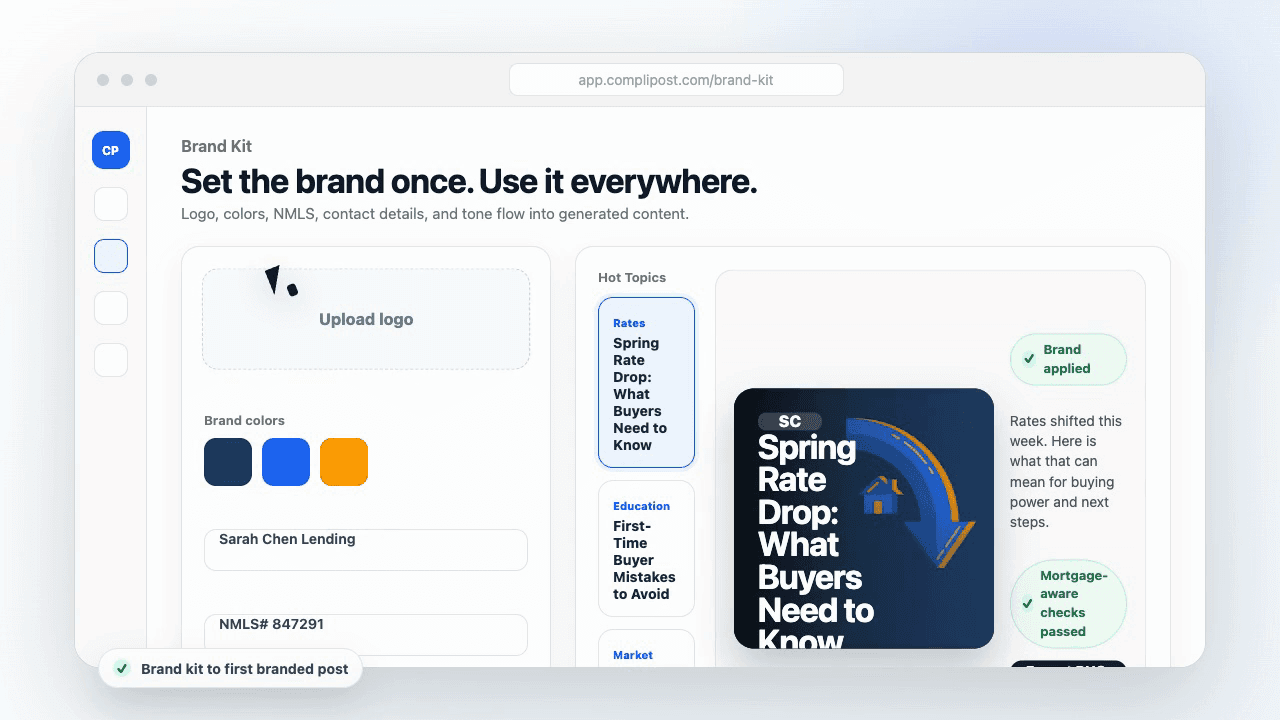
These previews reflect the core CompliPost workflow: create, review, save, and export assets for use in your own channels.
Workflow comparison
| Content approach | What happens | Why it matters |
|---|---|---|
| Random posting | One-off ideas created when there is spare time | Inconsistent visibility and weak reuse |
| Template-only posting | Faster design but still requires rewriting and review | Helpful starting point, but not a full system |
| CompliPost workflow | Plan, generate, review, save, and export from one place | Better consistency with mortgage-aware review context |
| Done-for-you service | Someone else creates much of the content | Useful for some teams, but less control and less immediate reuse |
Who this guide helps
This guide is for loan officers working on solo loan officers who need a repeatable mortgage content workflow. The goal is to turn a broad mortgage topic into one borrower question, one useful takeaway, and one asset that can be reviewed before it is shared.
- You need content that sounds like a loan officer, not a generic brand account
- You want examples that can become captions, graphics, GIFs, or PDFs
- You need a clear place to review claims before export
- You want finished work saved for reuse, not lost in a chat thread
A practical workflow for this use case
Start with a narrow scenario, then move through planning, drafting, visual creation, review, and export. For reverse mortgage specialist content, that means the topic should be specific enough that a borrower or referral partner can immediately understand what decision the content helps with.
- Choose the borrower type, loan topic, or platform before generating copy
- Draft the caption and visual together so the asset feels cohesive
- Use the federal baseline review aid to flag claims and disclosure gaps
- Export the finished asset and save the post as a reusable starting point
What makes the content stronger
Strong mortgage content is usually specific, plain-spoken, and calm. It explains tradeoffs without pretending one answer fits every borrower. That is especially important on public social channels, where a short post can be interpreted without the full context of a loan conversation.
- Name the borrower question in the first line
- Explain one decision or tradeoff instead of covering everything
- Use examples without implying approval, savings, or rate outcomes
- End with a soft next step, checklist, or guide rather than pressure
Compliance-aware review notes
CompliPost should be treated as a review aid, not a compliance approval system. The public page, generated draft, graphic, and exported asset should all stay honest about that boundary.
- Review specific payment, APR, rate, savings, and qualification language
- Avoid “best,” “lowest,” “guaranteed,” “free,” and urgency claims unless approved
- Check NMLS, Equal Housing, company, and state-specific requirements
- Use company or legal review for anything outside the federal baseline
How this connects to the rest of CompliPost
A focused guide should leave you with a usable next step. After you understand the topic, you can turn it into a calendar slot, a reviewed social post, a downloadable guide, or a platform-specific version for the channel where your audience already spends time.
- Use the content calendar to turn the idea into a weekly plan
- Use the compliance page when claims or disclosures need a slower pass
- Use lead magnets when the topic deserves a deeper PDF guide
- Use platform pages to adapt the same idea for LinkedIn, Facebook, or Instagram
Recommended next steps
Mortgage social media content
See the cross-platform content workflow for loan officers.
Reverse mortgage social media content
Post ideas and education angles for the reverse mortgage product.
Mortgage compliance disclaimer examples
How to frame HECM content with compliant language before export.
Loan officer thought leadership content
Build the authoritative voice that earns referrals from financial advisors and planners.
Examples
FAQ
What content topics work best for a reverse mortgage specialist?+
Myth-correction and honest product education are the foundation. The most effective reverse mortgage specialist content directly names the misconceptions seniors and their families carry — the bank-takes-the-house belief, the all-heirs-lose framing — and corrects them with documented accuracy. Content that addresses the adult-child audience and the family decision dynamic also performs well because it meets the audience where the decision actually happens.
What compliance risks should reverse mortgage specialists watch in their social content?+
HECM advertising has specific FHA rules around how loan advances and costs are discussed. The most common risks: implying specific payment amounts without full disclosure context, framing reverse mortgages as "free" or "no cost," and suggesting universal suitability without counseling and qualification context. CompliPost's federal-baseline review aid surfaces these risk signals before export. This product category benefits especially from compliance review by a professional familiar with FHA advertising guidelines.
How can a reverse mortgage specialist build referral relationships through content?+
By creating content that demonstrates the product knowledge and careful, non-pressured approach that estate attorneys, financial planners, and senior housing counselors need to feel comfortable referring their clients. LinkedIn posts that discuss the HECM as a financial planning tool — written with analytical precision rather than sales framing — earn credibility with professional referrers who are otherwise cautious about reverse mortgage recommendations.
What platforms work best for reverse mortgage content?+
Facebook is the most direct channel for reaching senior homeowners and the adult children who research on their behalf. LinkedIn reaches the financial and legal professionals who refer clients. YouTube and longer-form video work particularly well in this niche because the product explanation genuinely benefits from walk-through formats. The audience skews older and prefers platforms that allow more depth than short-form social.
Does CompliPost support reverse mortgage specialist content creation?+
Yes. CompliPost helps reverse mortgage specialists create, review, save, and export educational content — myth corrections, HECM explainers, family-conversation posts, and advisor-facing content. The federal-baseline review aid flags common reverse mortgage advertising risk signals before export. You post from your preferred platform; the review aid is an early-stage check, not a compliance approval.
Create mortgage content with a calmer workflow
CompliPost helps you plan, generate, review, save, and export useful mortgage content without pretending compliance or social distribution is automatic.
Start free