Platform content
Facebook content that makes you the local mortgage name
Facebook is where loan officers build neighborhood familiarity — with past clients, friends, and community groups. It works because most borrowers are not ready today, and a steady, helpful local presence makes you the name they remember when they are.
Write content neighbors will forward
Facebook reach for a loan officer comes mostly from sharing: a neighbor tags a friend who is house-hunting, or a past client sends your post to a cousin. So favor content that is easy to hand off — plain-language FAQs, checklists, and local explainers — over hot takes. A strong Facebook post is something a non-expert can forward and say "this is helpful, talk to this person."
- Borrower FAQs answered the way you would at an open house
- Local market notes in plain, non-alarming language
- Shareable checklists and first-time buyer guides
- Community posts: closings, local events, your why
Turn every closing into a week of content
Closings are a content goldmine most loan officers let evaporate. With the borrower's permission and identifying details removed, one closing becomes a Wednesday FAQ about a hurdle that came up, a Friday celebration post, and a shareable guide later. Facebook is the natural home for these because the audience already knows you locally and is glad to celebrate a neighbor.
Page or profile — and keeping it compliant
Many loan officers keep guides and FAQs on a business page and post community and personal content on a personal profile, where engagement is often warmer. Either way, keep the language educational. Watch casual phrasing especially: a line like "you would be wise to refinance" can cross into unauthorized financial advice. Follow your company policy on which account to use.
How CompliPost helps
Pick a local topic, generate the caption, build a branded graphic or a shareable PDF guide, and run the federal-baseline review aid before export. CompliPost applies your brand kit to every asset; you post from your own Facebook page or profile. It is a review aid that surfaces risk language, not compliance approval.
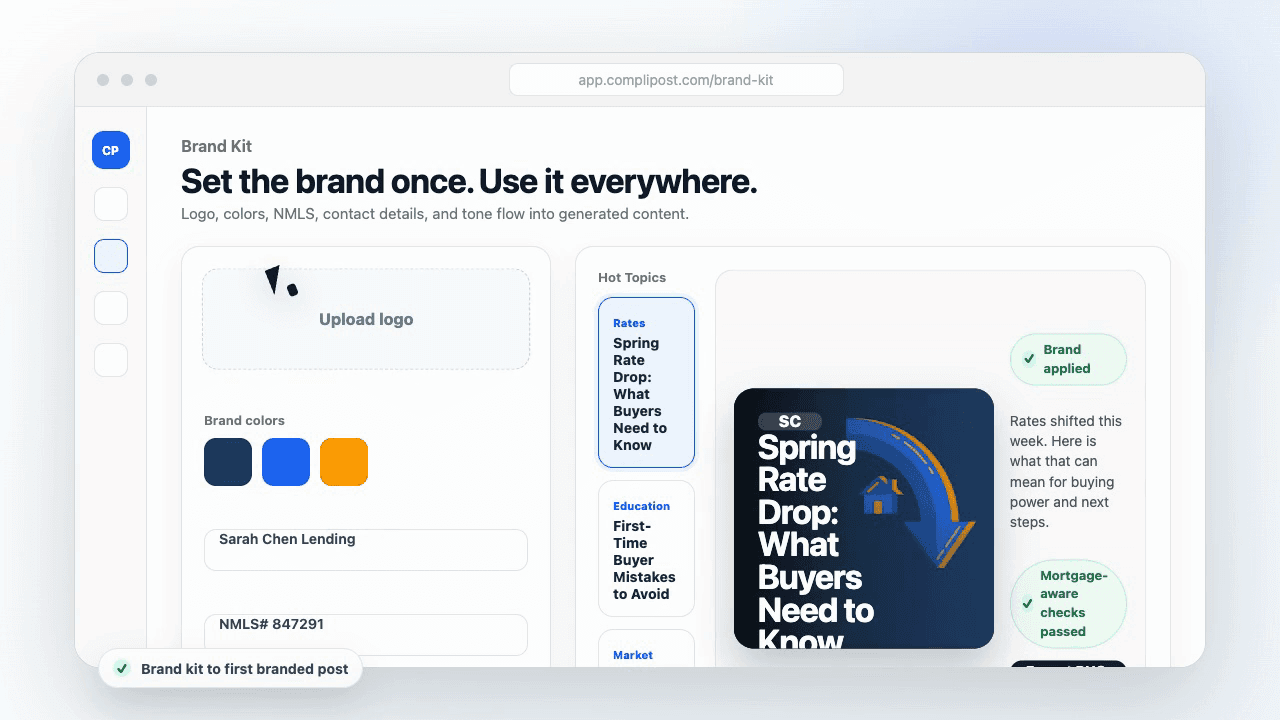
Product workflow
From blank page to export-ready mortgage content
- Start with a borrower topic
- Generate copy and a visual direction
- Review, save, and export the finished asset
These previews reflect the core CompliPost workflow: create, review, save, and export assets for use in your own channels.
Platform fit table
| Content job | Best format | Review note |
|---|---|---|
| Borrower education | Short explainer, carousel, or checklist | Keep claims general and educational |
| Referral partner trust | Process insight or local market context | Avoid borrower-identifying details |
| Lead magnet promotion | Guide preview plus soft CTA | Do not imply qualification or approval |
| Market update | Plain-language context | Avoid rate promises or panic language |
Who this guide helps
This guide is for loan officers working on local borrowers and community audiences on Facebook. The goal is to turn a broad mortgage topic into one borrower question, one useful takeaway, and one asset that can be reviewed before it is shared.
- You need content that sounds like a loan officer, not a generic brand account
- You want examples that can become captions, graphics, GIFs, or PDFs
- You need a clear place to review claims before export
- You want finished work saved for reuse, not lost in a chat thread
A practical workflow for this use case
Start with a narrow scenario, then move through planning, drafting, visual creation, review, and export. For loan officer Facebook content, that means the topic should be specific enough that a borrower or referral partner can immediately understand what decision the content helps with.
- Choose the borrower type, loan topic, or platform before generating copy
- Draft the caption and visual together so the asset feels cohesive
- Use the federal baseline review aid to flag claims and disclosure gaps
- Export the finished asset and save the post as a reusable starting point
What makes the content stronger
Strong mortgage content is usually specific, plain-spoken, and calm. It explains tradeoffs without pretending one answer fits every borrower. That is especially important on public social channels, where a short post can be interpreted without the full context of a loan conversation.
- Name the borrower question in the first line
- Explain one decision or tradeoff instead of covering everything
- Use examples without implying approval, savings, or rate outcomes
- End with a soft next step, checklist, or guide rather than pressure
Compliance-aware review notes
CompliPost should be treated as a review aid, not a compliance approval system. The public page, generated draft, graphic, and exported asset should all stay honest about that boundary.
- Review specific payment, APR, rate, savings, and qualification language
- Avoid “best,” “lowest,” “guaranteed,” “free,” and urgency claims unless approved
- Check NMLS, Equal Housing, company, and state-specific requirements
- Use company or legal review for anything outside the federal baseline
How this connects to the rest of CompliPost
A focused guide should leave you with a usable next step. After you understand the topic, you can turn it into a calendar slot, a reviewed social post, a downloadable guide, or a platform-specific version for the channel where your audience already spends time.
- Use the content calendar to turn the idea into a weekly plan
- Use the compliance page when claims or disclosures need a slower pass
- Use lead magnets when the topic deserves a deeper PDF guide
- Use platform pages to adapt the same idea for LinkedIn, Facebook, or Instagram
Recommended next steps
Loan officer Instagram content
The visual-first counterpart for carousels, reels, and stories.
Loan officer LinkedIn content
Where the referral-partner relationships live alongside local reach.
Loan officer lead magnets
Turn borrower education into branded PDF guides worth sharing on Facebook.
First-time buyer mortgage content
Education for new buyers — the most shareable Facebook topic there is.
Examples
FAQ
What should a loan officer post on Facebook?+
Post local, shareable content: borrower FAQs, neighborhood market notes, first-time buyer checklists, and community celebrations. Facebook rewards content that feels like advice from a knowledgeable neighbor and that people forward to a friend who is house-hunting.
How often should a loan officer post on Facebook?+
Three to five posts per week is a realistic, sustainable cadence. The exact number matters less than keeping it steady — a reliable rhythm builds the local familiarity that turns a neighbor into a referral.
Should I use a Facebook business page or my personal profile?+
Both have a role. A business page keeps marketing organized; a personal profile often gets warmer engagement from people who know you. Many loan officers split community content to the profile and guides to the page. Follow your company policy.
How do I keep Facebook mortgage posts compliant?+
Keep posts educational and avoid quoted rates, guaranteed outcomes, and urgency pressure. Watch casual phrases like "it's a great time to buy," which can read as unauthorized advice. CompliPost's federal baseline review aid flags this language before export.
Can CompliPost publish to Facebook for me?+
No. CompliPost helps you plan, generate, review, and export branded captions, graphics, and PDF guides. You post them from your own Facebook page or profile.
Create mortgage content with a calmer workflow
CompliPost helps you plan, generate, review, save, and export useful mortgage content without pretending compliance or social distribution is automatic.
Start free