Platform content
LinkedIn content that makes referral partners trust you
LinkedIn is where real estate agents, financial planners, and past clients decide whether you are worth referring. The content that works here is not a consumer pitch — it is professional commentary and process clarity that makes a partner look smart for sending you a buyer.
Write for referral partners, not cold borrowers
LinkedIn is a B2B room. Industry reporting shows the average real estate agent now works with 17 or more loan officers, so the job of your LinkedIn presence is to be the one they remember and trust. Aim posts at what an agent needs: confidence that your file will close on time, language they can repeat to their own buyers, and market context that makes them look informed.
- Process posts: how you keep a contract on schedule from offer to clear-to-close
- Market commentary with one clear, repeatable takeaway
- Borrower myth corrections an agent can forward to their client
- Client-safe lessons that show judgment, not just activity
Use length as an advantage
LinkedIn rewards substance, so this is the one channel where longer, considered posts outperform one-line hooks. A good LinkedIn post reads like a short, useful note from a professional who knows the craft. That depth is what earns a tag when an agent has a financing question — and it is increasingly what AI search tools quote when someone researches loan officers by name.
Show up consistently — that is the whole strategy
The most-named content pain for loan officers is "post when I have time," which becomes never. On LinkedIn the fix is modest: two to four genuine posts a week, every week. Consistency beats virality here because reputation compounds — when a partner sees steady, useful posts for months, you are already trusted before the first call.
How CompliPost helps
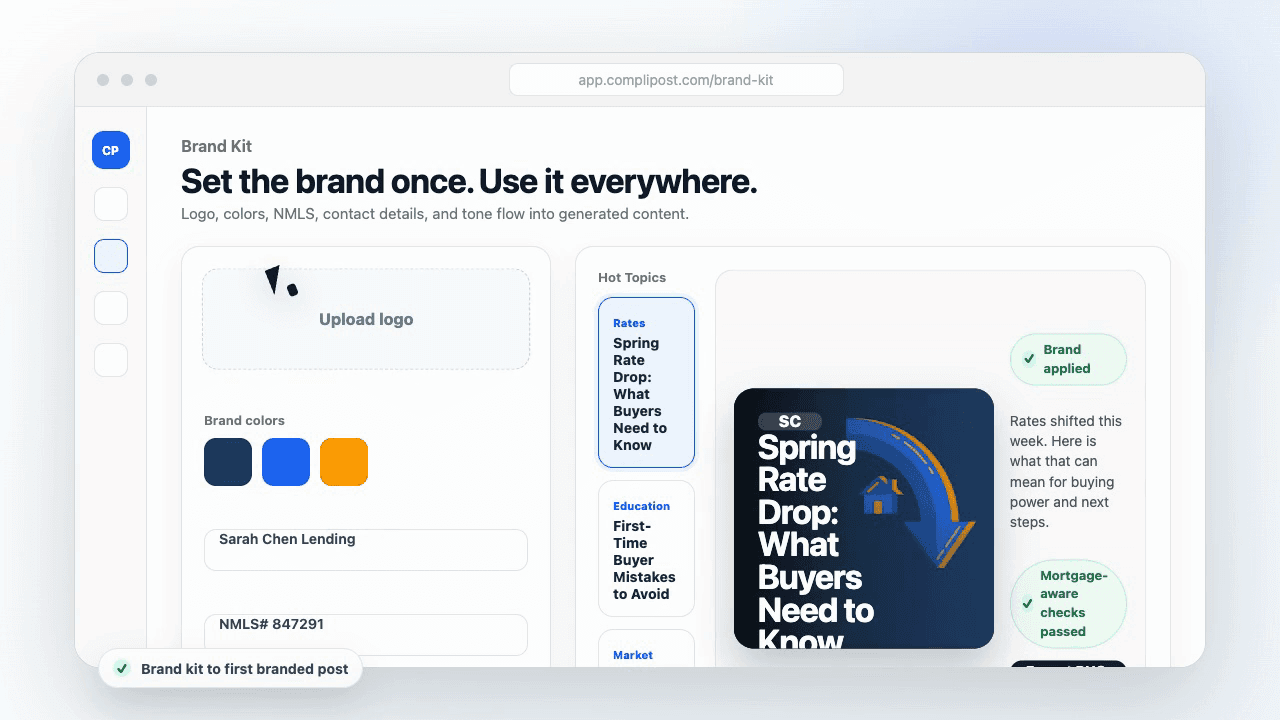
Pick a partner-facing topic, generate the long-form copy and a clean branded graphic when it helps, and run the federal-baseline review aid before export. CompliPost applies your brand kit to every asset and flags rate, guarantee, and disclosure language before it leaves your workspace. It is a review aid, not compliance approval — you post from your own LinkedIn profile.
Product workflow
From blank page to export-ready mortgage content
- Start with a borrower topic
- Generate copy and a visual direction
- Review, save, and export the finished asset
These previews reflect the core CompliPost workflow: create, review, save, and export assets for use in your own channels.
Platform fit table
| Content job | Best format | Review note |
|---|---|---|
| Borrower education | Short explainer, carousel, or checklist | Keep claims general and educational |
| Referral partner trust | Process insight or local market context | Avoid borrower-identifying details |
| Lead magnet promotion | Guide preview plus soft CTA | Do not imply qualification or approval |
| Market update | Plain-language context | Avoid rate promises or panic language |
Who this guide helps
This guide is for loan officers working on professional audiences and referral partners on LinkedIn. The goal is to turn a broad mortgage topic into one borrower question, one useful takeaway, and one asset that can be reviewed before it is shared.
- You need content that sounds like a loan officer, not a generic brand account
- You want examples that can become captions, graphics, GIFs, or PDFs
- You need a clear place to review claims before export
- You want finished work saved for reuse, not lost in a chat thread
A practical workflow for this use case
Start with a narrow scenario, then move through planning, drafting, visual creation, review, and export. For loan officer LinkedIn content, that means the topic should be specific enough that a borrower or referral partner can immediately understand what decision the content helps with.
- Choose the borrower type, loan topic, or platform before generating copy
- Draft the caption and visual together so the asset feels cohesive
- Use the federal baseline review aid to flag claims and disclosure gaps
- Export the finished asset and save the post as a reusable starting point
What makes the content stronger
Strong mortgage content is usually specific, plain-spoken, and calm. It explains tradeoffs without pretending one answer fits every borrower. That is especially important on public social channels, where a short post can be interpreted without the full context of a loan conversation.
- Name the borrower question in the first line
- Explain one decision or tradeoff instead of covering everything
- Use examples without implying approval, savings, or rate outcomes
- End with a soft next step, checklist, or guide rather than pressure
Compliance-aware review notes
CompliPost should be treated as a review aid, not a compliance approval system. The public page, generated draft, graphic, and exported asset should all stay honest about that boundary.
- Review specific payment, APR, rate, savings, and qualification language
- Avoid “best,” “lowest,” “guaranteed,” “free,” and urgency claims unless approved
- Check NMLS, Equal Housing, company, and state-specific requirements
- Use company or legal review for anything outside the federal baseline
How this connects to the rest of CompliPost
A focused guide should leave you with a usable next step. After you understand the topic, you can turn it into a calendar slot, a reviewed social post, a downloadable guide, or a platform-specific version for the channel where your audience already spends time.
- Use the content calendar to turn the idea into a weekly plan
- Use the compliance page when claims or disclosures need a slower pass
- Use lead magnets when the topic deserves a deeper PDF guide
- Use platform pages to adapt the same idea for LinkedIn, Facebook, or Instagram
Recommended next steps
Loan officer Facebook content
The local-familiarity counterpart to LinkedIn's partner-facing reach.
Loan officer X (Twitter) content
Short market takes that earn reshares from the same agent audience.
Realtor partner mortgage content
Post angles and guides that make agents confident referring borrowers to you.
Mortgage content calendar
Protect two to four LinkedIn slots a week with a repeatable plan.
Examples
FAQ
What should a loan officer post on LinkedIn?+
Post for referral partners: process explainers, market commentary with a clear takeaway, borrower myth corrections agents can reshare, and client-safe reflections. Content that helps a real estate agent look informed to their own buyers builds the most durable referral relationships.
How often should a loan officer post on LinkedIn?+
Two to four substantive posts per week is realistic and effective. LinkedIn rewards depth over frequency, so a few well-written posts outperform daily filler. Pick a cadence you can hold for months — consistency is what builds professional reputation.
Is LinkedIn better than Instagram for loan officers?+
They do different jobs. LinkedIn reaches referral partners and professional reputation with longer commentary-style posts; Instagram reaches consumers with visual carousels and reels. Most loan officers benefit from both, with LinkedIn carrying the partner relationships.
Can I post about mortgage rates on LinkedIn?+
You can post market context, but as education rather than a quoted rate or promise. Explain what moved and what it means for a borrower decision instead of stating a number. CompliPost flags rate, payment, and guarantee language before you export.
Does CompliPost post to LinkedIn for me?+
No. CompliPost helps you plan, generate, review, and export branded LinkedIn content. You publish it from your own profile, which keeps account ownership and timing in your hands.
Create mortgage content with a calmer workflow
CompliPost helps you plan, generate, review, save, and export useful mortgage content without pretending compliance or social distribution is automatic.
Start free