Compliance education
Mortgage disclaimer examples that protect loan officers before they post
Mortgage compliance for social media is not just what you say — it is what you do not include. The most common loan officer compliance issues are not obvious violations; they are casual phrases that cross into unauthorized financial advice. These disclaimer examples and before/after rewrites show the difference.
The phrases that actually get loan officers cited
Real loan officers get cited not for the obvious stuff but for well-meaning casual phrases. Based on compliance reporting from the industry (including Smarsh research on financial services social media), the actual phrases that create liability are surprisingly ordinary: "it's a great time to buy a home," "you'd be wise to refinance your student loans into a home-equity loan," "don't quote me on this," "delete after reading." These phrases sound helpful. They cross into unauthorized financial advice.
- ⚠ "It's a great time to buy" → ✓ "Here's what the current market looks like for buyers who have been waiting"
- ⚠ "You should refinance your student loans into your equity" → ✓ "Here's how to think about whether a cash-out refi makes sense for debt consolidation"
- ⚠ "Don't quote me on this" → ✓ (remove the sentence entirely)
- ⚠ "I did no work but still got 3 deals" → ✓ (remove entirely — implied deception)
NMLS and Equal Housing disclosure basics
Every mortgage advertisement — including social media posts — should include the loan officer's NMLS number and, where applicable, Equal Housing Lender language. The CFPB and state regulators have cited loan officers for social media posts that constitute advertisements without required disclosures. The practical implementation: NMLS number in every bio and in any post that advertises a specific product or offer.
- NMLS disclosure format: "NMLS# [your number]"
- Equal Housing: "Equal Housing Lender" or the Equal Housing logo
- Company NMLS: check whether your company requires the company NMLS# alongside your individual number
- State license: some state regulators require state license numbers in advertisements
Rate disclaimer formats for social media
Any post that includes a specific rate, payment amount, or APR requires TILA-compliant disclosures. The practical guidance for social media: avoid specific rates and payments in organic posts unless you are prepared to include full TILA disclosures. Educational posts about how rates work, what affects them, and how to compare them do not require rate-specific disclosures — and they are more useful to borrowers than rate claims anyway.
CompliPost as a federal-baseline review aid
CompliPost's compliance review feature is a federal-baseline check — it surfaces language worth a closer look before export. It is a risk-signal aid, not legal advice, not compliance approval, and not a substitute for your company's compliance review process. Use it to catch the casual phrases that hide in plain sight before they reach your compliance officer or, worse, a regulator.
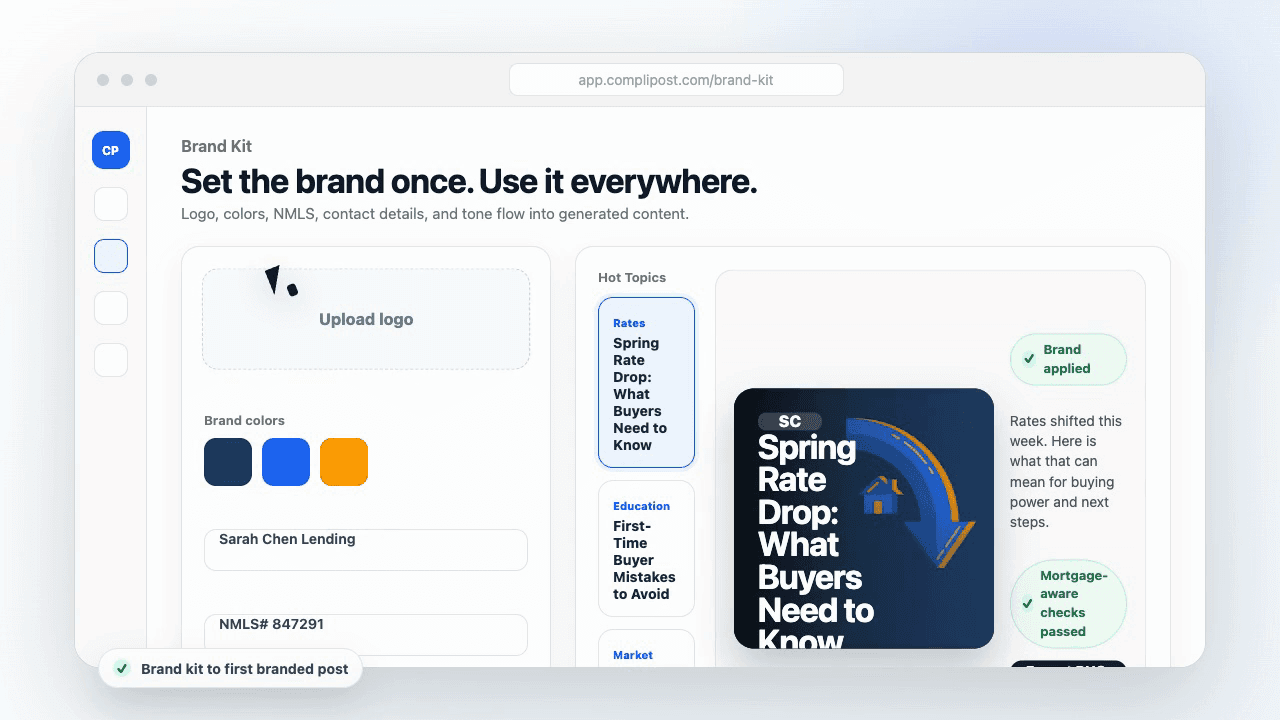
Product workflow
From blank page to export-ready mortgage content
- Start with a borrower topic
- Generate copy and a visual direction
- Review, save, and export the finished asset
These previews reflect the core CompliPost workflow: create, review, save, and export assets for use in your own channels.
Risky copy vs safer review direction
| Draft pattern | Why it needs review | Safer direction |
|---|---|---|
| Guaranteed lowest rate | Guarantee and superlative claim | Compare options carefully with a licensed professional |
| Save $500/month | Unsupported savings claim | Review refinance goals, costs, and break-even timing |
| No-cost loan | Potential fee and disclosure issue | Explain tradeoffs and confirm company-approved language |
| Act now before rates explode | Pressure and urgency language | Use calm market context and invite questions |
Who this guide helps
This guide is for loan officers working on solo loan officers who need a repeatable mortgage content workflow. The goal is to turn a broad mortgage topic into one borrower question, one useful takeaway, and one asset that can be reviewed before it is shared.
- You need content that sounds like a loan officer, not a generic brand account
- You want examples that can become captions, graphics, GIFs, or PDFs
- You need a clear place to review claims before export
- You want finished work saved for reuse, not lost in a chat thread
A practical workflow for this use case
Start with a narrow scenario, then move through planning, drafting, visual creation, review, and export. For mortgage compliance disclaimer examples, that means the topic should be specific enough that a borrower or referral partner can immediately understand what decision the content helps with.
- Choose the borrower type, loan topic, or platform before generating copy
- Draft the caption and visual together so the asset feels cohesive
- Use the federal baseline review aid to flag claims and disclosure gaps
- Export the finished asset and save the post as a reusable starting point
What makes the content stronger
Strong mortgage content is usually specific, plain-spoken, and calm. It explains tradeoffs without pretending one answer fits every borrower. That is especially important on public social channels, where a short post can be interpreted without the full context of a loan conversation.
- Name the borrower question in the first line
- Explain one decision or tradeoff instead of covering everything
- Use examples without implying approval, savings, or rate outcomes
- End with a soft next step, checklist, or guide rather than pressure
Compliance-aware review notes
CompliPost should be treated as a review aid, not a compliance approval system. The public page, generated draft, graphic, and exported asset should all stay honest about that boundary.
- Review specific payment, APR, rate, savings, and qualification language
- Avoid “best,” “lowest,” “guaranteed,” “free,” and urgency claims unless approved
- Check NMLS, Equal Housing, company, and state-specific requirements
- Use company or legal review for anything outside the federal baseline
How this connects to the rest of CompliPost
A focused guide should leave you with a usable next step. After you understand the topic, you can turn it into a calendar slot, a reviewed social post, a downloadable guide, or a platform-specific version for the channel where your audience already spends time.
- Use the content calendar to turn the idea into a weekly plan
- Use the compliance page when claims or disclosures need a slower pass
- Use lead magnets when the topic deserves a deeper PDF guide
- Use platform pages to adapt the same idea for LinkedIn, Facebook, or Instagram
Recommended next steps
Mortgage marketing compliance
Use a federal baseline review aid before exporting content.
Most common mortgage marketing compliance risks
Detailed guide to the compliance risks that appear most often in mortgage social media.
Loan officer thought leadership content
Build authoritative content that avoids the casual phrases that create compliance risk.
Mortgage content calendar
Plan a weekly rhythm so loan-type education posts on a schedule you can keep.
Examples
FAQ
Do loan officers need an NMLS number on every social media post?+
Most posts that constitute mortgage advertisements require NMLS disclosure. The safest practice is to include your NMLS number in your social media bio, and in any post that promotes a specific product, rate, or offer. Posts that are purely educational — explaining how the mortgage process works without advertising — may not require a per-post disclosure, but check your company policy and applicable state regulations.
What is the most common mortgage compliance violation on social media?+
Casual phrases that cross into unauthorized financial advice — "it's a great time to buy," implied rate predictions, guaranteed qualification claims — are among the most commonly cited. Real loan officers get cited for well-meaning conversational language that sounds like advice, not for obvious red-flag statements.
Is CompliPost a compliance system that approves my posts?+
No. CompliPost is a federal-baseline review aid that flags risk signals before export. It is designed to catch the casual phrases that compliance officers catch — earlier in the workflow, before they are exported. Final compliance approval rests with you, your company policy, and your compliance reviewer.
What does "federal baseline" mean in a compliance review context?+
Federal-baseline means CompliPost checks for language that may implicate federal regulations: TILA (rate and payment claims), RESPA (referral fee language), NMLS (disclosure presence), Fair Housing (discriminatory or exclusionary language), and UDAAP (deceptive or unfair claims). State-specific regulations, company policies, and regulatory updates require review beyond this baseline.
Create mortgage content with a calmer workflow
CompliPost helps you plan, generate, review, save, and export useful mortgage content without pretending compliance or social distribution is automatic.
Start free