Buyer Journey
What Mortgage Preapproval Actually Means
Mortgage preapproval is a lender's preliminary assessment that a borrower can qualify for a specific loan amount based on verified financial information. It signals to sellers that you are a serious, qualified buyer with real purchasing power. Use this foundation to create social content that educates your borrowers and builds confidence as they enter the buying process.
How preapproval differs from prequalification
Prequalification is an informal estimate based on borrower-provided information; preapproval is a formal underwriting decision backed by verified documents like tax returns, W2s, and bank statements. The key difference: preapproval carries weight in the real estate market and gives sellers confidence, while prequalification is exploratory. In social content, emphasize that preapproval is the credential buyers need to compete in today's market.
- Prequalification: borrower self-reports income and assets, no document review
- Preapproval: lender verifies employment, income, credit, assets, and employment history
- Preapproval letter: issued after underwriting and valid for 60-90 days
- Sellers view preapproval as proof of financing capability and buyer seriousness
What lenders verify during preapproval
During the preapproval process, your lender pulls credit, reviews income documentation, examines bank statements, and confirms employment. They assess debt-to-income ratio, credit history, and down payment sourcing. Honesty and completeness matter; any discrepancies can delay approval. Create content that walks borrowers through expected questions so they feel prepared.
- Credit score pull and review of payment history
- Verification of employment (VOE) or income documentation (1099, W2, profit-and-loss)
- Bank and asset statements to confirm down payment and closing cost reserves
- Review of existing debts, loans, and monthly obligations
The preapproval timeline and validity
Preapproval typically takes 3-5 business days but can happen faster if documents are submitted promptly. The approval letter is usually valid for 60 to 90 days; if rates change or more time passes, the borrower may need to re-verify income or re-pull credit. Use this timeline to set expectations in your content and reduce anxiety.
- Initial application and document collection: 1-2 days
- Underwriting review and verification calls: 2-4 days
- Conditional approval or clear-to-close: 1-2 days
- Preapproval letter validity: 60-90 days, may require refresh if market conditions shift
Why preapproval matters in competitive markets
In seller's markets, a preapproval letter signals genuine buying intent and financial readiness. Sellers are more likely to negotiate with preapproved buyers than those with only prequalification letters. Emphasize this competitive advantage in your content to motivate borrowers to move quickly through the preapproval process.
- Preapproval strengthens offer competitiveness, especially in multiple-offer situations
- Sellers reduce perceived risk when they see verified lender commitment
- Quick preapproval can accelerate offer acceptance and closing timeline
- Preapproval builds buyer confidence and reduces stress during the negotiation phase
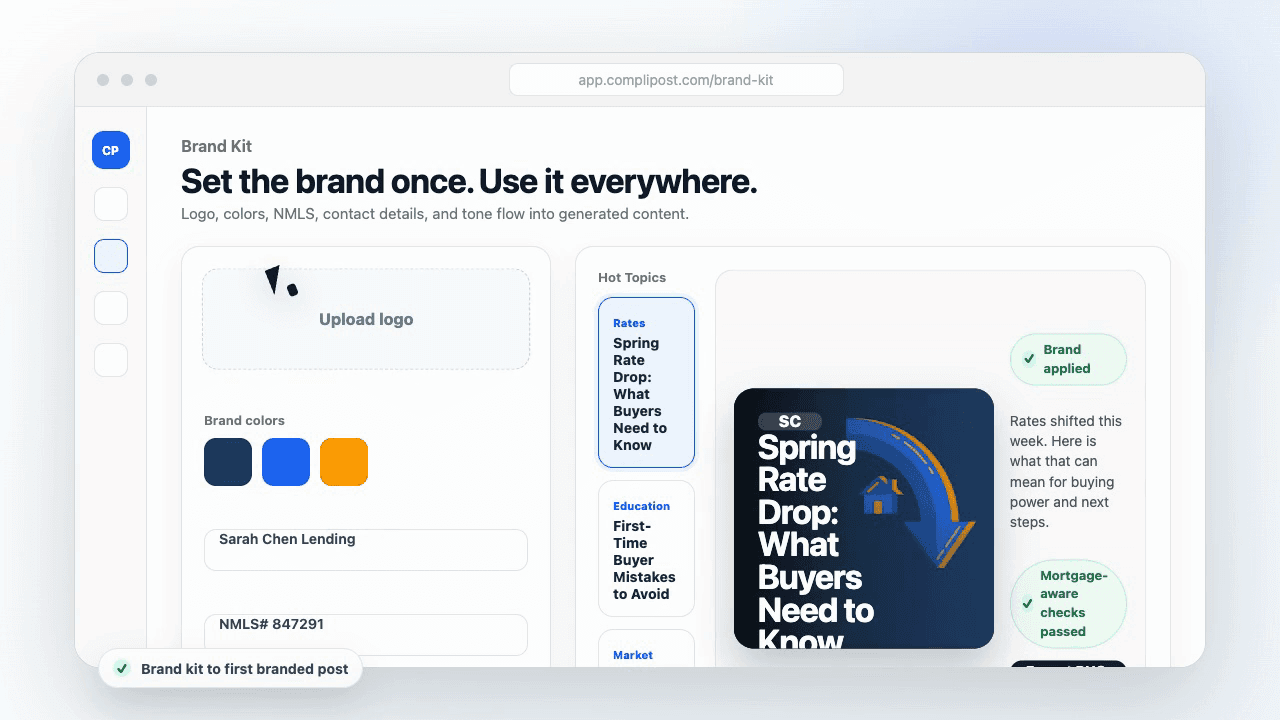
Product workflow
From blank page to export-ready mortgage content
- Start with a borrower topic
- Generate copy and a visual direction
- Review, save, and export the finished asset
These previews reflect the core CompliPost workflow: create, review, save, and export assets for use in your own channels.
Workflow comparison
| Content approach | What happens | Why it matters |
|---|---|---|
| Random posting | One-off ideas created when there is spare time | Inconsistent visibility and weak reuse |
| Template-only posting | Faster design but still requires rewriting and review | Helpful starting point, but not a full system |
| CompliPost workflow | Plan, generate, review, save, and export from one place | Better consistency with mortgage-aware review context |
| Done-for-you service | Someone else creates much of the content | Useful for some teams, but less control and less immediate reuse |
Who this guide helps
This guide is for loan officers working on solo loan officers who need a repeatable mortgage content workflow. The goal is to turn a broad mortgage topic into one borrower question, one useful takeaway, and one asset that can be reviewed before it is shared.
- You need content that sounds like a loan officer, not a generic brand account
- You want examples that can become captions, graphics, GIFs, or PDFs
- You need a clear place to review claims before export
- You want finished work saved for reuse, not lost in a chat thread
A practical workflow for this use case
Start with a narrow scenario, then move through planning, drafting, visual creation, review, and export. For mortgage preapproval explained, that means the topic should be specific enough that a borrower or referral partner can immediately understand what decision the content helps with.
- Choose the borrower type, loan topic, or platform before generating copy
- Draft the caption and visual together so the asset feels cohesive
- Use the federal baseline review aid to flag claims and disclosure gaps
- Export the finished asset and save the post as a reusable starting point
What makes the content stronger
Strong mortgage content is usually specific, plain-spoken, and calm. It explains tradeoffs without pretending one answer fits every borrower. That is especially important on public social channels, where a short post can be interpreted without the full context of a loan conversation.
- Name the borrower question in the first line
- Explain one decision or tradeoff instead of covering everything
- Use examples without implying approval, savings, or rate outcomes
- End with a soft next step, checklist, or guide rather than pressure
Compliance-aware review notes
CompliPost should be treated as a review aid, not a compliance approval system. The public page, generated draft, graphic, and exported asset should all stay honest about that boundary.
- Review specific payment, APR, rate, savings, and qualification language
- Avoid “best,” “lowest,” “guaranteed,” “free,” and urgency claims unless approved
- Check NMLS, Equal Housing, company, and state-specific requirements
- Use company or legal review for anything outside the federal baseline
How this connects to the rest of CompliPost
A focused guide should leave you with a usable next step. After you understand the topic, you can turn it into a calendar slot, a reviewed social post, a downloadable guide, or a platform-specific version for the channel where your audience already spends time.
- Use the content calendar to turn the idea into a weekly plan
- Use the compliance page when claims or disclosures need a slower pass
- Use lead magnets when the topic deserves a deeper PDF guide
- Use platform pages to adapt the same idea for LinkedIn, Facebook, or Instagram
Recommended next steps
First-time buyer content hub
Build clear education for first-time buyers.
Preapproval vs. Prequalification Explained
Clarify the key differences between prequalification and preapproval to help buyers understand where they stand in the lending process.
Debt-to-Income Ratio and Qualification Math
Teach borrowers how lenders calculate DTI and what ratios mean for their buying power and loan approval odds.
First-Time Home Buyer Checklist
Walk buyers through the complete home purchase process, including preapproval as the critical first step.
Examples
FAQ
What documents do I need to get preapproved?+
Most lenders require recent pay stubs, last 2 years of tax returns, current bank and asset statements (showing 60 days of history), and authorization to pull your credit and verify employment. If you're self-employed, bring 2 years of profit-and-loss statements or business tax returns. Have these documents ready to submit to speed up the preapproval process.
Does preapproval affect my credit score?+
Yes, but minimally. The credit pull during preapproval is a 'hard inquiry' and lowers your score by a few points, typically 5-10 points. The impact is temporary; your score recovers within 3-6 months. Multiple preapproval inquiries within 14-45 days (depending on the scoring model) often count as a single inquiry, so shop around for the best rate without fear of repeated score damage.
Can I get preapproved if I have debt or a lower credit score?+
Yes. Lenders offer programs for various credit profiles, including FHA loans for credit scores as low as 580, and portfolio or alternative programs for non-traditional credit histories. Your debt-to-income ratio and income stability matter as much as your credit score. Discuss your specific situation with your lender to explore suitable loan programs.
What if my financial situation changes after preapproval?+
Notify your lender immediately. Major changes—job loss, new debt, large purchases, credit inquiries—can affect your preapproval. Your lender may need to re-verify income, re-pull credit, or adjust your loan amount. Staying transparent prevents surprises at closing and keeps the process moving.
Is preapproval the same as a loan commitment?+
No. Preapproval is conditional; the lender commits to the loan amount based on the information provided, but the final approval depends on appraisal, title, and inspection results. A formal loan commitment comes later, after the property is appraised and all underwriting conditions are satisfied. Preapproval gets you shopping; commitment gets you to closing.
Create mortgage content with a calmer workflow
CompliPost helps you plan, generate, review, save, and export useful mortgage content without pretending compliance or social distribution is automatic.
Start free