Qualification
Understanding Debt-to-Income Ratio and Its Impact on Mortgage Qualification
Loan officers, mastering the debt-to-income (DTI) ratio is crucial for helping borrowers navigate mortgage qualifications. You’ll gain a comprehensive understanding of how DTI is calculated, the limits lenders typically set, and how it affects loan eligibility. By educating your clients on improving their DTI through strategic debt management and income adjustments, you can guide them toward successful mortgage applications. This insight will not only enhance your advisory role but also build trust with clients seeking your expertise. This gives you a reusable way to teach the topic, write captions, choose a soft call to action, and keep the message inside a safer mortgage marketing lane before you export it.
Front-end DTI: Understanding the Housing Payment Component
The front-end DTI ratio focuses exclusively on housing-related expenses, including mortgage payments, property taxes, homeowner's insurance, and any applicable homeowner association (HOA) fees. This ratio is calculated by dividing these total monthly housing expenses by the borrower's gross monthly income. Typically, lenders prefer a front-end DTI ratio that does not exceed 28-31%, although this can vary depending on loan products and lender policies. As a loan officer, your role involves assessing whether a borrower's housing expenses align with these guidelines, which can directly influence their mortgage approval chances. Educating borrowers about the significance of maintaining a manageable front-end DTI can help them plan their finances more effectively.
Back-end DTI: Total Debt Load Considerations
The back-end DTI ratio encompasses all monthly debt obligations, including the front-end DTI components and additional debts such as car loans, credit card payments, and student loans. This ratio offers a comprehensive view of a borrower's total debt load compared to their income. Lenders generally look for a back-end DTI ratio under 43-50%, though this range can fluctuate based on specific lender criteria and loan types. Understanding and explaining this broader debt picture is crucial for loan officers. By ensuring borrowers are aware of how their total debt impacts their mortgage qualification, you can help them make informed financial decisions and possibly adjust their debt or income to improve their eligibility.
Improving DTI: Strategies for Borrowers
Improving a borrower's DTI ratio can significantly enhance their mortgage qualification prospects. Loan officers can advise clients on reducing their DTI by paying down existing debts, such as credit card balances or personal loans, which can decrease monthly obligations. Alternatively, borrowers might focus on increasing their income through additional employment or salary negotiations. Additionally, setting realistic housing price targets can help keep the front-end DTI within acceptable limits. These strategies not only improve a client's DTI but also strengthen their overall financial health, making them more attractive candidates for mortgage approval.
Explaining DTI to Borrowers: Effective Communication
Communicating the importance of DTI to borrowers is a key aspect of a loan officer's role. Clear and concise explanations of how DTI is calculated and its impact on mortgage eligibility can empower clients to make smarter financial decisions. Use relatable examples to illustrate how managing their DTI can open up more favorable mortgage options. Provide guidance on practical steps they can take to adjust their finances, such as targeting specific debts for paydown or exploring income enhancement opportunities. Ensuring borrowers understand the long-term benefits of maintaining a healthy DTI will not only aid in their current mortgage journey but also contribute to their future financial stability.
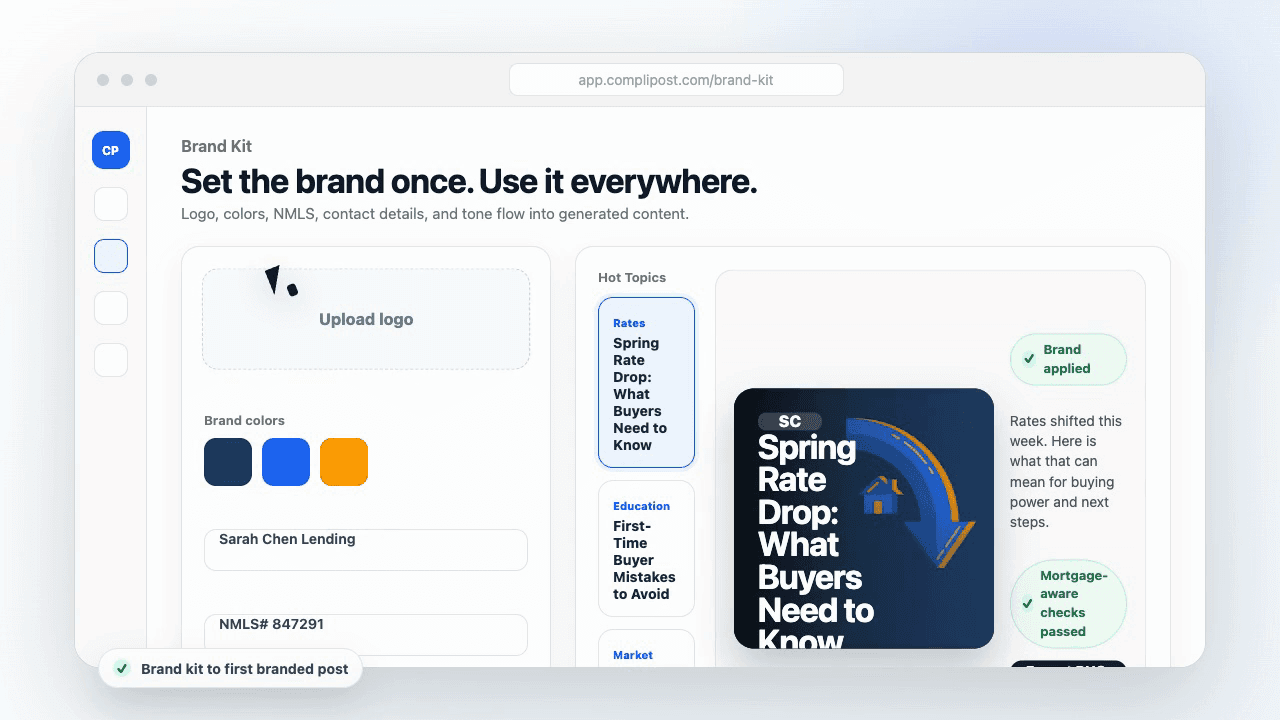
Product workflow
From blank page to export-ready mortgage content
- Start with a borrower topic
- Generate copy and a visual direction
- Review, save, and export the finished asset
These previews reflect the core CompliPost workflow: create, review, save, and export assets for use in your own channels.
Workflow comparison
| Content approach | What happens | Why it matters |
|---|---|---|
| Random posting | One-off ideas created when there is spare time | Inconsistent visibility and weak reuse |
| Template-only posting | Faster design but still requires rewriting and review | Helpful starting point, but not a full system |
| CompliPost workflow | Plan, generate, review, save, and export from one place | Better consistency with mortgage-aware review context |
| Done-for-you service | Someone else creates much of the content | Useful for some teams, but less control and less immediate reuse |
Who this guide helps
This guide is for loan officers working on solo loan officers who need a repeatable mortgage content workflow. The goal is to turn a broad mortgage topic into one borrower question, one useful takeaway, and one asset that can be reviewed before it is shared.
- You need content that sounds like a loan officer, not a generic brand account
- You want examples that can become captions, graphics, GIFs, or PDFs
- You need a clear place to review claims before export
- You want finished work saved for reuse, not lost in a chat thread
A practical workflow for this use case
Start with a narrow scenario, then move through planning, drafting, visual creation, review, and export. For debt-to-income ratio DTI calculation mortgage, that means the topic should be specific enough that a borrower or referral partner can immediately understand what decision the content helps with.
- Choose the borrower type, loan topic, or platform before generating copy
- Draft the caption and visual together so the asset feels cohesive
- Use the federal baseline review aid to flag claims and disclosure gaps
- Export the finished asset and save the post as a reusable starting point
What makes the content stronger
Strong mortgage content is usually specific, plain-spoken, and calm. It explains tradeoffs without pretending one answer fits every borrower. That is especially important on public social channels, where a short post can be interpreted without the full context of a loan conversation.
- Name the borrower question in the first line
- Explain one decision or tradeoff instead of covering everything
- Use examples without implying approval, savings, or rate outcomes
- End with a soft next step, checklist, or guide rather than pressure
Compliance-aware review notes
CompliPost should be treated as a review aid, not a compliance approval system. The public page, generated draft, graphic, and exported asset should all stay honest about that boundary.
- Review specific payment, APR, rate, savings, and qualification language
- Avoid “best,” “lowest,” “guaranteed,” “free,” and urgency claims unless approved
- Check NMLS, Equal Housing, company, and state-specific requirements
- Use company or legal review for anything outside the federal baseline
How this connects to the rest of CompliPost
A focused guide should leave you with a usable next step. After you understand the topic, you can turn it into a calendar slot, a reviewed social post, a downloadable guide, or a platform-specific version for the channel where your audience already spends time.
- Use the content calendar to turn the idea into a weekly plan
- Use the compliance page when claims or disclosures need a slower pass
- Use lead magnets when the topic deserves a deeper PDF guide
- Use platform pages to adapt the same idea for LinkedIn, Facebook, or Instagram
Recommended next steps
Examples
FAQ
What is a good DTI ratio for mortgage approval?+
A good DTI ratio varies by lender, but generally, a front-end DTI of 28-31% and a back-end DTI below 43-50% are favorable. Understanding these benchmarks helps loan officers guide borrowers in aligning their financial profiles with mortgage requirements. The practical move is to keep the answer educational, mention that details vary by borrower profile and lender guidelines, and invite the reader to ask for a personal review instead of implying a certain result.
How can borrowers reduce their DTI ratio?+
Borrowers can reduce their DTI by paying down high-interest debts, such as credit cards, or by increasing their income through side jobs or salary increases. Loan officers play a vital role in advising clients on these strategies to improve their mortgage eligibility. The practical move is to keep the answer educational, mention that details vary by borrower profile and lender guidelines, and invite the reader to ask for a personal review instead of implying a certain result.
Why is DTI important in the mortgage process?+
DTI is crucial because it helps lenders assess a borrower's ability to manage monthly payments alongside existing debts. A lower DTI indicates better financial health, increasing the likelihood of securing a mortgage. Loan officers should emphasize its importance in client discussions. The practical move is to keep the answer educational, mention that details vary by borrower profile and lender guidelines, and invite the reader to ask for a personal review instead of implying a certain result.
Can a high DTI ratio be offset by other factors?+
While a high DTI can be challenging, factors like a strong credit score, substantial savings, or a large down payment might offset it. Loan officers should assess the entire financial picture when advising clients on improving their mortgage prospects. The practical move is to keep the answer educational, mention that details vary by borrower profile and lender guidelines, and invite the reader to ask for a personal review instead of implying a certain result.
Create mortgage content with a calmer workflow
CompliPost helps you plan, generate, review, save, and export useful mortgage content without pretending compliance or social distribution is automatic.
Start free