Homebuyer Guidance
First-Time Buyer Checklist: Navigating the Journey
As a loan officer, providing structured guidance to first-time home buyers can set you apart as a trusted advisor. This comprehensive checklist offers a clear roadmap from initial financial readiness to the final closing. By breaking down the process into manageable steps, you can help clients feel more confident and prepared in their home buying journey. From understanding credit requirements to navigating the closing process, this checklist equips you with the tools to guide your clients effectively. Position yourself as a valuable resource and build long-lasting relationships by simplifying the complex process of buying a home.
Financial Foundations: Preparing Early (3-6 Months Before)
The journey to homeownership begins with establishing a solid financial foundation. Advise your clients to check their credit scores, ideally aiming for 640 or higher, and to address any errors on their credit reports. Encourage them to pay down existing debt, keeping credit card balances below 30% of the limit. Highlight the importance of timely bill payments and the benefits of avoiding new credit inquiries. Emphasize the need for a dedicated savings plan for both a down payment and an emergency fund covering 3-6 months of expenses. Documenting employment and income stability is also crucial at this stage.
- Review credit score and report
- Reduce credit card balances
- Maintain timely bill payments
- Avoid new credit inquiries
- Save for down payment and emergency fund
- Document employment stability
Taking the First Steps: Preapproval and Realtor Selection (1-2 Months Before)
Getting preapproved for a mortgage provides a clear picture of the budget and signals seriousness to sellers. Guide clients through the preapproval process, ensuring they understand the required documentation. Encourage them to interview multiple realtors to find one who understands their needs and the local market well. Empower them to learn about the neighborhoods and market trends, which will enhance their decision-making process. This stage sets the foundation for a focused and informed home search. first time home buyer checklist borrower concern: explain what a lender may verify, why the step matters, and how a reader can prepare. first time home buyer checklist content should clarify without becoming personal advice.
- Complete mortgage preapproval
- Determine budget limits
- Select a knowledgeable realtor
- Research local neighborhoods and market trends
Active House Hunting: Offers and Negotiations
This phase involves actively searching for homes, attending open houses, and making offers. Encourage clients to rely on their realtor to navigate negotiations and to schedule necessary inspections. Staying engaged with the lender for appraisals and other requirements is crucial. The timeline in this stage varies based on market conditions, but maintaining a proactive approach can lead to successful negotiations and an accepted offer. first time home buyer checklist compliance note: avoid exact terms, certainty language, and rushed decisions. first time home buyer checklist works better as education when it explains a tradeoff and invites a specific question.
- Visit open houses and explore listings
- Make competitive offers
- Negotiate terms with sellers
- Arrange for inspections and appraisals
Finalizing the Purchase: Closing Process
Guiding clients through the closing process involves several critical steps, including underwriting, title searches, and securing homeowner's insurance. Stress the importance of promptly responding to underwriting queries and reviewing appraisals. Organize a final walkthrough just before closing to ensure all conditions are met. Prepare clients for the signing of documents, after which funding and recording lead to receiving their keys. This phase marks the transition from buyer to homeowner. first time home buyer checklist reuse plan: make one caption, one carousel point, one email follow-up, and one saved template. first time home buyer checklist then supports social, partner, and nurture workflows.
- Promptly address underwriting requests
- Complete inspections and finalize insurance
- Review appraisal and conduct final walkthrough
- Sign closing documents and receive keys
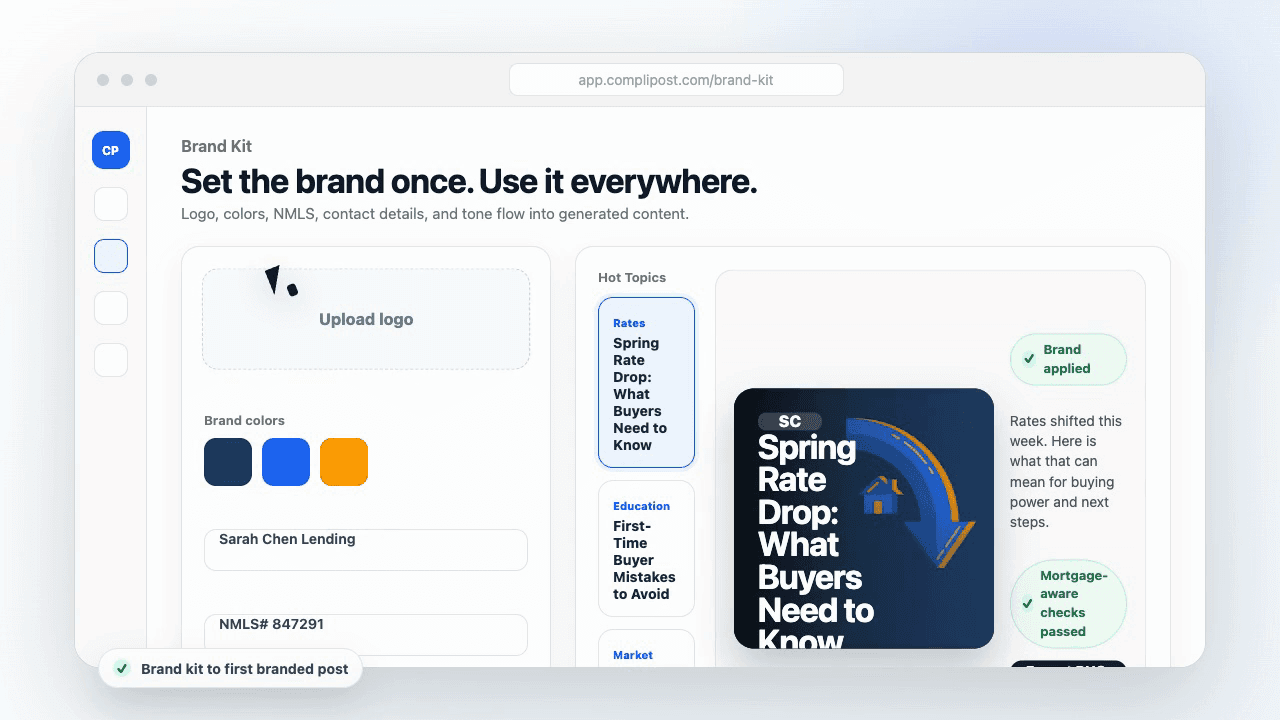
Product workflow
From blank page to export-ready mortgage content
- Start with a borrower topic
- Generate copy and a visual direction
- Review, save, and export the finished asset
These previews reflect the core CompliPost workflow: create, review, save, and export assets for use in your own channels.
Workflow comparison
| Content approach | What happens | Why it matters |
|---|---|---|
| Random posting | One-off ideas created when there is spare time | Inconsistent visibility and weak reuse |
| Template-only posting | Faster design but still requires rewriting and review | Helpful starting point, but not a full system |
| CompliPost workflow | Plan, generate, review, save, and export from one place | Better consistency with mortgage-aware review context |
| Done-for-you service | Someone else creates much of the content | Useful for some teams, but less control and less immediate reuse |
Who this guide helps
This guide is for loan officers working on first-time buyers who need simple next steps. The goal is to turn a broad mortgage topic into one borrower question, one useful takeaway, and one asset that can be reviewed before it is shared.
- You need content that sounds like a loan officer, not a generic brand account
- You want examples that can become captions, graphics, GIFs, or PDFs
- You need a clear place to review claims before export
- You want finished work saved for reuse, not lost in a chat thread
A practical workflow for this use case
Start with a narrow scenario, then move through planning, drafting, visual creation, review, and export. For first time home buyer checklist, that means the topic should be specific enough that a borrower or referral partner can immediately understand what decision the content helps with.
- Choose the borrower type, loan topic, or platform before generating copy
- Draft the caption and visual together so the asset feels cohesive
- Use the federal baseline review aid to flag claims and disclosure gaps
- Export the finished asset and save the post as a reusable starting point
What makes the content stronger
Strong mortgage content is usually specific, plain-spoken, and calm. It explains tradeoffs without pretending one answer fits every borrower. That is especially important on public social channels, where a short post can be interpreted without the full context of a loan conversation.
- Name the borrower question in the first line
- Explain one decision or tradeoff instead of covering everything
- Use examples without implying approval, savings, or rate outcomes
- End with a soft next step, checklist, or guide rather than pressure
Compliance-aware review notes
CompliPost should be treated as a review aid, not a compliance approval system. The public page, generated draft, graphic, and exported asset should all stay honest about that boundary.
- Review specific payment, APR, rate, savings, and qualification language
- Avoid “best,” “lowest,” “guaranteed,” “free,” and urgency claims unless approved
- Check NMLS, Equal Housing, company, and state-specific requirements
- Use company or legal review for anything outside the federal baseline
How this connects to the rest of CompliPost
A focused guide should leave you with a usable next step. After you understand the topic, you can turn it into a calendar slot, a reviewed social post, a downloadable guide, or a platform-specific version for the channel where your audience already spends time.
- Use the content calendar to turn the idea into a weekly plan
- Use the compliance page when claims or disclosures need a slower pass
- Use lead magnets when the topic deserves a deeper PDF guide
- Use platform pages to adapt the same idea for LinkedIn, Facebook, or Instagram
Recommended next steps
First-time buyer content hub
Build clear education for first-time buyers.
Mortgage content calendar
Plan a weekly rhythm of useful borrower and referral-partner posts.
Mortgage affordability education
Determine realistic budget.
Calendar generator
Turn one mortgage topic into a practical weekly content plan.
Examples
FAQ
How much should a first-time buyer save before purchasing?+
The amount saved should cover the down payment, typically between 5-20%, plus closing costs and reserves. Encourage clients to save for both the down payment and additional costs like closing fees and an emergency reserve covering 3-6 months of expenses. This preparation helps ensure a smoother buying process.
When is the right time to buy with less-than-perfect credit?+
Buying with a credit score above 640 is possible, though improving it to 700 or higher can offer better mortgage terms. Advise clients to balance their urgency to buy with the benefits of waiting to improve their credit, as this can impact their long-term financial picture with potentially lower interest rates.
Which is better for a first-time buyer: FHA or conventional loan?+
The choice between FHA and conventional loans depends on your client's financial situation. FHA loans often have lower credit requirements, making them accessible for those rebuilding credit. Conventional loans may offer better rates for those with higher credit scores. Encourage a side-by-side comparison of both options.
What actions can jeopardize mortgage approval during savings?+
Advise clients to avoid significant financial changes such as applying for new credit, changing jobs, or taking on new debt. Maintaining stable credit, income, and debt levels is crucial for mortgage approval. Encourage a steady and consistent approach in the months leading up to purchasing a home.
Create mortgage content with a calmer workflow
CompliPost helps you plan, generate, review, save, and export useful mortgage content without pretending compliance or social distribution is automatic.
Start free