Buyer Education
Preapproval vs. Prequalification: What Buyers Need to Know
Most borrowers confuse preapproval and prequalification because they sound similar and happen early in the process. Prequalification is informal and quick; preapproval is formal and backed by verified financial documents. In your social content, clarify this distinction to position yourself as an educator and build trust with borrowers who may not know the difference.
Prequalification: the informal starting point
Prequalification is a quick, non-binding estimate of how much a borrower might be able to borrow based on self-reported information. No documents are reviewed, no credit is pulled, and no verification occurs. It takes minutes and costs nothing, making it ideal for borrowers exploring their options. Use this angle in social content to invite hesitant buyers to start the conversation.
- Borrower provides income, assets, and debt information verbally or online
- No credit pull, no employment verification, no document review
- Estimate is rough and may change once real details are examined
- Valid tool for initial budget-setting but carries no weight with sellers
Preapproval: the formal financial commitment
Preapproval is a lender's formal decision that a borrower qualifies for a specific loan amount, backed by verified income, credit, assets, and employment. The lender has pulled credit, reviewed documentation, and made an underwriting judgment. Preapproval carries real weight in negotiations and signals to sellers that the buyer is qualified and serious.
- Lender verifies employment, income, credit, and down payment source
- Credit is pulled; documents are reviewed by underwriters
- Borrower receives a preapproval letter stating the approved loan amount
- Sellers and real estate agents view preapproval as proof of qualification
Why sellers care about preapproval, not prequalification
In competitive real estate markets, sellers receive multiple offers and prioritize those from preapproved buyers. Prequalification suggests uncertainty; preapproval shows the lender has done the homework and committed to financing. When crafting social content, emphasize that preapproval is the credential that makes offers stand out.
- Preapproval reduces seller risk by proving lender confidence in financing
- Prequalification provides no protection if the buyer's financial profile changes
- Real estate agents routinely ask for preapproval letters before scheduling showings
- Preapproval can accelerate offer acceptance and shorten closing timelines
Timeline and cost comparison
Prequalification takes minutes and is free; preapproval takes 3-5 business days and may involve a small fee or appraisal cost later. The prequalification-to-preapproval journey is the normal progression. Use this in content to set expectations and show borrowers the value of moving from exploration to commitment.
- Prequalification: 5-15 minutes, no cost, no documentation required
- Preapproval: 3-5 business days, documentation required, free but may include future appraisal fee
- Progression: prequalify to explore, preapprove to compete, close to own
- Both processes are part of the normal home buying journey
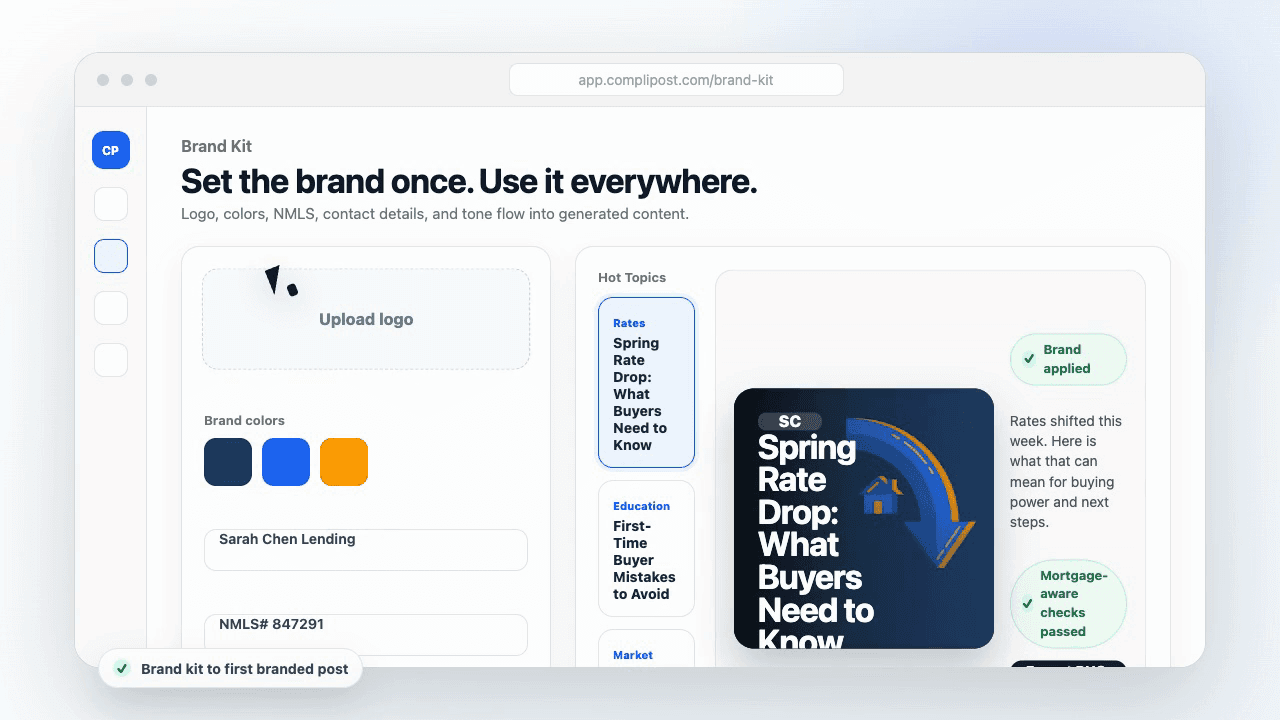
Product workflow
From blank page to export-ready mortgage content
- Start with a borrower topic
- Generate copy and a visual direction
- Review, save, and export the finished asset
These previews reflect the core CompliPost workflow: create, review, save, and export assets for use in your own channels.
Workflow comparison
| Content approach | What happens | Why it matters |
|---|---|---|
| Random posting | One-off ideas created when there is spare time | Inconsistent visibility and weak reuse |
| Template-only posting | Faster design but still requires rewriting and review | Helpful starting point, but not a full system |
| CompliPost workflow | Plan, generate, review, save, and export from one place | Better consistency with mortgage-aware review context |
| Done-for-you service | Someone else creates much of the content | Useful for some teams, but less control and less immediate reuse |
Who this guide helps
This guide is for loan officers working on solo loan officers who need a repeatable mortgage content workflow. The goal is to turn a broad mortgage topic into one borrower question, one useful takeaway, and one asset that can be reviewed before it is shared.
- You need content that sounds like a loan officer, not a generic brand account
- You want examples that can become captions, graphics, GIFs, or PDFs
- You need a clear place to review claims before export
- You want finished work saved for reuse, not lost in a chat thread
A practical workflow for this use case
Start with a narrow scenario, then move through planning, drafting, visual creation, review, and export. For preapproval vs prequalification, that means the topic should be specific enough that a borrower or referral partner can immediately understand what decision the content helps with.
- Choose the borrower type, loan topic, or platform before generating copy
- Draft the caption and visual together so the asset feels cohesive
- Use the federal baseline review aid to flag claims and disclosure gaps
- Export the finished asset and save the post as a reusable starting point
What makes the content stronger
Strong mortgage content is usually specific, plain-spoken, and calm. It explains tradeoffs without pretending one answer fits every borrower. That is especially important on public social channels, where a short post can be interpreted without the full context of a loan conversation.
- Name the borrower question in the first line
- Explain one decision or tradeoff instead of covering everything
- Use examples without implying approval, savings, or rate outcomes
- End with a soft next step, checklist, or guide rather than pressure
Compliance-aware review notes
CompliPost should be treated as a review aid, not a compliance approval system. The public page, generated draft, graphic, and exported asset should all stay honest about that boundary.
- Review specific payment, APR, rate, savings, and qualification language
- Avoid “best,” “lowest,” “guaranteed,” “free,” and urgency claims unless approved
- Check NMLS, Equal Housing, company, and state-specific requirements
- Use company or legal review for anything outside the federal baseline
How this connects to the rest of CompliPost
A focused guide should leave you with a usable next step. After you understand the topic, you can turn it into a calendar slot, a reviewed social post, a downloadable guide, or a platform-specific version for the channel where your audience already spends time.
- Use the content calendar to turn the idea into a weekly plan
- Use the compliance page when claims or disclosures need a slower pass
- Use lead magnets when the topic deserves a deeper PDF guide
- Use platform pages to adapt the same idea for LinkedIn, Facebook, or Instagram
Recommended next steps
First-time buyer content hub
Build clear education for first-time buyers.
What Mortgage Preapproval Actually Means
Dive deeper into the preapproval process, what lenders verify, and why it matters for buyer confidence.
First-Time Home Buyer Checklist
Guide first-time buyers through the entire home purchase journey, starting with preapproval.
How Credit Score Affects Mortgage Approval
Explain how credit scoring impacts preapproval and final loan approval rates and terms.
Examples
FAQ
Can I make an offer with only a prequalification letter?+
Technically yes, but it's risky. In seller's markets, sellers deprioritize offers from prequalified buyers because there's no proof of lender approval. Real estate agents may not even show you homes if you're only prequalified. Preapproval signals serious intent and qualification; prequalification signals you're still exploring. Move to preapproval before making offers.
How long does preapproval take compared to prequalification?+
Prequalification is instant—often done over the phone or online in under 15 minutes. Preapproval takes 3-5 business days because the lender must review documents, verify employment, and pull credit. Have your documents ready (pay stubs, tax returns, bank statements) to speed up the preapproval process.
Will I have to pay for preapproval?+
Prequalification is always free. Preapproval itself is usually free, but you may face costs later: credit pull (often waived), appraisal (typically $400-600), and processing or underwriting fees (varies by lender). Some lenders roll these into closing costs. Ask your lender upfront what fees apply to your preapproval.
What happens if I'm preapproved but my credit drops before closing?+
Your preapproval can be affected if your credit score drops significantly or if you incur new debt. Major credit inquiries, missed payments, or new credit cards opened during the preapproval period can trigger a re-pull of your credit and possible re-underwriting. Avoid big financial changes between preapproval and closing.
Do I need prequalification if I'm going for preapproval?+
No. Most borrowers skip prequalification and go straight to preapproval because preapproval is the credential that matters in real estate. Prequalification is useful only if you're exploring options before committing to a specific lender, but once you're ready to move forward, apply for preapproval with your chosen lender.
Create mortgage content with a calmer workflow
CompliPost helps you plan, generate, review, save, and export useful mortgage content without pretending compliance or social distribution is automatic.
Start free