Myth-Busting
Preapproval Myths Debunked: Separating Fact from Fiction
Borrowers often believe misconceptions about preapproval that prevent them from moving forward or create unrealistic expectations. Debunk common myths in your social content to position yourself as the educator and problem-solver your audience needs.
Myth 1: Preapproval guarantees the loan
False. Preapproval is conditional approval; the lender commits to the loan amount based on information provided. The final approval depends on appraisal, title, and underwriting conditions being satisfied. If the property appraises low or underwriting discovers issues, the loan can be denied or modified. Manage expectations by explaining this clearly.
- Preapproval: lender says 'yes, conditional on appraisal and title'
- Final approval: lender says 'yes, unconditionally, ready to fund'
- Conditions must be satisfied: appraisal, title, employment verification, inspections
- Low appraisal: can change loan amount or require larger down payment
Myth 2: Preapproval locks in an interest rate
False. Unless you've signed a rate lock agreement, your interest rate can change. Rates fluctuate daily based on market conditions. Many borrowers think preapproval means rate protection; it doesn't. Explain the difference between preapproval rate and locked rate in your content.
- Preapproval rate: indicative; may change before lock
- Rate lock: formal agreement protecting rate for 15-60 days
- Market conditions: rates change daily; older preapprovals may show higher/lower rates
- When to lock: typically after appraisal or within 10 days of closing
Myth 3: Preapproval hurts your credit permanently
False. The credit pull lowers your score 5-10 points—minor and temporary. The impact fades in 3-6 months. Multiple preapproval inquiries within 14-45 days count as one for scoring. Don't fear the credit pull; the damage is minimal and temporary.
- Credit pull impact: 5-10 points, temporary
- Score recovery: 3-6 months as inquiry ages
- Multiple inquiries: rate-shopping inquiries within 14 days count as one
- Net impact: minimal if you're building positive payment history
Myth 4: You must buy within the preapproval amount
False. Preapproval is a ceiling, not a requirement. You can buy below your approved amount without issue. You can also increase your down payment to buy below your approval ceiling. Use preapproval as a maximum, not a mandate.
- Preapproval amount: maximum you're approved to borrow, not minimum
- Flexibility: buy anywhere up to your approval limit
- Down payment strategy: larger down payment = lower loan amount = more options
- No penalty: buying below approval is common and encouraged
Myth 5: Preapproval is the same as a mortgage approval
False. Preapproval is preliminary; approval is final. Preapproval says the lender has done basic underwriting; approval says all conditions are met and the lender is ready to fund. The terminology matters and borrowers often confuse them.
- Preapproval: conditional, preliminary, based on initial documents
- Approval: unconditional, final, ready to fund
- Timeline: preapproval takes 3-5 days; final approval takes 30-45 days
- Conditions: preapproval has conditions; approval usually has none
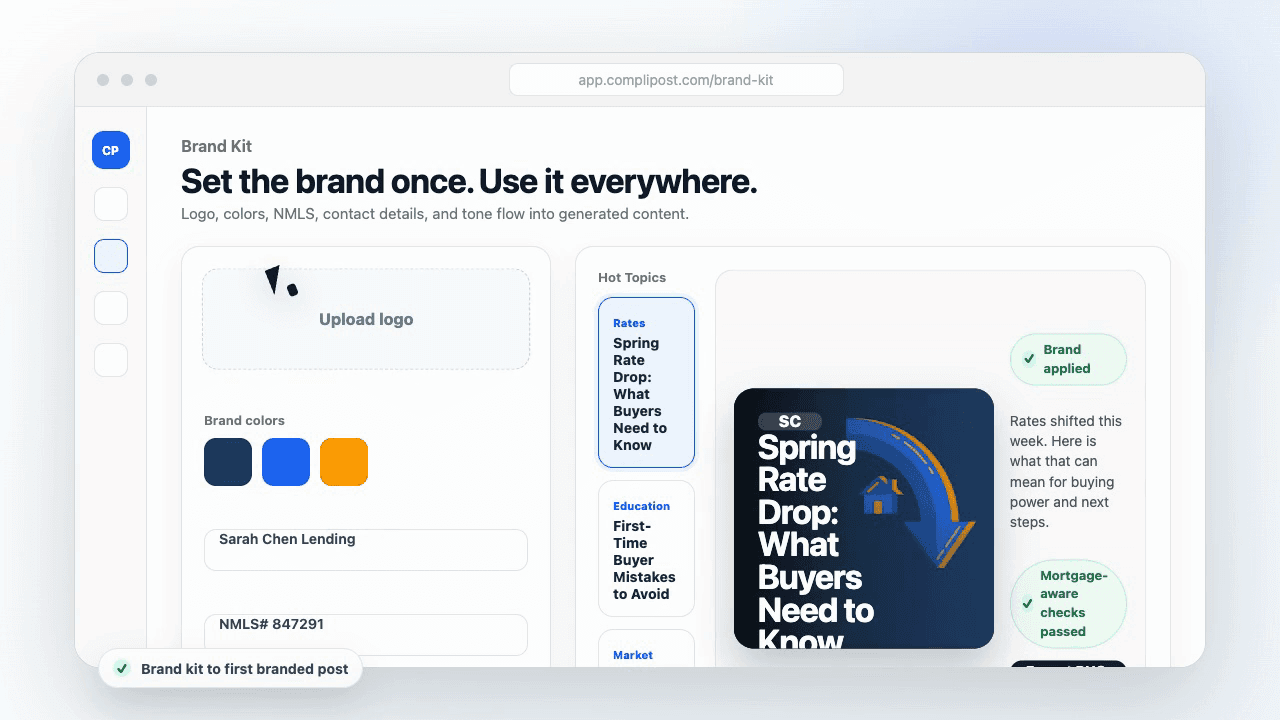
Product workflow
From blank page to export-ready mortgage content
- Start with a borrower topic
- Generate copy and a visual direction
- Review, save, and export the finished asset
These previews reflect the core CompliPost workflow: create, review, save, and export assets for use in your own channels.
Workflow comparison
| Content approach | What happens | Why it matters |
|---|---|---|
| Random posting | One-off ideas created when there is spare time | Inconsistent visibility and weak reuse |
| Template-only posting | Faster design but still requires rewriting and review | Helpful starting point, but not a full system |
| CompliPost workflow | Plan, generate, review, save, and export from one place | Better consistency with mortgage-aware review context |
| Done-for-you service | Someone else creates much of the content | Useful for some teams, but less control and less immediate reuse |
Who this guide helps
This guide is for loan officers working on solo loan officers who need a repeatable mortgage content workflow. The goal is to turn a broad mortgage topic into one borrower question, one useful takeaway, and one asset that can be reviewed before it is shared.
- You need content that sounds like a loan officer, not a generic brand account
- You want examples that can become captions, graphics, GIFs, or PDFs
- You need a clear place to review claims before export
- You want finished work saved for reuse, not lost in a chat thread
A practical workflow for this use case
Start with a narrow scenario, then move through planning, drafting, visual creation, review, and export. For preapproval myths debunked, that means the topic should be specific enough that a borrower or referral partner can immediately understand what decision the content helps with.
- Choose the borrower type, loan topic, or platform before generating copy
- Draft the caption and visual together so the asset feels cohesive
- Use the federal baseline review aid to flag claims and disclosure gaps
- Export the finished asset and save the post as a reusable starting point
What makes the content stronger
Strong mortgage content is usually specific, plain-spoken, and calm. It explains tradeoffs without pretending one answer fits every borrower. That is especially important on public social channels, where a short post can be interpreted without the full context of a loan conversation.
- Name the borrower question in the first line
- Explain one decision or tradeoff instead of covering everything
- Use examples without implying approval, savings, or rate outcomes
- End with a soft next step, checklist, or guide rather than pressure
Compliance-aware review notes
CompliPost should be treated as a review aid, not a compliance approval system. The public page, generated draft, graphic, and exported asset should all stay honest about that boundary.
- Review specific payment, APR, rate, savings, and qualification language
- Avoid “best,” “lowest,” “guaranteed,” “free,” and urgency claims unless approved
- Check NMLS, Equal Housing, company, and state-specific requirements
- Use company or legal review for anything outside the federal baseline
How this connects to the rest of CompliPost
A focused guide should leave you with a usable next step. After you understand the topic, you can turn it into a calendar slot, a reviewed social post, a downloadable guide, or a platform-specific version for the channel where your audience already spends time.
- Use the content calendar to turn the idea into a weekly plan
- Use the compliance page when claims or disclosures need a slower pass
- Use lead magnets when the topic deserves a deeper PDF guide
- Use platform pages to adapt the same idea for LinkedIn, Facebook, or Instagram
Recommended next steps
First-time buyer content hub
Build clear education for first-time buyers.
What Mortgage Preapproval Actually Means
Understand the real preapproval process and what lenders verify.
Preapproval vs. Prequalification
Clarify the terminology so borrowers understand where they stand.
Rate Locks, Float-Down, and Rate-Hold Strategy
Explain interest rate protection and when to lock your rate.
Examples
FAQ
If I'm preapproved for $400k, am I obligated to spend that?+
No. Preapproval is a maximum, not a minimum. You can spend less. Many borrowers are preapproved for more than they want to spend—smart financial planning is to stay below your approval limit. Bigger down payment + lower loan = lower monthly payment and less interest over time.
What if my preapproval rate is different when I lock?+
Rates change daily based on market conditions. If rates have fallen since preapproval, your lock rate will be lower. If rates have risen, it will be higher. The preapproval rate was an estimate; the lock rate is the real rate you're paying. Lock when you're ready to commit to the home.
Can I lose my preapproval between application and closing?+
Yes, if your financial situation changes significantly. New debt, job loss, or large purchases can affect your qualification. Avoid major financial changes between preapproval and closing. If something happens, tell your lender immediately so they can assess the impact.
Does preapproval mean I'm approved for any home at that price?+
No. The home must appraise at or above the purchase price, and it must pass other underwriting standards. Some homes are harder to finance (condo projects, luxury properties, rural properties). The preapproval amount is what you're approved to borrow; the specific property matters.
If preapproved, will I definitely get the loan?+
Most likely, if conditions are satisfied and your situation doesn't change. However, preapproval is not a guarantee. Low appraisal, title issues, employment changes, or new debt can affect final approval. Stay in touch with your lender and maintain your financial profile unchanged from preapproval to closing.
Create mortgage content with a calmer workflow
CompliPost helps you plan, generate, review, save, and export useful mortgage content without pretending compliance or social distribution is automatic.
Start free