PHYSICIAN AUDIENCE
Help Physicians with $200K+ Student Debt Buy Homes and Qualify
Medical school debt is not a barrier to homeownership for physicians—it's a standard part of the financial profile. Your content should demystify how lenders treat student debt (income-driven repayment plans, different debt-to-income calculations), explain why paying down debt before buying often isn't the best strategy, and show that physicians with high debt-to-income ratios still qualify for mortgages. Address the psychological barrier (guilt, fear) around debt and reframe it as normal and manageable.
How Lenders Calculate Student Debt Impact on Qualification
The critical insight: most lenders don't count the full student loan balance against your debt-to-income ratio. Instead, they use an estimated monthly payment based on income-driven repayment plans (typically 1% of your loan balance, or the actual payment you're on, whichever is lower). This dramatically improves your mortgage qualification. Your content should demystify this calculation so physicians understand that $300K in debt might only count as $250/month in DTI.
- Standard calculation: payment of 1% of student loan balance (not the full loan balance)
- Income-driven repayment plans: interest-based payments can be very low for residents/fellows
- Actual payment method: some lenders use your actual IDR payment if it's on your credit report
- Physician-specific underwriting: specialized lenders have refined this calculation for physicians
- DTI improvement: proper student debt calculation can improve your buying power 20–30%
Should You Pay Down Student Debt Before Buying?
This is a common question physicians ask, and the answer is often 'no.' Paying down debt takes away down payment capital, and the mortgage you can afford isn't usually reduced by paying down student debt. Your content should walk through the math: mortgage interest rates are often lower than student loan interest rates, so it's better to buy now (lock in rate) and pay student debt long-term. The exception: if you have very high student debt and very low income, a modest paydown can help.
- Mortgage rates currently 6–8%; student loan rates often 5–7%—prioritize mortgage qualification
- Down payment savings > debt paydown: pay 5% down, use cash for mortgage, not for debt reduction
- Student loans are tax-deductible (up to $2,500/year)—not the same as non-deductible debt
- Building home equity (20%+ annual appreciation in many markets) beats paying down lower-rate debt
- Income growth strategy: as physician income rises, student debt becomes smaller percentage of income
Income-Driven Repayment Strategy and Homebuying Timing
Physicians often worry that their student loan payment will be too high. Your content should explain income-driven repayment (IDR) options—PAYE, REPAYE, IBR—and how these keep payments low during residency/fellowship, then scale with income as attending. Show that IDR is compatible with homeownership at any career stage, and that federal student loans are more forgiving than private debt.
- REPAYE: 10% of discretionary income, roughly $250/month on $65K resident salary with $300K debt
- PAYE: 10% of discretionary income, but capped at standard 10-year repayment amount
- IBR: income-based, works well for residents, adjusts as income grows
- Public Service Loan Forgiveness (PSLF): qualifying physicians can have loans forgiven tax-free after 10 years
- Student loan repayment still requires monthly payment (not deferred), but calculation is favorable
The Psychological Barrier: Reframing Debt as a Physician Credential
Many physicians feel shame or guilt about their debt, which can paralyze their homebuying decisions. Your content should reframe: physician debt is a sign of achievement (you earned an MD), is standard across the profession, and is structured in a way that doesn't prevent homeownership. Address the emotional aspect, not just the financial.
- Physician debt = credential achieved, not failure; MD degree commands income to service it
- Standard debt levels: average MD graduates with $200K+, is normal for peers
- Debt is manageable: 8–10 years of physician income easily services debt
- Homeownership still possible: debt doesn't prevent owning property, building wealth
- Debt payoff timeline: aggressive payoff possible once attending, but not required for buying
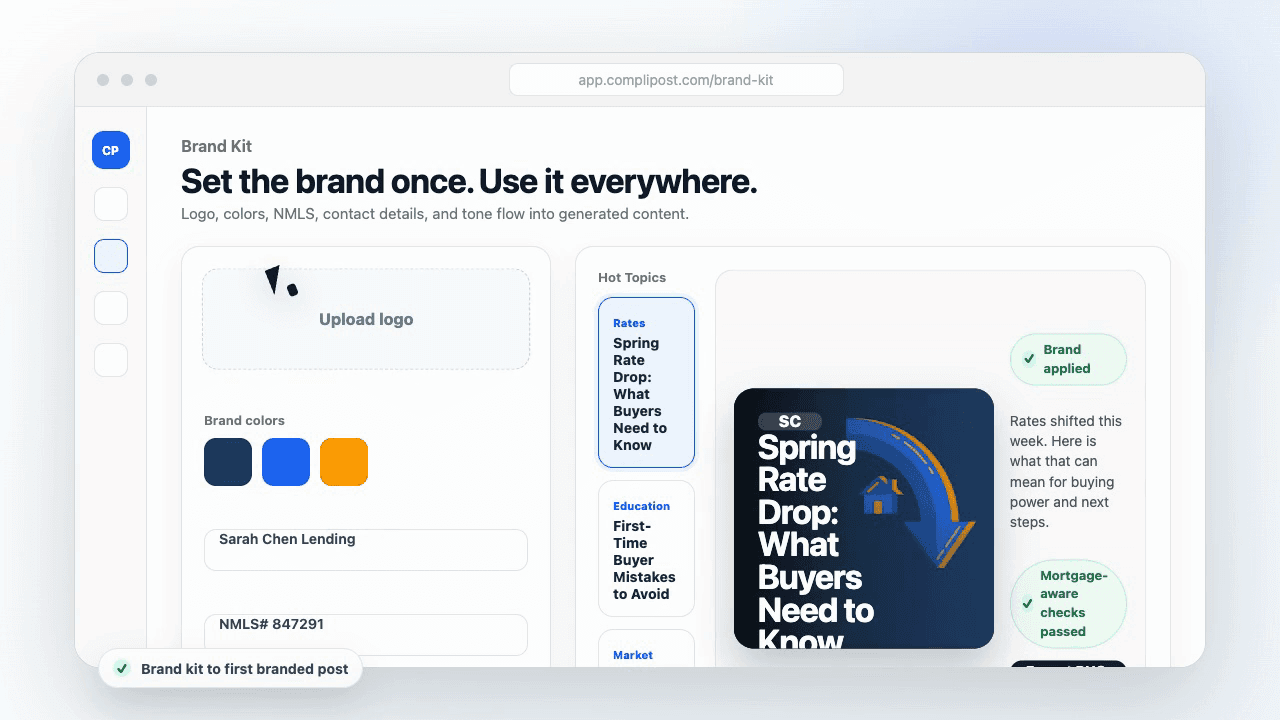
Product workflow
From blank page to export-ready mortgage content
- Start with a borrower topic
- Generate copy and a visual direction
- Review, save, and export the finished asset
These previews reflect the core CompliPost workflow: create, review, save, and export assets for use in your own channels.
Workflow comparison
| Content approach | What happens | Why it matters |
|---|---|---|
| Random posting | One-off ideas created when there is spare time | Inconsistent visibility and weak reuse |
| Template-only posting | Faster design but still requires rewriting and review | Helpful starting point, but not a full system |
| CompliPost workflow | Plan, generate, review, save, and export from one place | Better consistency with mortgage-aware review context |
| Done-for-you service | Someone else creates much of the content | Useful for some teams, but less control and less immediate reuse |
Who this guide helps
This guide is for loan officers working on solo loan officers who need a repeatable mortgage content workflow. The goal is to turn a broad mortgage topic into one borrower question, one useful takeaway, and one asset that can be reviewed before it is shared.
- You need content that sounds like a loan officer, not a generic brand account
- You want examples that can become captions, graphics, GIFs, or PDFs
- You need a clear place to review claims before export
- You want finished work saved for reuse, not lost in a chat thread
A practical workflow for this use case
Start with a narrow scenario, then move through planning, drafting, visual creation, review, and export. For physician homebuyer student loan debt mortgage, that means the topic should be specific enough that a borrower or referral partner can immediately understand what decision the content helps with.
- Choose the borrower type, loan topic, or platform before generating copy
- Draft the caption and visual together so the asset feels cohesive
- Use the federal baseline review aid to flag claims and disclosure gaps
- Export the finished asset and save the post as a reusable starting point
What makes the content stronger
Strong mortgage content is usually specific, plain-spoken, and calm. It explains tradeoffs without pretending one answer fits every borrower. That is especially important on public social channels, where a short post can be interpreted without the full context of a loan conversation.
- Name the borrower question in the first line
- Explain one decision or tradeoff instead of covering everything
- Use examples without implying approval, savings, or rate outcomes
- End with a soft next step, checklist, or guide rather than pressure
Compliance-aware review notes
CompliPost should be treated as a review aid, not a compliance approval system. The public page, generated draft, graphic, and exported asset should all stay honest about that boundary.
- Review specific payment, APR, rate, savings, and qualification language
- Avoid “best,” “lowest,” “guaranteed,” “free,” and urgency claims unless approved
- Check NMLS, Equal Housing, company, and state-specific requirements
- Use company or legal review for anything outside the federal baseline
How this connects to the rest of CompliPost
A focused guide should leave you with a usable next step. After you understand the topic, you can turn it into a calendar slot, a reviewed social post, a downloadable guide, or a platform-specific version for the channel where your audience already spends time.
- Use the content calendar to turn the idea into a weekly plan
- Use the compliance page when claims or disclosures need a slower pass
- Use lead magnets when the topic deserves a deeper PDF guide
- Use platform pages to adapt the same idea for LinkedIn, Facebook, or Instagram
Recommended next steps
Self-employed borrower hub
Create income-documentation education for self-employed borrowers.
Debt-to-Income Ratio Calculation and Qualification
Master DTI calculation so you can explain to physician clients how student debt actually impacts their qualification.
Physician Mortgage Specialist Content for Loan Officers
Build trust by showing you understand the unique financial picture of physicians—debt, income, career path.
Income Documentation and Qualification Requirements
Learn how to document physician income and debt correctly so application moves smoothly.
Examples
FAQ
How much of my student loan balance counts against my debt-to-income ratio?+
Most lenders count approximately 1% of your federal student loan balance as a monthly payment, though some use your actual income-driven repayment (IDR) payment if it's lower. For example, if you have $300K in federal student loans, most lenders calculate your payment as $250–$300/month, not the full loan balance. This is significantly better than the standard 1% calculation that non-physician borrowers face. Specialized physician lenders refine this further based on your specific IDR plan and income.
Should I aggressively pay down my student loans before buying a home?+
Generally, no. Instead of using your savings to pay down student loans, use it for a down payment. Mortgage rates are often lower than or comparable to student loan interest rates, so it's financially smarter to buy now and lock in a rate, then pay down student loans over the long term. Additionally, your down payment capital is limited, and using it for debt paydown reduces your buying power. The exception is if you have very high student debt and marginal income, where a modest paydown might improve mortgage qualification.
Does income-driven repayment affect my mortgage application?+
Not negatively. Lenders are familiar with income-driven repayment plans and factor them into the DTI calculation correctly. If you're on an IDR plan, make sure your lender sees the documentation (payment plan summary, payment amount, etc.) so they calculate your DTI accurately. In most cases, being on an IDR plan actually helps your mortgage qualification because your payment is lower than a standard 10-year repayment would be.
Can I get a mortgage while on a student loan deferment or forbearance?+
Yes, though lenders handle deferrals and forbearances slightly differently. If your loans are in forbearance, lenders may count a higher calculated payment in your DTI rather than zero. If you're in deferment with a qualifying situation (like residency), some lenders will count zero payment. Being in repayment status is preferable for mortgage qualification, so if you can exit deferment before applying, that's beneficial. Ask your lender how they handle your specific deferment/forbearance situation.
What if I have both federal and private student loans?+
Federal and private student loans are treated differently. Federal loans get the favorable 1% calculation (or your IDR payment), while private student loans typically count their actual monthly payment toward your DTI. If you have both, disclose all of them to your lender so they calculate your DTI accurately. Private student loans can slightly reduce your mortgage buying power compared to all-federal debt, but most physicians still qualify for substantial mortgages even with mixed federal/private loans.
Create mortgage content with a calmer workflow
CompliPost helps you plan, generate, review, save, and export useful mortgage content without pretending compliance or social distribution is automatic.
Start free