Documentation Guide
Income Documentation Essentials for Mortgage Qualification
Navigating income documentation for mortgage qualification demands precise strategies tailored to each borrower's distinctive financial profile. As a loan officer, understanding these nuances equips you to guide clients effectively, ensuring their financial documentation aligns with lender expectations and regulatory standards. This guide delves into the specific documentation needs for different income types, providing you with practical insights to streamline the qualification process. Whether dealing with W-2 employees or self-employed clients, mastering this aspect empowers you to enhance your advisory role, fostering trust and efficiency. Explore comprehensive strategies within each section to ensure a seamless documentation process for your clients.
W-2 Income Documentation: Streamlined Requirements
For borrowers with W-2 income, the documentation process is relatively straightforward, yet essential to handle with care. Loan officers should ensure clients provide two years of tax returns, recent pay stubs, and an employer verification letter. These documents form the core of income verification, offering lenders a comprehensive view of the borrower's financial stability. Pay attention to any inconsistencies or gaps that could raise red flags with underwriters. Ensuring accuracy in these documents not only aids in lender approval but also streamlines the client's journey through the mortgage process. By guiding borrowers to prepare these documents meticulously, you enhance their likelihood of a smooth qualification process.
Self-Employed Income: Navigating Complexity
Handling self-employed borrowers requires a keen understanding of more intricate documentation. Loan officers should advise clients to prepare two to three years of tax returns, profit and loss statements, and business bank statements. These documents collectively provide a detailed financial picture, crucial for lender assessment. Encourage borrowers to maintain accurate and up-to-date records, as this transparency can significantly influence lender confidence. Additionally, understanding industry-specific challenges and how they impact income stability will enable you to offer more tailored advice. This approach helps in mitigating potential concerns lenders might have regarding the variability of self-employed income.
Commission, Bonus, and Variable Income: Historical Insights
Borrowers relying on commission, bonuses, or variable income present unique documentation challenges. Loan officers should ensure clients compile at least two years of historical income documentation to establish a reliable average. This includes providing detailed statements and any relevant documentation that confirms the consistency of income over time. Lenders often scrutinize these income types for patterns and stability, making it vital to present a clear and accurate financial history. By helping clients understand the importance of documenting fluctuations and trends, you can better position them for successful mortgage qualification, emphasizing the need for transparent and thorough documentation.
Compliance Considerations in Income Documentation
Compliance plays a critical role in income documentation for mortgage qualification. Loan officers must be vigilant about adhering to regulatory requirements such as the Truth in Lending Act (TILA) and the SAFE Act. These guidelines ensure that all income documentation is collected and assessed fairly, without bias or discriminatory practices. Understanding these regulatory frameworks helps in safeguarding both the borrower and the lender. Educate borrowers on the importance of full disclosure and accurate documentation to prevent any compliance-related issues. Keeping abreast of compliance requirements not only protects your practice but also enhances the trust clients place in your services.
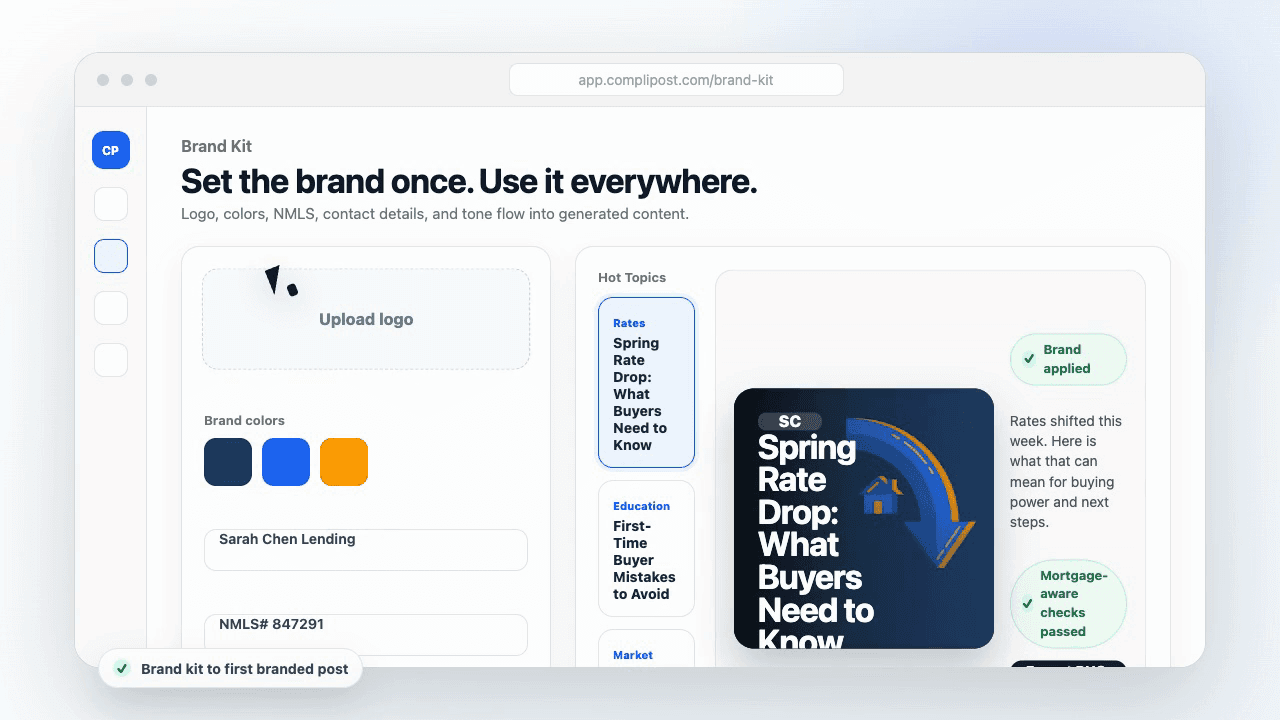
Product workflow
From blank page to export-ready mortgage content
- Start with a borrower topic
- Generate copy and a visual direction
- Review, save, and export the finished asset
These previews reflect the core CompliPost workflow: create, review, save, and export assets for use in your own channels.
Workflow comparison
| Content approach | What happens | Why it matters |
|---|---|---|
| Random posting | One-off ideas created when there is spare time | Inconsistent visibility and weak reuse |
| Template-only posting | Faster design but still requires rewriting and review | Helpful starting point, but not a full system |
| CompliPost workflow | Plan, generate, review, save, and export from one place | Better consistency with mortgage-aware review context |
| Done-for-you service | Someone else creates much of the content | Useful for some teams, but less control and less immediate reuse |
Who this guide helps
This guide is for loan officers working on solo loan officers who need a repeatable mortgage content workflow. The goal is to turn a broad mortgage topic into one borrower question, one useful takeaway, and one asset that can be reviewed before it is shared.
- You need content that sounds like a loan officer, not a generic brand account
- You want examples that can become captions, graphics, GIFs, or PDFs
- You need a clear place to review claims before export
- You want finished work saved for reuse, not lost in a chat thread
A practical workflow for this use case
Start with a narrow scenario, then move through planning, drafting, visual creation, review, and export. For income documentation mortgage qualification requirements, that means the topic should be specific enough that a borrower or referral partner can immediately understand what decision the content helps with.
- Choose the borrower type, loan topic, or platform before generating copy
- Draft the caption and visual together so the asset feels cohesive
- Use the federal baseline review aid to flag claims and disclosure gaps
- Export the finished asset and save the post as a reusable starting point
What makes the content stronger
Strong mortgage content is usually specific, plain-spoken, and calm. It explains tradeoffs without pretending one answer fits every borrower. That is especially important on public social channels, where a short post can be interpreted without the full context of a loan conversation.
- Name the borrower question in the first line
- Explain one decision or tradeoff instead of covering everything
- Use examples without implying approval, savings, or rate outcomes
- End with a soft next step, checklist, or guide rather than pressure
Compliance-aware review notes
CompliPost should be treated as a review aid, not a compliance approval system. The public page, generated draft, graphic, and exported asset should all stay honest about that boundary.
- Review specific payment, APR, rate, savings, and qualification language
- Avoid “best,” “lowest,” “guaranteed,” “free,” and urgency claims unless approved
- Check NMLS, Equal Housing, company, and state-specific requirements
- Use company or legal review for anything outside the federal baseline
How this connects to the rest of CompliPost
A focused guide should leave you with a usable next step. After you understand the topic, you can turn it into a calendar slot, a reviewed social post, a downloadable guide, or a platform-specific version for the channel where your audience already spends time.
- Use the content calendar to turn the idea into a weekly plan
- Use the compliance page when claims or disclosures need a slower pass
- Use lead magnets when the topic deserves a deeper PDF guide
- Use platform pages to adapt the same idea for LinkedIn, Facebook, or Instagram
Recommended next steps
Mortgage social media content
See the cross-platform content workflow for loan officers.
Self-employed mortgage guide
Explore tailored documentation strategies for self-employed borrowers.
Mortgage content calendar
Plan a weekly rhythm of useful borrower and referral-partner posts.
Calendar generator
Turn one mortgage topic into a practical weekly content plan.
Examples
FAQ
What income documentation is necessary for mortgage qualification?+
The necessary income documentation varies by income type. For W-2 employees, recent pay stubs and tax returns are essential. Self-employed borrowers need tax returns, profit and loss statements, and business bank statements. Those with variable income should provide a two-year average of their earnings. Understanding these requirements enables loan officers to guide clients effectively through the qualification process.
How can loan officers assist self-employed borrowers with documentation?+
Loan officers can assist by advising self-employed borrowers to maintain accurate and comprehensive financial records. Encourage them to prepare detailed profit and loss statements and ensure tax returns are up-to-date. Understanding industry-specific challenges and providing tailored advice can further aid in presenting a clear financial picture to lenders.
Why is historical income data crucial for commission-based borrowers?+
Historical income data is vital for commission-based borrowers as it provides lenders with insights into income consistency and stability. Loan officers should ensure clients compile at least two years of income records to establish a reliable average. This transparency can significantly influence lender confidence and improve the chances of mortgage qualification.
Why is compliance important in income documentation?+
Compliance ensures that income documentation is collected and assessed fairly, protecting both borrowers and lenders. Loan officers must adhere to regulations like TILA and the SAFE Act, which safeguard against discriminatory practices. Educating borrowers on compliance helps prevent issues and builds trust in the mortgage process.
Create mortgage content with a calmer workflow
CompliPost helps you plan, generate, review, save, and export useful mortgage content without pretending compliance or social distribution is automatic.
Start free