Content Craft
Demystify Mortgage Jargon: Technical Carousels Borrowers Actually Read
Underwriting, appraisal, debt-to-income ratio—these terms confuse borrowers. A carousel that defines them in jargon makes borrowers tune out. A carousel that explains them in plain language (and tells them why it matters) is useful. This guide shows you how to take technical mortgage concepts and translate them into language borrowers understand.
Translate, Don't Just Define
Don't write 'Debt-to-income ratio is the percentage of gross monthly income allocated to debt payments.' Do write 'Lenders want to see that your monthly debts (mortgage, car, student loans, credit cards) don't exceed 43–50% of your gross monthly income. If you earn $5,000/month and your debts total $2,000/month, you're at 40%—good.' Translation tells borrowers what it means and why it matters.
- Define in borrower terms, not regulatory terms
- Always explain why it matters ('Lenders check this because...')
- Use real numbers and examples ('If you earn X and owe Y, here's your ratio')
- Connect to outcomes ('This is why they approved or denied you')
Appraisal Carousels
Many borrowers don't know what an appraisal is or why lenders require it. Carousel: 'Appraisal = Lender's insurance. Here's how it works. (1) House is appraised by a professional. (2) They compare it to similar houses nearby. (3) They give a value. (4) If value is lower than your offer, you have options.' This explains the what, why, and what happens if things go sideways.
- What is an appraisal? A professional assessment of home value
- Why do lenders require it? To ensure the house is worth what you're borrowing
- Timeline: Usually 5–7 business days
- What if it comes in low? You have options (renegotiate, increase down payment, walk away)
Underwriting Carousels
Underwriting sounds like a black box to borrowers. Carousel: 'Underwriting = The lender's verification team. They check: (1) Your income is real. (2) Your assets are real. (3) Your debts are accurately reported. (4) Your credit story makes sense.' This makes underwriting feel like a transparent, logical process, not a mysterious gatekeeping function.
- What is underwriting? The process of verifying everything you told the lender
- What do they check? Income, assets, debts, credit, employment history
- Timeline: Usually 3–5 business days
- Why it matters: This is where most loan denials happen; prepare docs in advance
Down-Payment-Assistance Carousels
Many borrowers don't know down-payment assistance (DPA) exists. Carousel: 'Down-payment assistance = Free or low-cost money to help with down payment. (1) Some programs are government-backed. (2) Some are nonprofit. (3) Some are offered by lenders or realtors. (4) Eligibility varies by location and income.' This opens eyes to possibilities.
- What is DPA? Grants or soft loans to help with down payment
- Who qualifies? Usually low-to-moderate income borrowers, first-time buyers
- How much? $2,000–$20,000+ depending on program
- Gotcha: May require attending homebuyer education class or using specific lender
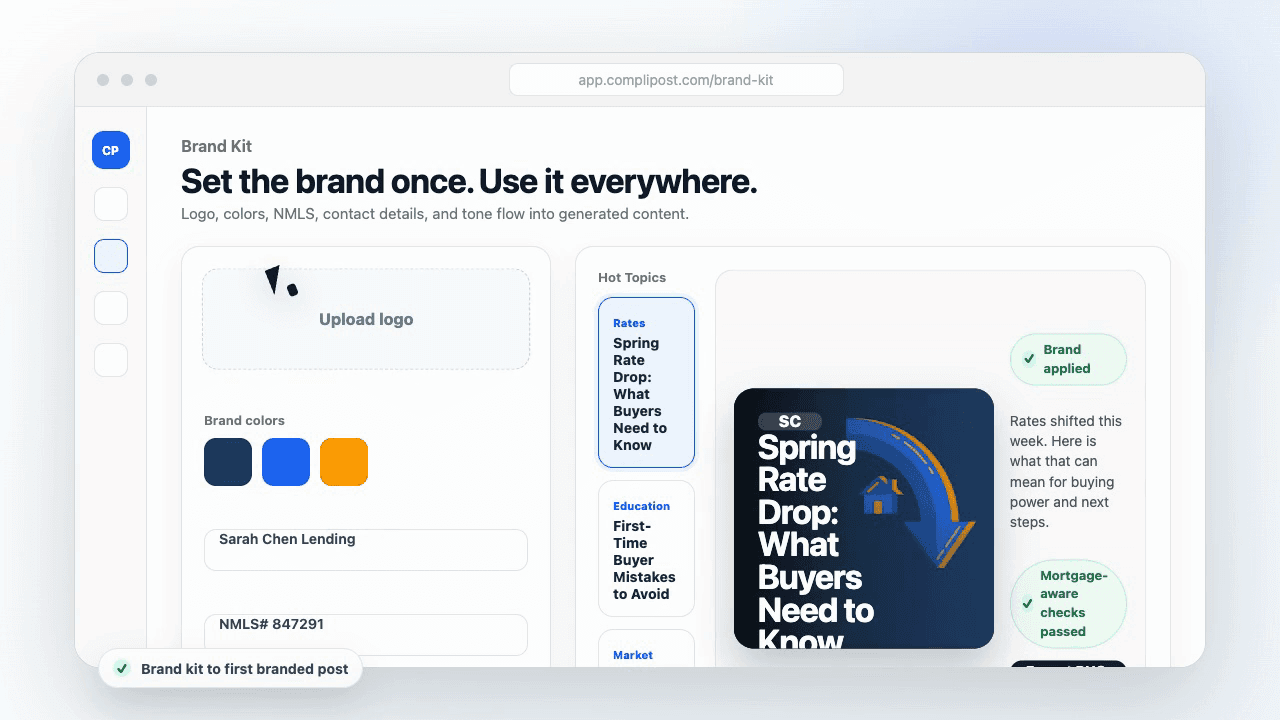
Product workflow
From blank page to export-ready mortgage content
- Start with a borrower topic
- Generate copy and a visual direction
- Review, save, and export the finished asset
These previews reflect the core CompliPost workflow: create, review, save, and export assets for use in your own channels.
Workflow comparison
| Content approach | What happens | Why it matters |
|---|---|---|
| Random posting | One-off ideas created when there is spare time | Inconsistent visibility and weak reuse |
| Template-only posting | Faster design but still requires rewriting and review | Helpful starting point, but not a full system |
| CompliPost workflow | Plan, generate, review, save, and export from one place | Better consistency with mortgage-aware review context |
| Done-for-you service | Someone else creates much of the content | Useful for some teams, but less control and less immediate reuse |
Who this guide helps
This guide is for loan officers working on solo loan officers who need a repeatable mortgage content workflow. The goal is to turn a broad mortgage topic into one borrower question, one useful takeaway, and one asset that can be reviewed before it is shared.
- You need content that sounds like a loan officer, not a generic brand account
- You want examples that can become captions, graphics, GIFs, or PDFs
- You need a clear place to review claims before export
- You want finished work saved for reuse, not lost in a chat thread
A practical workflow for this use case
Start with a narrow scenario, then move through planning, drafting, visual creation, review, and export. For carousel jargon mortgage terms, that means the topic should be specific enough that a borrower or referral partner can immediately understand what decision the content helps with.
- Choose the borrower type, loan topic, or platform before generating copy
- Draft the caption and visual together so the asset feels cohesive
- Use the federal baseline review aid to flag claims and disclosure gaps
- Export the finished asset and save the post as a reusable starting point
What makes the content stronger
Strong mortgage content is usually specific, plain-spoken, and calm. It explains tradeoffs without pretending one answer fits every borrower. That is especially important on public social channels, where a short post can be interpreted without the full context of a loan conversation.
- Name the borrower question in the first line
- Explain one decision or tradeoff instead of covering everything
- Use examples without implying approval, savings, or rate outcomes
- End with a soft next step, checklist, or guide rather than pressure
Compliance-aware review notes
CompliPost should be treated as a review aid, not a compliance approval system. The public page, generated draft, graphic, and exported asset should all stay honest about that boundary.
- Review specific payment, APR, rate, savings, and qualification language
- Avoid “best,” “lowest,” “guaranteed,” “free,” and urgency claims unless approved
- Check NMLS, Equal Housing, company, and state-specific requirements
- Use company or legal review for anything outside the federal baseline
How this connects to the rest of CompliPost
A focused guide should leave you with a usable next step. After you understand the topic, you can turn it into a calendar slot, a reviewed social post, a downloadable guide, or a platform-specific version for the channel where your audience already spends time.
- Use the content calendar to turn the idea into a weekly plan
- Use the compliance page when claims or disclosures need a slower pass
- Use lead magnets when the topic deserves a deeper PDF guide
- Use platform pages to adapt the same idea for LinkedIn, Facebook, or Instagram
Recommended next steps
Instagram content hub
Create visual mortgage education for carousels, reels, and stories.
Carousel Structures That Convert
Technical carousels work well in the 'timeline walkthrough' structure.
Carousel Ideas for Every Loan Type
A library of technical carousel ideas organized by topic.
Social Copy Compliance
When explaining technical topics, compliance language matters.
Examples
FAQ
What's the risk of oversimplifying technical concepts?+
Oversimplifying can be inaccurate. For example, saying 'debt-to-income is always 43%' ignores that it varies by program and lender. Simplify, but be accurate. Use phrases like 'typically', 'usually', 'in most cases' to account for variation. And always invite questions: 'This is the general rule; your situation might be different.'
Should I explain why a technical thing matters?+
Yes, always. 'Underwriting exists because lenders have been defrauded before' makes it feel less arbitrary. 'Appraisals protect you because they confirm the house is worth what you're paying' makes borrowers understand the benefit, not just the burden.
Can I use diagrams or visuals to explain technical topics?+
Absolutely. A visual breakdown of debt-to-income calculation or a timeline showing underwriting steps is easier to understand than text alone. Use icons, flowcharts, or simple graphics to make technical topics feel less overwhelming.
How long should a technical carousel be?+
Technical carousels can be 6–8 slides because borrowers are hungry for understanding. If you're explaining underwriting in depth, 7 slides works. A technical carousel that's too short skips important nuance.
Create mortgage content with a calmer workflow
CompliPost helps you plan, generate, review, save, and export useful mortgage content without pretending compliance or social distribution is automatic.
Start free