Content Strategy
When to Post About FHA vs. Conventional: Strategic Messaging for Each Audience
Not every borrower needs to hear about FHA vs. conventional at the same time. Strategic messaging means mentioning the right program to the right audience at the right moment in their home-buying journey. This guide teaches you when and how to introduce each program so your content resonates and educates.
Early awareness: catching borrowers before they assume conventional-only
Many borrowers assume they need 20% down or have perfect credit to buy a home. Content about FHA accessibility early in the journey (pre-approval stage) expands their mindset. Post about: FHA basics, 3.5% down availability, flexible credit requirements. This positions you as an educator, not a transaction-chaser, and builds authority. Timing: post this when borrowers are just starting to think about homeownership, researching down payment requirements, or exploring options after a credit setback. The message: 'You might have more options than you think.'
- Early journey: talk about FHA accessibility and flexibility
- Message: 'You might qualify for more than 20% down and perfect credit'
- Content: FHA basics, 3.5% down availability, credit flexibility
- Platform: blog, social, email to newsletter subscribers exploring homeownership
- Goal: expand mindset and position yourself as educator
Decision stage: comparing programs when the borrower is serious
Once a borrower is under contract or actively shopping, they're ready for detailed comparisons. Post about: FHA vs. conventional total cost, appraisal differences, timeline impacts. This is when detailed FAQs, payment calculators, and scenario comparisons resonate. Timing: post this when borrowers ask 'Which program should I use?' or 'Can I afford this home?' The message: 'Here's how to choose based on your situation.' At this stage, borrowers want specifics, not generalities.
- Decision stage: detailed comparisons and scenario analysis
- Message: 'Here's how to choose based on your credit, down payment, and timeline'
- Content: cost comparisons, appraisal differences, timelines, payment scenarios
- Platform: blog, email to under-contract borrowers, social to engaged followers
- Goal: help borrowers make confident, informed decisions
Objection handling: addressing FHA concerns and misconceptions
Borrowers often have outdated FHA concerns ('FHA is only for poor people,' 'FHA appraisals always fail,' 'FHA is more expensive'). Content addressing these misconceptions is powerful, especially if positioned as myth-busting. Post about: FHA seller perception (and why it's outdated), FHA appraisal reality (not all properties fail), FHA cost comparison (when it's actually cheaper). Timing: post this when borrowers express concern about FHA, when you see FHA myths in comments or questions, or preemptively if you know FHA will be a strong option. The message: 'Here's the truth about FHA vs. the myths you've heard.'
- Objection stage: myth-busting and concern addressing
- Message: 'Here's the truth about [FHA myth]'
- Content: seller perception reality, appraisal success rates, cost comparisons, benefits
- Platform: social responses to comments/questions, blog posts, email follow-ups
- Goal: overcome hesitation and reframe FHA as a legitimate choice
Post-close/refi stage: positioning conventional refinance for FHA borrowers
FHA borrowers who've owned 5+ years and built equity might benefit from conventional refinance to remove MIP. Post about: FHA-to-conventional refinance benefits, equity milestones, PMI removal potential. Timing: post this to repeat or past clients who have FHA loans and have been building equity. The message: 'Your improved equity and credit might make conventional refinance worthwhile.' This positions you as forward-thinking and invested in their long-term financial health.
- Post-close stage: refinance and long-term planning
- Message: 'You've built equity; let's explore whether conventional refinance saves money'
- Content: FHA-to-conventional refinance process, cost analysis, equity milestones, timeline
- Platform: email to past clients, blog for FHA borrowers approaching 5-year mark
- Goal: demonstrate long-term value and generate refi leads
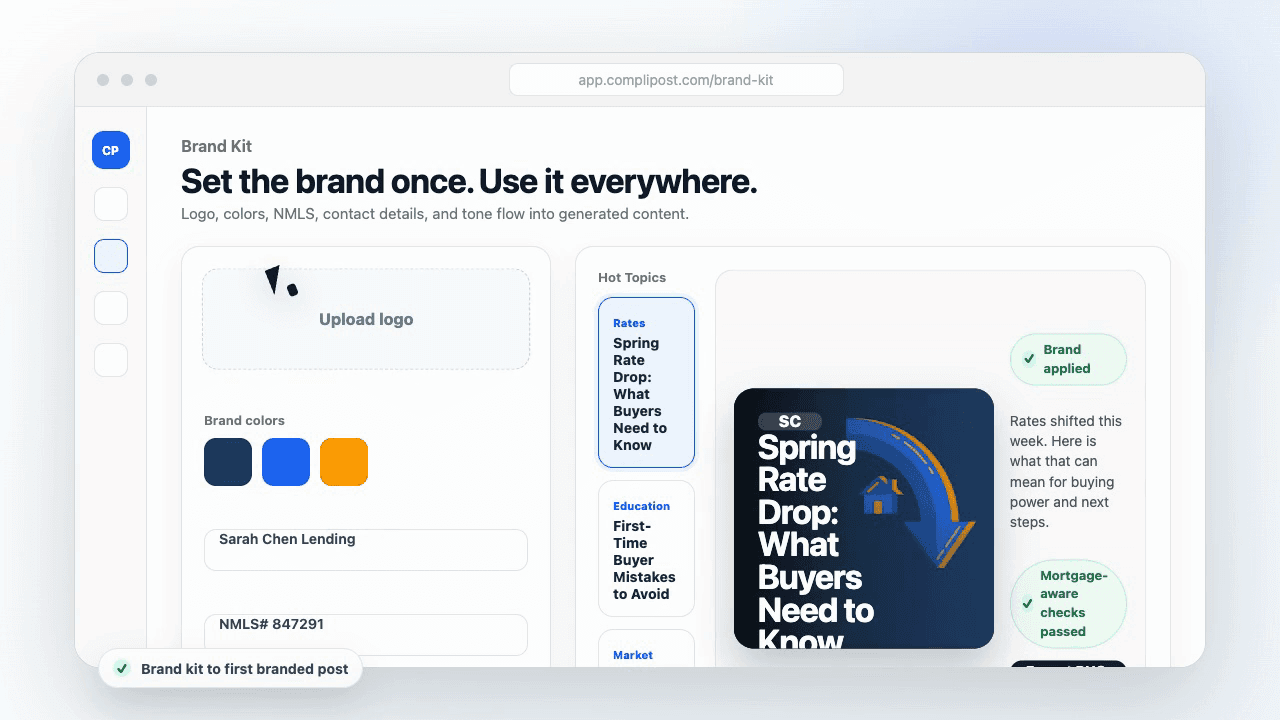
Product workflow
From blank page to export-ready mortgage content
- Start with a borrower topic
- Generate copy and a visual direction
- Review, save, and export the finished asset
These previews reflect the core CompliPost workflow: create, review, save, and export assets for use in your own channels.
Workflow comparison
| Content approach | What happens | Why it matters |
|---|---|---|
| Random posting | One-off ideas created when there is spare time | Inconsistent visibility and weak reuse |
| Template-only posting | Faster design but still requires rewriting and review | Helpful starting point, but not a full system |
| CompliPost workflow | Plan, generate, review, save, and export from one place | Better consistency with mortgage-aware review context |
| Done-for-you service | Someone else creates much of the content | Useful for some teams, but less control and less immediate reuse |
Who this guide helps
This guide is for loan officers working on solo loan officers who need a repeatable mortgage content workflow. The goal is to turn a broad mortgage topic into one borrower question, one useful takeaway, and one asset that can be reviewed before it is shared.
- You need content that sounds like a loan officer, not a generic brand account
- You want examples that can become captions, graphics, GIFs, or PDFs
- You need a clear place to review claims before export
- You want finished work saved for reuse, not lost in a chat thread
A practical workflow for this use case
Start with a narrow scenario, then move through planning, drafting, visual creation, review, and export. For FHA vs conventional messaging timing strategy, that means the topic should be specific enough that a borrower or referral partner can immediately understand what decision the content helps with.
- Choose the borrower type, loan topic, or platform before generating copy
- Draft the caption and visual together so the asset feels cohesive
- Use the federal baseline review aid to flag claims and disclosure gaps
- Export the finished asset and save the post as a reusable starting point
What makes the content stronger
Strong mortgage content is usually specific, plain-spoken, and calm. It explains tradeoffs without pretending one answer fits every borrower. That is especially important on public social channels, where a short post can be interpreted without the full context of a loan conversation.
- Name the borrower question in the first line
- Explain one decision or tradeoff instead of covering everything
- Use examples without implying approval, savings, or rate outcomes
- End with a soft next step, checklist, or guide rather than pressure
Compliance-aware review notes
CompliPost should be treated as a review aid, not a compliance approval system. The public page, generated draft, graphic, and exported asset should all stay honest about that boundary.
- Review specific payment, APR, rate, savings, and qualification language
- Avoid “best,” “lowest,” “guaranteed,” “free,” and urgency claims unless approved
- Check NMLS, Equal Housing, company, and state-specific requirements
- Use company or legal review for anything outside the federal baseline
How this connects to the rest of CompliPost
A focused guide should leave you with a usable next step. After you understand the topic, you can turn it into a calendar slot, a reviewed social post, a downloadable guide, or a platform-specific version for the channel where your audience already spends time.
- Use the content calendar to turn the idea into a weekly plan
- Use the compliance page when claims or disclosures need a slower pass
- Use lead magnets when the topic deserves a deeper PDF guide
- Use platform pages to adapt the same idea for LinkedIn, Facebook, or Instagram
Recommended next steps
FHA loan content hub
Create FHA loan explainers and buyer guidance.
FHA vs. Conventional Explained Simply
Core facts about both programs for foundational education.
FHA vs. Conventional: Decision Framework for Your Situation
Guide borrowers through the actual decision with this framework.
FHA vs. Conventional: Seller Perception & Offer Strategy
Address FHA concerns and help borrowers position strong offers.
Examples
FAQ
Should I always mention both FHA and conventional, or focus on one?+
Mention both, but time them strategically. Early awareness content can focus on FHA alone (expanding options). Decision-stage content should compare both. Objection content addresses FHA misconceptions. Refinance content targets FHA borrowers. Targeting content to the right audience at the right time is more effective than generic 'both programs exist' messaging.
How do I talk about FHA without sounding like I'm pushing borrowers toward it?+
Focus on education, not recommendation. Say 'FHA allows 3.5% down' (fact) rather than 'You should do FHA' (recommendation). Show pros and cons for both programs. Run honest scenarios. Avoid gatekeeping language like 'You can't afford conventional' or 'FHA is the only option.' Most borrowers have options; your job is to help them evaluate.
What if a borrower has strong credit and down payment—should I still mention FHA?+
Briefly, and only if relevant to their situation. If they have 15% down and strong credit, conventional is likely optimal. Mention FHA as a 'what if' ('If down payment became a constraint, FHA is an option'), but don't push. Respect where they are financially and recommend accordingly.
How do I handle borrowers who already have a strong preference for one program?+
Ask why they prefer it. If it's based on misconception ('FHA is for poor people'), gently correct with facts. If it's based on genuine concern ('I worry about appraisal delays'), address the concern directly and show how to mitigate it. Respect their preference, but ensure it's informed, not based on outdated assumptions.
Should I post different messaging for first-time buyers vs. move-up buyers?+
Yes. First-time buyers often assume 20% down is required; FHA messaging resonate strongly. Move-up buyers often have equity and refinance options; conventional-refi messaging works. Tailor messaging to the audience's stage and concerns.
Create mortgage content with a calmer workflow
CompliPost helps you plan, generate, review, save, and export useful mortgage content without pretending compliance or social distribution is automatic.
Start free