Choosing the Right Loan
FHA vs. Conventional: How to Choose the Right Program for You
Choosing between FHA and conventional isn't about one program being 'better'—it's about which fits your specific financial situation, timeline, and goals. This guide gives you a practical decision framework to evaluate credit, down payment, ownership timeline, and true cost. Use it to have honest conversations with borrowers and help them choose confidently.
Credit score: the first decision point
If your credit score is below 620, FHA is likely your only option. Conventional loans typically require 620+ (some lenders allow 600, but rates are penalized). If your score is 620-660, both programs are available, but FHA may offer better rates. If your score is 660+, conventional typically offers competitive or better rates than FHA. Above 680, conventional often wins on rate and long-term cost. Be honest about your credit: a recent late payment or collection hits both programs, but FHA shows more flexibility for older credit issues if other factors (income, down payment, employment) are solid. Run quotes at both programs to see which offers better rates for your credit profile.
- Below 620: FHA only; conventional is off the table
- 620-660: both available; run quotes to compare rates
- 660-680: conventional increasingly competitive; compare total cost
- 680+: conventional typically wins on rate and long-term cost
- Recent credit issues: FHA more flexible; older issues less impactful on both
Down payment: affordability vs. long-term cost
If you have less than 5% saved, FHA's 3.5% down is your better option. If you have 5-10% saved, compare FHA and conventional costs—sometimes conventional is cheaper long-term despite higher down payment required. If you have 10%+ saved, conventional typically wins on cost. Also consider: can you save to 20% within 12 months? If yes, waiting 6-12 months and then buying conventional (without PMI) might be cheaper than buying FHA now and paying MIP for years. This isn't always obvious, so run the numbers. If conventional down payment would completely drain your savings, FHA's lower down payment might be the right choice even if cost is higher—having reserves matters for financial security.
- Under 5% saved: FHA 3.5% down is likely the right choice
- 5-10% saved: compare total 30-year costs before deciding
- 10%+ saved: conventional typically cheaper, especially long-term
- Can you save to 20% in 6-12 months? Consider waiting for no-PMI conventional
- Don't go with FHA just to preserve savings; emergency reserves matter
Ownership timeline: how long will you own the home?
If you plan to own for 5 years or less, FHA cost difference vs. conventional may be small—choose based on down payment and credit. If you plan to own 5-10 years, run a 10-year cost comparison; conventional often wins because PMI drops at 20% equity (usually 5-7 years) while FHA MIP continues. If you plan to own 15+ years, conventional almost always wins because FHA's lifetime MIP accumulates to thousands more than conventional's removable PMI. However, if you can't qualify for conventional (credit or down payment), FHA is still the right choice despite higher long-term cost.
- 5 years or less: cost difference minimal; choose on accessibility and rates
- 5-10 years: run 10-year cost comparison; conventional often wins
- 10-15 years: conventional likely wins significantly due to PMI removal
- 15+ years: conventional wins substantially; MIP costs mount on FHA
- Ownership timeline is a critical factor—ask borrowers early and often
The full decision checklist: putting it together
Start with credit: below 620, FHA only. Then evaluate down payment: under 5%, lean FHA; 5-10%, compare costs; 10%+, lean conventional. Next, consider timeline: short-term, FHA acceptable; long-term, conventional preferable. Finally, run payment quotes for both programs and show the borrower the total 30-year cost. Include the surprise factor: does conventional require a higher rate because of credit? Does the lower down payment advantage actually make FHA cheaper? Every situation is different. Share your recommendation, but ultimately the borrower's comfort, financial situation, and timeline drive the choice. Honesty and transparency throughout build trust and avoid buyer's remorse.
- Start with credit: is conventional even available for this borrower?
- Evaluate down payment: how much can be saved and when?
- Consider timeline: is this a 5-year home or 30-year commitment?
- Run quotes and compare 5-, 10-, and 30-year payment scenarios
- Present both options honestly; let the borrower decide with full information
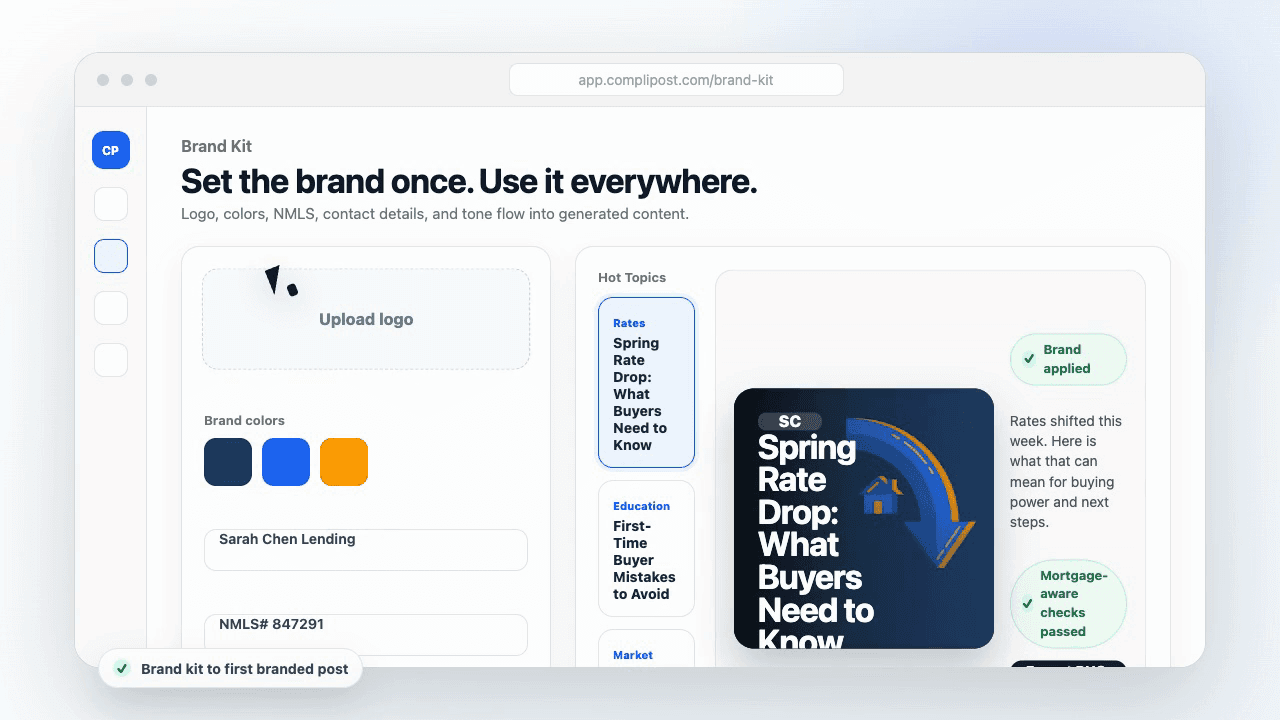
Product workflow
From blank page to export-ready mortgage content
- Start with a borrower topic
- Generate copy and a visual direction
- Review, save, and export the finished asset
These previews reflect the core CompliPost workflow: create, review, save, and export assets for use in your own channels.
Workflow comparison
| Content approach | What happens | Why it matters |
|---|---|---|
| Random posting | One-off ideas created when there is spare time | Inconsistent visibility and weak reuse |
| Template-only posting | Faster design but still requires rewriting and review | Helpful starting point, but not a full system |
| CompliPost workflow | Plan, generate, review, save, and export from one place | Better consistency with mortgage-aware review context |
| Done-for-you service | Someone else creates much of the content | Useful for some teams, but less control and less immediate reuse |
Who this guide helps
This guide is for loan officers working on solo loan officers who need a repeatable mortgage content workflow. The goal is to turn a broad mortgage topic into one borrower question, one useful takeaway, and one asset that can be reviewed before it is shared.
- You need content that sounds like a loan officer, not a generic brand account
- You want examples that can become captions, graphics, GIFs, or PDFs
- You need a clear place to review claims before export
- You want finished work saved for reuse, not lost in a chat thread
A practical workflow for this use case
Start with a narrow scenario, then move through planning, drafting, visual creation, review, and export. For how to choose FHA vs conventional loan, that means the topic should be specific enough that a borrower or referral partner can immediately understand what decision the content helps with.
- Choose the borrower type, loan topic, or platform before generating copy
- Draft the caption and visual together so the asset feels cohesive
- Use the federal baseline review aid to flag claims and disclosure gaps
- Export the finished asset and save the post as a reusable starting point
What makes the content stronger
Strong mortgage content is usually specific, plain-spoken, and calm. It explains tradeoffs without pretending one answer fits every borrower. That is especially important on public social channels, where a short post can be interpreted without the full context of a loan conversation.
- Name the borrower question in the first line
- Explain one decision or tradeoff instead of covering everything
- Use examples without implying approval, savings, or rate outcomes
- End with a soft next step, checklist, or guide rather than pressure
Compliance-aware review notes
CompliPost should be treated as a review aid, not a compliance approval system. The public page, generated draft, graphic, and exported asset should all stay honest about that boundary.
- Review specific payment, APR, rate, savings, and qualification language
- Avoid “best,” “lowest,” “guaranteed,” “free,” and urgency claims unless approved
- Check NMLS, Equal Housing, company, and state-specific requirements
- Use company or legal review for anything outside the federal baseline
How this connects to the rest of CompliPost
A focused guide should leave you with a usable next step. After you understand the topic, you can turn it into a calendar slot, a reviewed social post, a downloadable guide, or a platform-specific version for the channel where your audience already spends time.
- Use the content calendar to turn the idea into a weekly plan
- Use the compliance page when claims or disclosures need a slower pass
- Use lead magnets when the topic deserves a deeper PDF guide
- Use platform pages to adapt the same idea for LinkedIn, Facebook, or Instagram
Recommended next steps
FHA loan content hub
Create FHA loan explainers and buyer guidance.
FHA vs. Conventional Explained Simply
Fundamentals of both programs to inform your decision.
FHA vs. Conventional: Monthly Payment & True Cost Comparison
How to calculate and compare total payment costs across both programs.
FHA vs. Conventional: Credit, Down Payment & Accessibility
Detailed requirements for each program so you know if you qualify.
Examples
FAQ
Which program is 'better'—FHA or conventional?+
Neither is universally better; it depends entirely on your situation. FHA is better if you have limited down payment savings or credit challenges. Conventional is better if you can save 5%+ down, have good credit, and plan to own long-term. The 'better' program is the one that fits your credit, finances, and timeline while minimizing your true cost. This is why comparing total 30-year costs (not just rates or down payments) is essential.
Should I choose FHA just to get into a home faster?+
Not necessarily. If conventional saves you money long-term and you can qualify, waiting a few months to save down payment is often worth it. However, if you've been saving for years and still don't have 5% down, FHA is the right choice—don't let perfect be the enemy of good. Also consider the market: if home prices are rising and you'd be outpriced by waiting 6 months, buying now with FHA might be smarter than waiting. The decision should factor in both personal timeline and market conditions.
If I start with FHA, can I refinance to conventional later?+
Yes. You can refinance an FHA loan into a conventional loan once you have enough equity (typically 20%) and your credit profile qualifies. However, you'll pay refinance costs (appraisal, processing fees, etc.), so refinancing should be evaluated alongside the original choice. If you're seriously considering refinancing later, that's a sign conventional now might be better. But if you have no choice except FHA, refinancing is always an option.
What if my credit and down payment are both weak?+
FHA is your program. Focus on building up your credit and savings for the next 6-12 months, then explore conventional options. In the meantime, use FHA content to educate yourself on loan requirements and prepare a strong application. Work with a loan officer who understands FHA flexibility and can maximize your approval odds. FHA exists precisely for borrowers in this situation—use it confidently.
Should I choose based on the interest rate I'm quoted, or other factors?+
Interest rate is important, but it's only one factor. The true cost includes rate + insurance + loan amount + timeline. A lower FHA rate might still result in higher total payments if MIP is high. Conversely, a slightly higher conventional rate might be cheaper overall if you reach 20% equity quickly and PMI drops off. Always compare total cost scenarios, not just headline rates.
Create mortgage content with a calmer workflow
CompliPost helps you plan, generate, review, save, and export useful mortgage content without pretending compliance or social distribution is automatic.
Start free