Payment Breakdown
FHA vs. Conventional: What Does Your Monthly Payment Actually Include?
FHA and conventional loans have very different monthly payment structures due to insurance, rates, and down payment differences. Understanding what goes into each payment—principal, interest, taxes, insurance, PMI, and MIP—helps borrowers make informed choices and prevents surprise sticker shock. This guide teaches you how to transparently compare true monthly costs.
Breaking down the monthly payment: PITI, PMI, and MIP
A full mortgage payment includes Principal, Interest, Taxes, and Insurance (PITI) plus mortgage insurance. On conventional loans, mortgage insurance (PMI) is added monthly until you reach 20% equity. On FHA loans, mortgage insurance (MIP) includes an upfront premium (typically 1.75% of the loan amount, financed into the loan) plus annual MIP spread across monthly payments. The result: even with a lower interest rate, FHA monthly payments often exceed conventional because of MIP. After reaching 20% equity, conventional PMI drops off; FHA MIP typically stays for the loan's life (or 11+ years on lower down payments). This long-term cost difference is often overlooked in initial comparisons.
- PITI (principal, interest, taxes, insurance) is the base on both programs
- FHA adds upfront MIP (~1.75%) financed into the loan plus annual MIP
- Conventional adds PMI (varies by credit, down payment) until 20% equity
- FHA MIP is permanent on most loans; conventional PMI is removable
- True cost requires comparing 10-30 year payment totals, not just initial rates
Comparing interest rates and their long-term impact
FHA rates are often 0.25-0.5% lower than conventional rates for the same credit profile, because FHA is government-backed. However, this rate advantage can be erased or reversed when you factor in MIP costs. A borrower with 3.5% down on FHA might get a 6.5% rate but pay 1.5% annually in MIP, effectively costing 8% when added together. A conventional borrower with 5% down might pay 7% interest plus PMI costs ~0.5-1% annually. The comparison: 8% equivalent vs. 7.5-8% equivalent—roughly equivalent or slightly favoring conventional. Transparency here builds trust: show borrowers the full cost picture, not just interest rate.
- FHA often offers 0.25-0.5% lower rates due to government backing
- Rate advantage is partially offset by MIP costs
- Effective borrowing cost = interest rate + insurance costs
- Conventional PMI decreases over time; FHA MIP typically stays flat
- Run 10- and 30-year payment comparisons to show true cost difference
Down payment impact on total cost
FHA's 3.5% down requirement means financing 96.5% of the purchase price, which increases the loan amount and thus total interest paid. Conventional at 5-10% down means financing less, resulting in lower total interest despite potentially higher rates. A $300K home: FHA finances $289.5K; conventional at 5% finances $285K. Over 30 years, that $4.5K difference compounds to thousands in additional interest. Add in FHA's permanent MIP, and the total cost over 30 years often favors conventional. However, if a borrower cannot save the down payment for conventional, FHA's lower down payment requirement is the deciding factor—even if total cost is higher.
- FHA's 3.5% down means higher loan amount and more total interest
- Conventional 5-10% down reduces loan amount but requires larger upfront cash
- Total 30-year interest paid often favors conventional due to lower loan amount
- If conventional down payment isn't feasible, FHA cost difference is secondary
- Build down payment savings strategy; it may be cheaper than FHA MIP long-term
When to recommend each program based on true cost
Recommend FHA if down payment savings are not available and credit is marginal (580-640); FHA's accessibility outweighs cost. Recommend FHA if the borrower plans to own for less than 5-7 years; MIP removal is unlikely and FHA cost may be acceptable short-term. Recommend conventional if borrower can save 5-10% down and has good credit (680+); the long-term cost savings and PMI removal potential justify the wait. Recommend conventional if the borrower expects to own for 10+ years; the cumulative MIP costs on FHA will be substantial. Always run payment scenarios for both programs and show the borrower the 30-year cost comparison.
- FHA: best when down payment savings are genuinely impossible
- Conventional: better long-term if down payment is achievable in 6-12 months
- Consider ownership timeline: short-term (5yr) favors FHA; long-term (10yr+) favors conventional
- Always show 10-, 15-, and 30-year payment and cost comparisons
- Factor in rate differentials, which vary with credit and market conditions
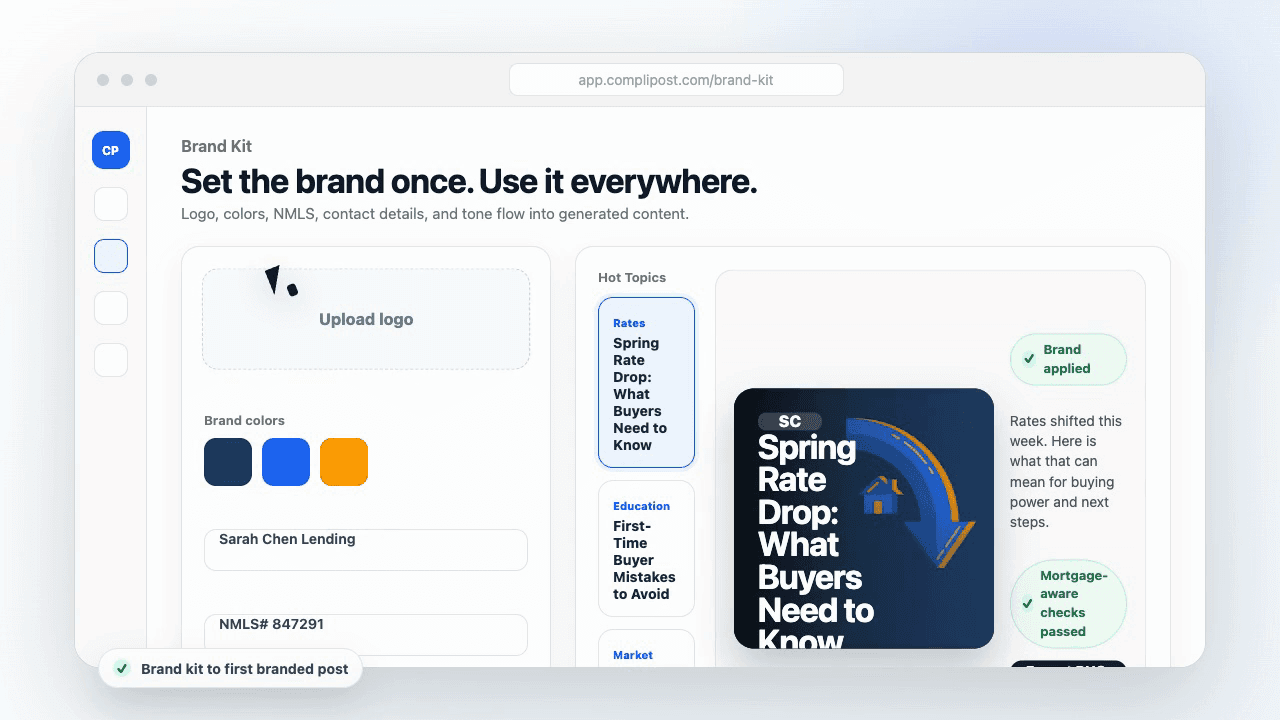
Product workflow
From blank page to export-ready mortgage content
- Start with a borrower topic
- Generate copy and a visual direction
- Review, save, and export the finished asset
These previews reflect the core CompliPost workflow: create, review, save, and export assets for use in your own channels.
Workflow comparison
| Content approach | What happens | Why it matters |
|---|---|---|
| Random posting | One-off ideas created when there is spare time | Inconsistent visibility and weak reuse |
| Template-only posting | Faster design but still requires rewriting and review | Helpful starting point, but not a full system |
| CompliPost workflow | Plan, generate, review, save, and export from one place | Better consistency with mortgage-aware review context |
| Done-for-you service | Someone else creates much of the content | Useful for some teams, but less control and less immediate reuse |
Who this guide helps
This guide is for loan officers working on solo loan officers who need a repeatable mortgage content workflow. The goal is to turn a broad mortgage topic into one borrower question, one useful takeaway, and one asset that can be reviewed before it is shared.
- You need content that sounds like a loan officer, not a generic brand account
- You want examples that can become captions, graphics, GIFs, or PDFs
- You need a clear place to review claims before export
- You want finished work saved for reuse, not lost in a chat thread
A practical workflow for this use case
Start with a narrow scenario, then move through planning, drafting, visual creation, review, and export. For FHA vs conventional monthly payment cost, that means the topic should be specific enough that a borrower or referral partner can immediately understand what decision the content helps with.
- Choose the borrower type, loan topic, or platform before generating copy
- Draft the caption and visual together so the asset feels cohesive
- Use the federal baseline review aid to flag claims and disclosure gaps
- Export the finished asset and save the post as a reusable starting point
What makes the content stronger
Strong mortgage content is usually specific, plain-spoken, and calm. It explains tradeoffs without pretending one answer fits every borrower. That is especially important on public social channels, where a short post can be interpreted without the full context of a loan conversation.
- Name the borrower question in the first line
- Explain one decision or tradeoff instead of covering everything
- Use examples without implying approval, savings, or rate outcomes
- End with a soft next step, checklist, or guide rather than pressure
Compliance-aware review notes
CompliPost should be treated as a review aid, not a compliance approval system. The public page, generated draft, graphic, and exported asset should all stay honest about that boundary.
- Review specific payment, APR, rate, savings, and qualification language
- Avoid “best,” “lowest,” “guaranteed,” “free,” and urgency claims unless approved
- Check NMLS, Equal Housing, company, and state-specific requirements
- Use company or legal review for anything outside the federal baseline
How this connects to the rest of CompliPost
A focused guide should leave you with a usable next step. After you understand the topic, you can turn it into a calendar slot, a reviewed social post, a downloadable guide, or a platform-specific version for the channel where your audience already spends time.
- Use the content calendar to turn the idea into a weekly plan
- Use the compliance page when claims or disclosures need a slower pass
- Use lead magnets when the topic deserves a deeper PDF guide
- Use platform pages to adapt the same idea for LinkedIn, Facebook, or Instagram
Recommended next steps
FHA loan content hub
Create FHA loan explainers and buyer guidance.
FHA vs. Conventional Explained Simply
Core differences including insurance, rates, and down payment requirements.
FHA vs. Conventional: Understanding Mortgage Insurance Costs
Deep dive into FHA MIP and conventional PMI—when they apply and how to calculate them.
FHA vs. Conventional: Down Payment & Savings Planning
Strategies for saving down payment and evaluating the down payment vs. MIP tradeoff.
Examples
FAQ
Why is my FHA monthly payment higher than the conventional payment if FHA rates are lower?+
Because FHA's rate advantage is offset by mortgage insurance (MIP) costs. FHA includes an upfront premium (1.75% financed into the loan) plus annual MIP spread across monthly payments, which typically totals 0.5-1.5% of your loan balance annually. Conventional PMI is similar but removable once you reach 20% equity. The result: FHA's lower rate is neutralized by higher insurance costs, making monthly payments similar or higher than conventional. This is why rate comparisons alone are misleading—you must include insurance in the true cost calculation.
When does FHA mortgage insurance drop off?+
On most FHA loans, MIP does not drop off automatically. It typically lasts the life of the loan on mortgages with down payments under 10%. On FHA loans with 10%+ down, MIP can be removed after 11 years. To remove MIP early, you'd need to refinance into a conventional loan once you have 20% equity. This permanence of FHA MIP (unlike conventional PMI removal) is a significant long-term cost factor.
Should I just put down 10% on FHA to get MIP removed after 11 years?+
It depends on your cash position. A 10% down FHA loan costs more upfront than 3.5% down, but it qualifies you for MIP removal after 11 years instead of forever. If you have the cash and plan to stay 11+ years, 10% down could save money long-term. However, if that cash could be better invested elsewhere or if you might move within 11 years, 3.5% down is fine. Run a 30-year cost comparison with and without the 10% down option.
Is conventional always cheaper than FHA if I can save the down payment?+
Usually, but not always. Conventional requires 5-10% down and typically a higher credit score (620+), which may mean a higher rate. If you have poor credit, FHA's 0.5% rate advantage might offset the down payment and PMI difference. Run the scenarios for your specific credit profile and down payment amount. However, if you have decent credit (680+) and can save 5-10% down, conventional is often cheaper long-term due to lower loan amount and removable PMI.
How much should I budget for mortgage insurance on each program?+
FHA MIP typically costs 0.5-1.5% of the loan balance annually (wrapped into monthly payments), plus a 1.75% upfront fee financed into the loan. Conventional PMI costs 0.3-1.5% annually depending on credit score, down payment, and loan-to-value ratio. Get quotes from lenders for your specific situation to see exact costs. Use the mortgage insurance cost to calculate true monthly payment and compare programs.
Create mortgage content with a calmer workflow
CompliPost helps you plan, generate, review, save, and export useful mortgage content without pretending compliance or social distribution is automatic.
Start free