Offer Strategy
FHA vs. Conventional Offers: What Sellers Think & What's Actually True
In competitive markets, sellers sometimes prefer conventional offers over FHA, even when the offers are identical in price and timing. This bias exists because of outdated perceptions about FHA loans. Understanding why sellers have these concerns—and what's fact vs. fiction—helps you advise your buyer-clients on positioning their FHA offers competitively and knowing when to push back against discrimination.
Why sellers perceive FHA as riskier (and what's actually true)
Sellers worry that FHA appraisals will kill deals because of strict property standards. This concern is partially valid: FHA appraisals do identify defects that conventional appraisals might gloss over. However, the risk is manageable with honest property disclosure and pre-appraisal inspections. Sellers also fear FHA borrowers are less qualified, which is outdated thinking—FHA borrowers with 580+ credit and 3.5% down can be as creditworthy as conventional borrowers with lower down payments. The real risk: if an FHA appraisal identifies defects, the loan requires repairs, which can delay closing or renegotiate the deal. Conventional appraisals allow negotiation; FHA appraisals force resolution. This timeline risk is the legitimate seller concern.
- Sellers fear FHA appraisals will identify defects and delay/derail the deal
- FHA borrowers are not less qualified; credit and income requirements are rigorous
- The real difference: FHA appraisal defects are non-waivable; conventional are negotiable
- Closing timeline is the legitimate risk concern, not borrower quality
- Seller's agent bias (outdated assumptions) is often the bigger barrier than real risk
Positioning FHA offers to compete with conventional
To overcome seller bias, position your FHA buyer as detail-oriented, prepared, and committed. Get a pre-appraisal or professional inspection before offering; this demonstrates confidence and reduces the surprise factor if an FHA appraisal flags issues. Include a strong pre-approval letter emphasizing credit and income. Offer proof of funds or down payment savings to show financial stability. Set clear expectations in the offer: include an appraisal contingency (standard on both FHA and conventional) but note your willingness to work collaboratively on any appraisal defects identified. A well-structured FHA offer with strong buyer credentials and clear communication can overcome seller bias.
- Get pre-appraisal before offering; demonstrates confidence and reduces appraisal surprises
- Include strong pre-approval letter emphasizing credit and income
- Offer proof of down payment funds and financial stability documentation
- Be explicit about appraisal contingency and willingness to collaborate on defects
- Consider offering slightly faster closing timeline to offset timeline risk perception
When to challenge FHA bias vs. when to walk away
If a seller rejects your FHA offer solely because it's FHA (stated outright), this is technically discrimination, though enforcement is complex. Push back by clarifying facts: borrower creditworthiness, down payment, timeline. Ask the seller's agent whether there are legitimate concerns beyond loan type. If the seller remains rigid and won't accept FHA despite identical offer terms, assess whether the property is worth the fight. In hot markets, sellers have options; in slower markets or when offers are thin, sellers often come around. If you're advising a buyer, be realistic: FHA may cost them deals in competitive markets, but conventional at higher rates may cost them more in the long run. Run scenarios.
- Factual pushback helps: clarify borrower quality, down payment, timeline
- Explicit FHA rejection = potential discrimination, but enforcement is murky
- In competitive markets, expect seller preference for conventional; adjust expectations
- In slower markets, FHA bias matters less; sellers prioritize certainty and price
- Evaluate whether fighting FHA bias is worth the deal or if moving on is smarter
Honest conversation with borrowers about FHA perception
Set expectations early: in competitive markets, FHA offers may face seller bias. Discuss whether the borrower wants to accept this risk or explore conventional. If conventional isn't viable (down payment, credit), frame FHA as a strong option with clear communication as the antidote to bias. If the buyer insists on FHA, prepare them for potential rejection and help them stay emotionally resilient. Emphasize that FHA rejection reflects seller bias, not borrower quality. Many buyers appreciate the honesty; it builds trust. In slower markets, downplay FHA concerns entirely. Honest framing prevents disappointment and positions you as a trusted advisor, not a salesperson pushing one program.
- Set expectations on FHA perception early in the process
- Discuss conventional alternatives even if not ideal for the borrower
- Frame FHA as viable with honest communication and strong offer positioning
- Prepare borrowers for potential rejection; help them stay resilient
- Emphasize that FHA rejection reflects bias, not their borrower quality
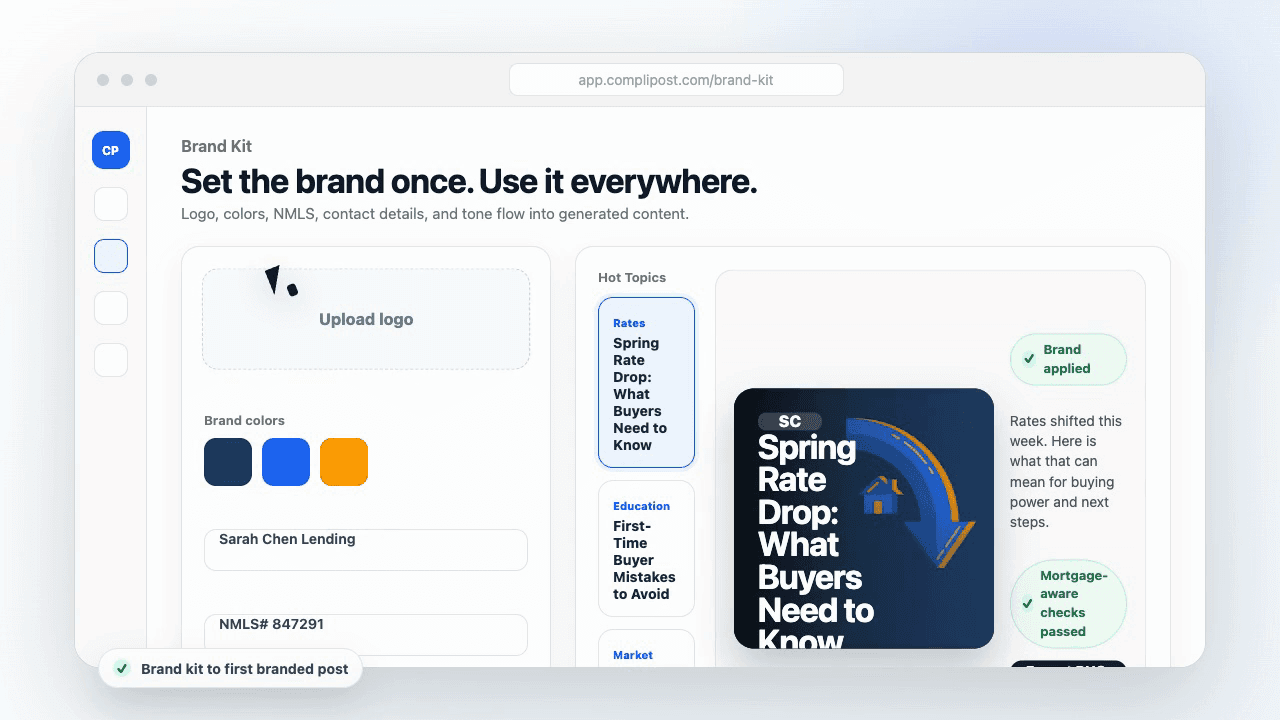
Product workflow
From blank page to export-ready mortgage content
- Start with a borrower topic
- Generate copy and a visual direction
- Review, save, and export the finished asset
These previews reflect the core CompliPost workflow: create, review, save, and export assets for use in your own channels.
Workflow comparison
| Content approach | What happens | Why it matters |
|---|---|---|
| Random posting | One-off ideas created when there is spare time | Inconsistent visibility and weak reuse |
| Template-only posting | Faster design but still requires rewriting and review | Helpful starting point, but not a full system |
| CompliPost workflow | Plan, generate, review, save, and export from one place | Better consistency with mortgage-aware review context |
| Done-for-you service | Someone else creates much of the content | Useful for some teams, but less control and less immediate reuse |
Who this guide helps
This guide is for loan officers working on solo loan officers who need a repeatable mortgage content workflow. The goal is to turn a broad mortgage topic into one borrower question, one useful takeaway, and one asset that can be reviewed before it is shared.
- You need content that sounds like a loan officer, not a generic brand account
- You want examples that can become captions, graphics, GIFs, or PDFs
- You need a clear place to review claims before export
- You want finished work saved for reuse, not lost in a chat thread
A practical workflow for this use case
Start with a narrow scenario, then move through planning, drafting, visual creation, review, and export. For FHA offers vs conventional seller perspective, that means the topic should be specific enough that a borrower or referral partner can immediately understand what decision the content helps with.
- Choose the borrower type, loan topic, or platform before generating copy
- Draft the caption and visual together so the asset feels cohesive
- Use the federal baseline review aid to flag claims and disclosure gaps
- Export the finished asset and save the post as a reusable starting point
What makes the content stronger
Strong mortgage content is usually specific, plain-spoken, and calm. It explains tradeoffs without pretending one answer fits every borrower. That is especially important on public social channels, where a short post can be interpreted without the full context of a loan conversation.
- Name the borrower question in the first line
- Explain one decision or tradeoff instead of covering everything
- Use examples without implying approval, savings, or rate outcomes
- End with a soft next step, checklist, or guide rather than pressure
Compliance-aware review notes
CompliPost should be treated as a review aid, not a compliance approval system. The public page, generated draft, graphic, and exported asset should all stay honest about that boundary.
- Review specific payment, APR, rate, savings, and qualification language
- Avoid “best,” “lowest,” “guaranteed,” “free,” and urgency claims unless approved
- Check NMLS, Equal Housing, company, and state-specific requirements
- Use company or legal review for anything outside the federal baseline
How this connects to the rest of CompliPost
A focused guide should leave you with a usable next step. After you understand the topic, you can turn it into a calendar slot, a reviewed social post, a downloadable guide, or a platform-specific version for the channel where your audience already spends time.
- Use the content calendar to turn the idea into a weekly plan
- Use the compliance page when claims or disclosures need a slower pass
- Use lead magnets when the topic deserves a deeper PDF guide
- Use platform pages to adapt the same idea for LinkedIn, Facebook, or Instagram
Recommended next steps
FHA loan content hub
Create FHA loan explainers and buyer guidance.
FHA vs. Conventional Explained Simply
Core differences and real risk comparison between programs.
FHA vs. Conventional: Appraisal Standards & Property Requirements
What appraisal differences actually mean and why sellers worry about them.
Positioning Your Offer in a Competitive Market
How to choose the right loan program for your financial and market situation.
Examples
FAQ
Is it legal for a seller to reject my offer just because it's FHA?+
Technically, refusing an offer solely because of the loan type may violate fair lending laws in some circumstances, but enforcement is weak and proving discrimination is hard. Sellers and their agents rarely state outright that FHA is the reason—they'll cite other concerns (appraisal risk, timeline, contingencies). If you suspect discrimination, document everything and consult a real estate attorney. In practice, overcoming seller bias through strong offer positioning and communication is faster than fighting discrimination. Focus your energy on demonstrating borrower quality and confidence.
What's a pre-appraisal and does it really help with FHA offers?+
A pre-appraisal is an informal appraisal ordered before making an offer, conducted by a professional appraiser. It's not an official FHA appraisal, but it gives you a sense of property condition and potential appraisal issues. Sharing pre-appraisal results with the seller's agent demonstrates confidence and transparency—it signals that you've already vetted the property and aren't worried about appraisal surprises. This can significantly reduce seller hesitation about FHA. If the pre-appraisal flags defects, you can address them upfront (renegotiate price, ask for repairs, or walk away early) rather than having the FHA appraisal kill the deal later.
Should I tell the seller upfront that my offer is FHA, or should I mention it later?+
Disclose FHA in the offer itself—don't hide it and hope the seller won't notice. Transparency builds credibility. Include clear language about your pre-approval, strong financial position, and timeline expectations. Frame FHA as a positive: "Strong FHA buyer with excellent credit and substantial down payment" rather than defensively. If you hide FHA and the seller discovers it later, you've lost trust and the deal is at risk. Honesty, combined with strong offer positioning, is your best defense.
If I switch to conventional to overcome seller bias, what should I know?+
Conventional requires typically 5-10% down (vs. FHA's 3.5%), a higher credit score (often 620+), and stricter DTI limits. Over the life of the loan, conventional may offer better rates if your credit is strong (680+). If you're switching from FHA to conventional to win an offer, calculate the true cost: higher down payment, potential higher interest rate (if your credit isn't excellent), and conventional MI. Sometimes FHA is genuinely cheaper even if it means losing one offer to seller bias. Run the math before deciding.
How do I know if a seller rejected my FHA offer because of the loan type or other reasons?+
Ask directly through your agent. Request feedback on why your offer wasn't accepted. Legitimate reasons: higher price offer, fewer contingencies, faster closing, stronger earnest money. Suspicious reasons: vague references to 'appraisal concerns,' 'timeline issues,' or 'buyer strength.' If the seller accepted a similar or lower offer that was conventional, loan type was likely the factor. Document this for future reference, but don't dwell—move to the next opportunity.
Create mortgage content with a calmer workflow
CompliPost helps you plan, generate, review, save, and export useful mortgage content without pretending compliance or social distribution is automatic.
Start free