Appraisal Standards
FHA vs. Conventional Appraisals: What Inspectors Look for & Why
FHA and conventional appraisals follow different standards, and those differences can make or break a deal on properties with deferred maintenance, lower condition ratings, or unusual features. FHA appraisals are more rigid about health and safety requirements, while conventional appraisals focus more on market value and comparable sales. Understanding these distinctions helps you set borrower expectations early and positions your advice as trustworthy and on top of details.
FHA appraisal standards: health, safety, and structural requirements
FHA appraisals check for health and safety hazards (lead paint, mold, structural damage) with strict pass/fail criteria. Properties must have functioning electrical, plumbing, and heating systems. Roofs must have sufficient life remaining (typically 2+ years). Bathrooms and kitchens must be operational. Any property defect that poses a health or safety risk must be repaired before FHA loan closing. This means older homes or properties needing significant work may fail an FHA appraisal entirely, not just negotiate a lower value. Conventional appraisers focus primarily on market value and condition relative to comparable homes, not on pass/fail safety criteria.
- FHA requires health and safety standards; conventional focuses on market value
- FHA rejects properties with lead paint hazards, active mold, or structural damage
- FHA requires roofs, plumbing, electrical, and heating systems to be operational
- FHA may require repairs before closing; conventional allows buyer to negotiate repairs post-sale
- Conventional appraisals adjust value for condition but don't block loans on unsafe properties
Specific property features FHA and conventional view differently
FHA has strict rules on condos (must be on the approved list and meet specific reserve requirements), mobile homes (certain types are not eligible), and properties with code violations. Unconventional living spaces (converted garages, basement apartments, ADUs) often fail FHA appraisals unless properly permitted. Conventional loans allow more flexibility here—a well-maintained ADU or converted space can pass appraisal as long as it doesn't overstate the property's market value. Historic homes and fixer-uppers often pass conventional appraisals but fail FHA because of safety or condition requirements. Waterfront properties and those in flood zones require additional appraisal scrutiny under both programs, but conventional handles them more flexibly.
- FHA condos must be on FHA's approved condo list with strong reserves
- Conventional allows condos with weaker reserve requirements and faster approval
- Converted spaces and ADUs often fail FHA; conventional is more flexible
- Historic homes: conventional handles easier if well-maintained; FHA stricter on safety codes
- Flood-zone properties: both require appraisals but conventional may approve more readily
What happens if a property fails FHA appraisal
If a property fails FHA appraisal for health or safety reasons, the lender will not approve the loan until repairs are made and verified. This is non-negotiable and non-waivable. The seller can agree to repair the property before closing, the buyer can negotiate a price reduction, or the deal falls apart. There is no 'as-is' option for FHA loans on properties with safety defects. Conventional loans, by contrast, allow buyers and sellers to negotiate repairs, credits, or accept the property as-is. This difference is critical when advising on fixer-uppers or older homes—FHA may simply not be an option.
- FHA appraisal failures on safety items are non-waivable—repairs required before closing
- Seller can repair, buyer can negotiate price, or deal terminates
- No 'as-is' option for FHA loans on health/safety defects
- Conventional allows negotiation or as-is acceptance on appraisal issues
- Budget timeline carefully if FHA appraisal fails—repairs can extend closing by weeks
How to guide borrowers on appraisal risk before making an offer
For FHA borrowers, know the property condition going in. Older homes, fixer-uppers, foreclosures, and properties with visible deferred maintenance carry higher appraisal risk. Consider a pre-appraisal or professional inspection before offering. For conventional borrowers, appraisal risk is primarily about value justification, not pass/fail safety. Communicate clearly: FHA is safer on newer, well-maintained homes; conventional is more flexible on older or lower-condition properties. Consider the timeline and emotional investment—if an FHA appraisal fails, the deal may terminate. Encourage borrowers to include appraisal contingencies and discuss risk openly.
- FHA: assess property condition before offering; older/fixer-uppers carry higher risk
- Conventional: appraisal risk is value-based, not safety-based; more flexible overall
- Order pre-appraisals or professional inspections before submitting offers on questionable properties
- Include appraisal contingencies and review language carefully
- FHA failure = potential deal termination; conventional failure = negotiation opportunity
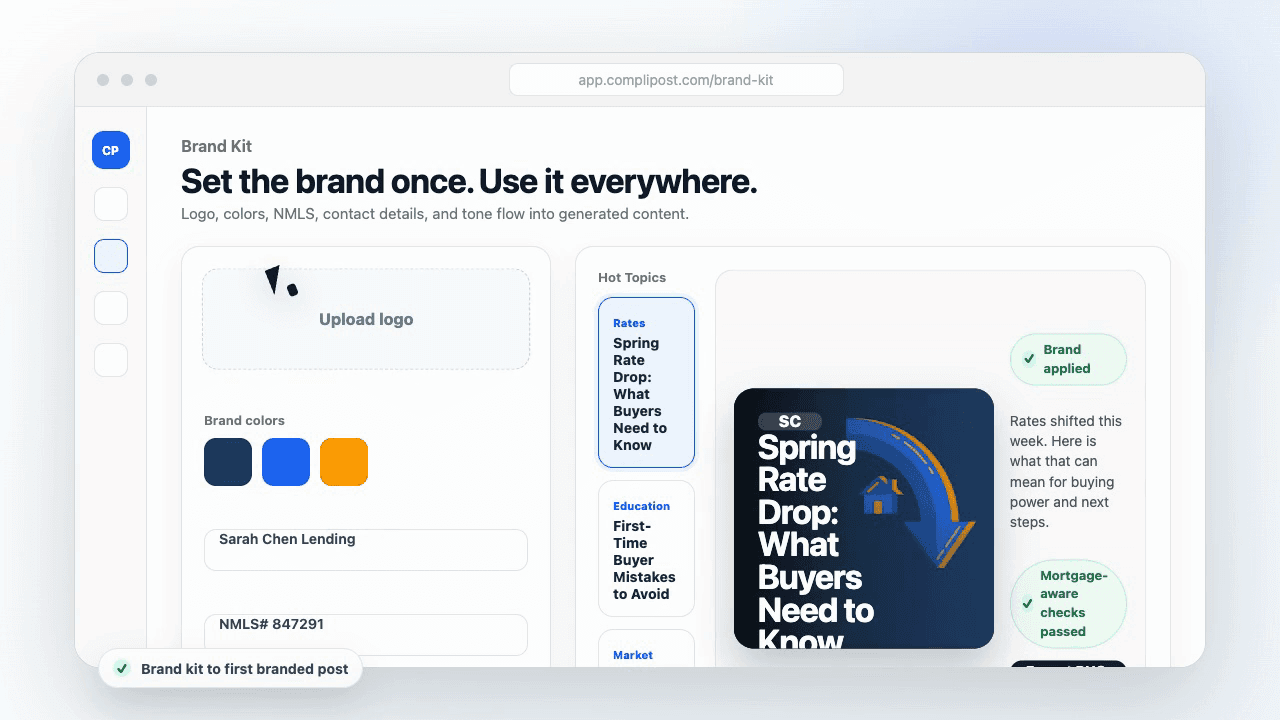
Product workflow
From blank page to export-ready mortgage content
- Start with a borrower topic
- Generate copy and a visual direction
- Review, save, and export the finished asset
These previews reflect the core CompliPost workflow: create, review, save, and export assets for use in your own channels.
Workflow comparison
| Content approach | What happens | Why it matters |
|---|---|---|
| Random posting | One-off ideas created when there is spare time | Inconsistent visibility and weak reuse |
| Template-only posting | Faster design but still requires rewriting and review | Helpful starting point, but not a full system |
| CompliPost workflow | Plan, generate, review, save, and export from one place | Better consistency with mortgage-aware review context |
| Done-for-you service | Someone else creates much of the content | Useful for some teams, but less control and less immediate reuse |
Who this guide helps
This guide is for loan officers working on solo loan officers who need a repeatable mortgage content workflow. The goal is to turn a broad mortgage topic into one borrower question, one useful takeaway, and one asset that can be reviewed before it is shared.
- You need content that sounds like a loan officer, not a generic brand account
- You want examples that can become captions, graphics, GIFs, or PDFs
- You need a clear place to review claims before export
- You want finished work saved for reuse, not lost in a chat thread
A practical workflow for this use case
Start with a narrow scenario, then move through planning, drafting, visual creation, review, and export. For FHA vs conventional appraisals, that means the topic should be specific enough that a borrower or referral partner can immediately understand what decision the content helps with.
- Choose the borrower type, loan topic, or platform before generating copy
- Draft the caption and visual together so the asset feels cohesive
- Use the federal baseline review aid to flag claims and disclosure gaps
- Export the finished asset and save the post as a reusable starting point
What makes the content stronger
Strong mortgage content is usually specific, plain-spoken, and calm. It explains tradeoffs without pretending one answer fits every borrower. That is especially important on public social channels, where a short post can be interpreted without the full context of a loan conversation.
- Name the borrower question in the first line
- Explain one decision or tradeoff instead of covering everything
- Use examples without implying approval, savings, or rate outcomes
- End with a soft next step, checklist, or guide rather than pressure
Compliance-aware review notes
CompliPost should be treated as a review aid, not a compliance approval system. The public page, generated draft, graphic, and exported asset should all stay honest about that boundary.
- Review specific payment, APR, rate, savings, and qualification language
- Avoid “best,” “lowest,” “guaranteed,” “free,” and urgency claims unless approved
- Check NMLS, Equal Housing, company, and state-specific requirements
- Use company or legal review for anything outside the federal baseline
How this connects to the rest of CompliPost
A focused guide should leave you with a usable next step. After you understand the topic, you can turn it into a calendar slot, a reviewed social post, a downloadable guide, or a platform-specific version for the channel where your audience already spends time.
- Use the content calendar to turn the idea into a weekly plan
- Use the compliance page when claims or disclosures need a slower pass
- Use lead magnets when the topic deserves a deeper PDF guide
- Use platform pages to adapt the same idea for LinkedIn, Facebook, or Instagram
Recommended next steps
FHA loan content hub
Create FHA loan explainers and buyer guidance.
FHA vs. Conventional Explained Simply
Core differences in down payment, credit, and insurance at a glance.
FHA vs. Conventional: Property Condition & Appraisal Standards
What condition standards each program requires and why it matters.
FHA Loan Limits & Property Eligibility Rules
FHA caps and eligible property types—know these before advising buyers.
Examples
FAQ
Can I get an FHA loan on a property that failed a conventional appraisal?+
Not necessarily. A conventional appraisal failure usually means the property's value doesn't support the loan amount—a negotiable issue. An FHA appraisal failure typically means health or safety defects that must be repaired. A property could fail both appraisals for different reasons. A property with cosmetic issues might fail conventional valuation but pass FHA (if safe). Conversely, a property with safety issues could pass conventional value-based appraisal but fail FHA's safety requirements entirely.
What if the seller won't fix the FHA appraisal issues?+
If the seller refuses to make required repairs, your FHA loan will not be approved. There are no exceptions or waivers. Your options are: renegotiate to accept a lower price and repair the property yourself post-purchase (if the lender allows), walk away, or switch to a conventional loan (if the property qualifies). This is why FHA appraisal contingencies are critical—they protect you from financing falling through due to property defects beyond your control.
Does the FHA appraiser need to visit the property multiple times if repairs are made?+
Yes, typically. If repairs are required, the appraiser will need to re-inspect the property to verify that all required work was completed correctly. This adds time and can delay closing. Some major repairs (roof replacement, structural work) require inspection by specialized contractors and then appraiser re-approval. Plan for 1-2 weeks of additional time if significant repairs are needed. Conventional appraisals rarely require re-appraisals unless substantial property changes occur.
Can I negotiate a lower price based on FHA appraisal requirements?+
Absolutely. If an FHA appraisal identifies required repairs, you can negotiate the price down to reflect repair costs, ask the seller to complete repairs before closing, or ask for a credit at closing to cover repairs. The amount negotiated should be based on reasonable repair quotes. Both you and the seller benefit from clarity here—the repairs will be required regardless, so negotiating upfront is easier than dealing with loan denial after closing.
Are there types of properties that typically pass FHA appraisals easily?+
Yes. Newer homes (10 years or less), well-maintained mid-age homes with updated systems, and properties on FHA's approved condo list tend to pass FHA appraisals smoothly. Properties with recent roof replacement, updated electrical and plumbing, and no visible structural issues sail through. Homes in good condition relative to their age and neighborhood typically present no appraisal obstacles. If you're buying with FHA and want appraisal certainty, focus on newer or well-maintained properties.
Create mortgage content with a calmer workflow
CompliPost helps you plan, generate, review, save, and export useful mortgage content without pretending compliance or social distribution is automatic.
Start free