Q&A Guide
FHA vs. Conventional: 12 Questions Borrowers Always Ask (Answered)
Every borrower considering FHA vs. conventional asks similar questions. Anticipating and answering these builds confidence and positions you as an informed, trustworthy advisor. This guide gives you clear, honest answers to the most common questions—use it in conversations, posts, and content.
The fundamental question: which program is right for me?
This depends on three factors: credit, down payment, and timeline. FHA works if credit is below 620 or down payment is under 5%; conventional works if credit is 620+ and down payment is 5%+. Both work if credit is strong and down payment is adequate. The 'right' program minimizes your long-term cost while fitting your current financial situation. Run scenarios for both and compare total 30-year payments. Many borrowers assume FHA is for people with problems and conventional is for everyone else—this is wrong. Strong borrowers might choose FHA if timeline is short or they want lower down payment. Weak borrowers might not qualify for either. Be honest about what fits.
- Credit under 620: FHA likely only option
- Credit 620-680: both available; compare costs
- Credit 680+: conventional often wins on rate and cost
- Down payment under 5%: FHA advantage
- Down payment 5%+: both available; compare long-term cost
Will FHA or conventional affect my ability to buy again later?
No. Either loan type doesn't prevent future homeownership. However, the balance and your equity position affect future borrowing. If you buy with FHA and have 5% equity after 5 years, refinancing into conventional becomes an option. If you buy conventional and reach 20% equity, PMI removal opens up. Future borrowing capacity depends on your credit, income, and existing debt load—not the loan type you chose previously. What matters is on-time payments and building equity. A clean FHA payment history is as valuable as a clean conventional history.
- Loan type doesn't prevent future home purchase
- Future borrowing depends on credit, income, equity, and payment history
- FHA or conventional: consistent, on-time payments matter most
- Reaching equity milestones (20% on FHA, refine/remove PMI on conventional) improves future options
- Your past loan choice is less relevant than your current financial standing
Why do some lenders push FHA and others push conventional?
Lenders sometimes push based on their business model or internal incentives. Some lenders specialize in FHA and have streamlined processes; some specialize in conventional. Some push based on loan pricing (one program pays higher commissions). This is a conflict of interest—it's why you need an advisor who runs honest scenarios for both programs and shows you the true cost difference. Ask your lender: 'What's the rate and payment if we do FHA?' and 'What's the rate and payment if we do conventional?' Compare the actual quotes, not just recommendations.
- Lenders may specialize in one program and push it accordingly
- Some loan programs pay different commissions; this can bias recommendations
- Always ask for quotes on both programs and compare rates
- Recommend loans based on borrower fit, not lender business interests
- Transparency builds trust; hidden recommendations erode it
If I get FHA now, can I refinance to conventional later and remove the mortgage insurance?
Yes, once you have enough equity (typically 20%). You'd refinance into a conventional loan, pay closing costs (appraisal, processing fees, etc.), and go through underwriting again. The benefit: conventional PMI is removable, while FHA MIP typically isn't. However, refinancing takes time and costs money, so don't assume you'll definitely do it. If you might own the home 15+ years, evaluate whether buying conventional now (if you can) might be cheaper than FHA now plus refinancing costs later. Refinancing is always an option for FHA borrowers, but it shouldn't be the plan—it should be a backup strategy.
- FHA→conventional refinance is possible once you reach 20% equity
- Conventional PMI is removable; this is the benefit of refinancing out of FHA
- Refinancing costs money (appraisal, processing, fees); factor these into the calculation
- If you plan to stay long-term, evaluate whether conventional now is cheaper than FHA + refi
- Refinancing should be a backup option, not a primary plan
Will my FHA or conventional choice affect the interest rate I get?
Yes, sometimes. FHA rates are often 0.25-0.5% lower than conventional rates because of government backing. However, your credit score, down payment, loan amount, and market conditions also affect rate. You might get a lower FHA rate but higher monthly payment (due to MIP) than conventional. Always compare the effective cost (rate plus insurance), not just the headline rate. Run actual quotes from your lender for both programs to see which offers the better true cost.
- FHA rates often 0.25-0.5% lower than conventional due to government backing
- Credit score, down payment, and market conditions also affect rates
- Lower FHA rate doesn't always mean lower payment (MIP offsets)
- Compare effective cost (rate + insurance), not headline rate
- Get quotes for both programs; rates vary by lender and borrower
What happens if my appraisal comes back low on FHA vs. conventional?
On FHA: low appraisal = value issue, not health/safety issue. You can renegotiate price, ask seller for a credit, or put more down. On conventional: same options. If appraisal comes back with health/safety defects (FHA-specific), FHA requires repairs before closing; conventional allows negotiation or as-is acceptance. The difference: FHA defects are non-waivable, so you must negotiate a fix. Conventional defects are negotiable. Always include an appraisal contingency; it protects you on both programs.
- Low appraisal on FHA or conventional: renegotiate, ask for credit, or put more down
- FHA defects (health/safety): non-waivable, must be fixed
- Conventional defects: negotiable; can accept as-is if agreed with seller
- Appraisal contingency protects both programs
- Know property condition before offering; older homes = higher appraisal risk
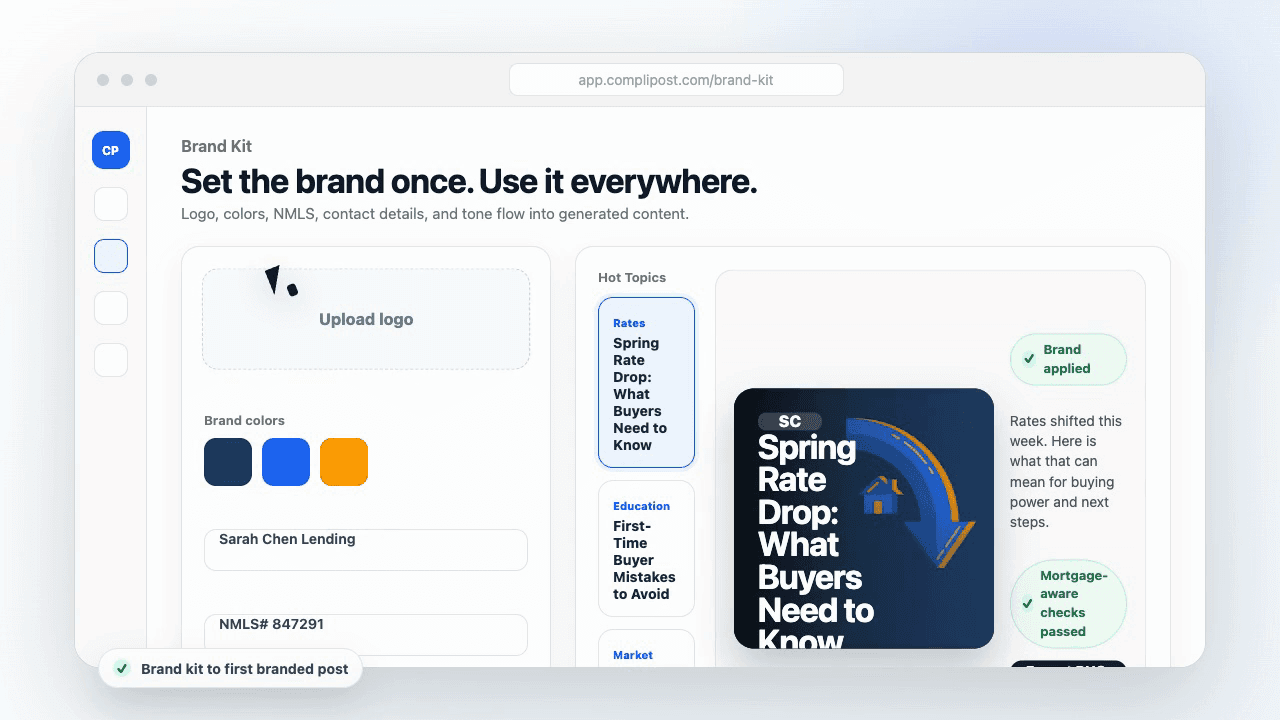
Product workflow
From blank page to export-ready mortgage content
- Start with a borrower topic
- Generate copy and a visual direction
- Review, save, and export the finished asset
These previews reflect the core CompliPost workflow: create, review, save, and export assets for use in your own channels.
Workflow comparison
| Content approach | What happens | Why it matters |
|---|---|---|
| Random posting | One-off ideas created when there is spare time | Inconsistent visibility and weak reuse |
| Template-only posting | Faster design but still requires rewriting and review | Helpful starting point, but not a full system |
| CompliPost workflow | Plan, generate, review, save, and export from one place | Better consistency with mortgage-aware review context |
| Done-for-you service | Someone else creates much of the content | Useful for some teams, but less control and less immediate reuse |
Who this guide helps
This guide is for loan officers working on solo loan officers who need a repeatable mortgage content workflow. The goal is to turn a broad mortgage topic into one borrower question, one useful takeaway, and one asset that can be reviewed before it is shared.
- You need content that sounds like a loan officer, not a generic brand account
- You want examples that can become captions, graphics, GIFs, or PDFs
- You need a clear place to review claims before export
- You want finished work saved for reuse, not lost in a chat thread
A practical workflow for this use case
Start with a narrow scenario, then move through planning, drafting, visual creation, review, and export. For FHA vs conventional borrower questions answers, that means the topic should be specific enough that a borrower or referral partner can immediately understand what decision the content helps with.
- Choose the borrower type, loan topic, or platform before generating copy
- Draft the caption and visual together so the asset feels cohesive
- Use the federal baseline review aid to flag claims and disclosure gaps
- Export the finished asset and save the post as a reusable starting point
What makes the content stronger
Strong mortgage content is usually specific, plain-spoken, and calm. It explains tradeoffs without pretending one answer fits every borrower. That is especially important on public social channels, where a short post can be interpreted without the full context of a loan conversation.
- Name the borrower question in the first line
- Explain one decision or tradeoff instead of covering everything
- Use examples without implying approval, savings, or rate outcomes
- End with a soft next step, checklist, or guide rather than pressure
Compliance-aware review notes
CompliPost should be treated as a review aid, not a compliance approval system. The public page, generated draft, graphic, and exported asset should all stay honest about that boundary.
- Review specific payment, APR, rate, savings, and qualification language
- Avoid “best,” “lowest,” “guaranteed,” “free,” and urgency claims unless approved
- Check NMLS, Equal Housing, company, and state-specific requirements
- Use company or legal review for anything outside the federal baseline
How this connects to the rest of CompliPost
A focused guide should leave you with a usable next step. After you understand the topic, you can turn it into a calendar slot, a reviewed social post, a downloadable guide, or a platform-specific version for the channel where your audience already spends time.
- Use the content calendar to turn the idea into a weekly plan
- Use the compliance page when claims or disclosures need a slower pass
- Use lead magnets when the topic deserves a deeper PDF guide
- Use platform pages to adapt the same idea for LinkedIn, Facebook, or Instagram
Recommended next steps
FHA loan content hub
Create FHA loan explainers and buyer guidance.
FHA vs. Conventional Explained Simply
The fundamentals laid out clearly for any borrower.
FHA vs. Conventional: Decision Framework for Your Situation
Practical framework to evaluate which program fits your specific needs.
FHA vs. Conventional: Monthly Payment & True Cost Analysis
How to calculate and compare total costs across both programs.
Examples
FAQ
Is FHA for people with bad credit and conventional for people with good credit?+
Not exactly. FHA accommodates lower credit scores (down to 580), while conventional typically requires 620+. However, borrowers with good credit (680+) might still choose FHA if down payment is limited or timeline is short. Conversely, borrowers with moderate credit might choose conventional if down payment and rates are favorable. The right choice depends on your complete financial picture, not just credit.
If my credit improves after I get an FHA loan, does anything change?+
Your existing FHA loan won't change. However, improved credit becomes valuable if you later refinance into conventional. You can refinance at any time, but reaching 20% equity plus improved credit makes conventional refinance most attractive. Your credit today determines your rate and approval odds; credit improvement later affects future refinancing options.
Is there a penalty for paying off an FHA loan early?+
No. Both FHA and conventional allow you to pay off the loan early without penalty. In fact, paying extra toward principal can help you reach 20% equity faster on conventional (so PMI can be removed) and is always beneficial. The only caveat: if you have prepayment penalties, but those are rare on residential mortgages.
Why is mortgage insurance required at all—isn't it just extra cost?+
Mortgage insurance protects the lender if you default on the loan. It allows lenders to offer lower-down-payment and lower-credit-score loans without excessive risk. Without mortgage insurance, only borrowers with 20%+ down and excellent credit could get approved. Insurance makes homeownership accessible to more people. Yes, it's extra cost, but it's the price of accessibility. On conventional loans, once you reach 20% equity, PMI is removed (you're no longer a 'risky' borrower). On FHA, MIP typically stays because FHA programs serve borrowers who may not ever reach 20% equity.
Can I get a mortgage without any insurance requirement—FHA or conventional?+
Yes, if you have 20%+ down payment and good credit on a conventional loan, you don't need PMI. No insurance required. FHA loans always require MIP (no exception) because FHA is designed for lower-down-payment borrowers. If you want to avoid all insurance, save 20% down and use conventional.
Create mortgage content with a calmer workflow
CompliPost helps you plan, generate, review, save, and export useful mortgage content without pretending compliance or social distribution is automatic.
Start free