Local Programs
State and Local Down Payment Assistance: Find What's Available Where You Live
Down payment assistance varies dramatically by state and city. Some states and cities offer generous grants (up to $50,000); others have minimal programs. The gap exists because housing costs and policy priorities differ regionally. A first-time buyer in one state might qualify for a $15,000 grant, while an identical borrower in another state gets nothing. Understanding what's available in your geography is the first step to finding help.
Why assistance varies by geography
Down payment assistance is often funded by state and local housing authorities, not federal programs. States with high housing costs and policy commitment to affordability (California, New York, Massachusetts) often have robust programs. Rural states may have fewer programs but use USDA and VA loans as alternatives. Local programs target specific neighborhoods or city populations. This geographic variation means you must search locally; national generalizations don't apply. Your zip code strongly influences what assistance is available.
- State programs vary by policy and funding—no national standard
- High-cost states often have more generous programs
- Rural states rely more on USDA and VA programs
- City programs target specific neighborhoods or populations
- Your location determines what programs you can access
How to find state and local programs
Start with HUD.gov's searchable database of state housing agencies, then contact your state's housing agency directly. They maintain lists of active programs and can often refer you. Ask your lender: they know which programs are currently available and active in your state. Local housing authorities and nonprofits (search 'housing assistance' + your city) often run programs specific to your community. Don't rely on a single search; check state, local, and nonprofit sources to be thorough.
- HUD.gov: search state housing agencies by state
- Your state housing authority: primary source for state programs
- Your lender: knows current, active programs in your area
- Local housing authority or nonprofit: city-specific programs
- Search online: '[your state/city] down payment assistance programs'
Understanding program restrictions and eligibility
State and local programs often have geographic restrictions: the property must be in a specific state, city, or neighborhood. Some target first-time buyers only; others serve repeat buyers or specific professions. Income limits may be tighter or looser than federal programs. Home price caps may apply. Understanding these restrictions helps you qualify efficiently. A program might be unavailable because you're buying outside the eligible area, not because you don't qualify personally.
- Property location restrictions: must be in eligible area (state, city, neighborhood)
- Borrower restrictions: first-time buyer, low/moderate income, specific occupation
- Home price caps: assistance only for homes under $X
- Income verification: must meet program-specific thresholds
- Eligibility is often tied to location first, then borrower profile
Timing and application for local programs
Local and state programs often have slower approval timelines than federal programs. Some are first-come, first-served and have annual funding caps (once funds are exhausted, you wait for next year's allocation). Others accept applications year-round. Ask about timeline and funding availability when you start. If a program is nearly out of money for the year, moving to a backup plan might be wise. Planning timing around program cycles is important.
- Many programs have annual funding cycles—apply early in the fiscal year
- Some programs are first-come, first-served and run out of funds
- Approval timelines: weeks to months depending on program
- Ask: is this program currently accepting applications? Are funds available?
- Have backup plans if your preferred program has limited funding
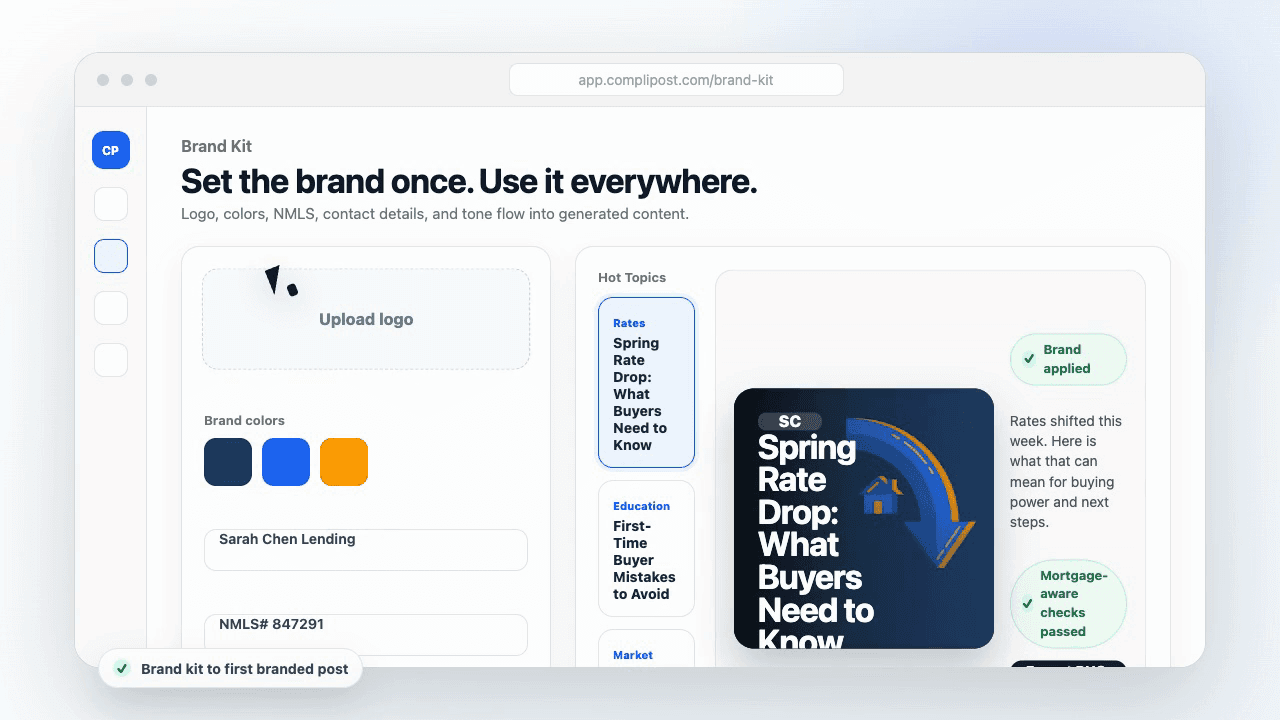
Product workflow
From blank page to export-ready mortgage content
- Start with a borrower topic
- Generate copy and a visual direction
- Review, save, and export the finished asset
These previews reflect the core CompliPost workflow: create, review, save, and export assets for use in your own channels.
Workflow comparison
| Content approach | What happens | Why it matters |
|---|---|---|
| Random posting | One-off ideas created when there is spare time | Inconsistent visibility and weak reuse |
| Template-only posting | Faster design but still requires rewriting and review | Helpful starting point, but not a full system |
| CompliPost workflow | Plan, generate, review, save, and export from one place | Better consistency with mortgage-aware review context |
| Done-for-you service | Someone else creates much of the content | Useful for some teams, but less control and less immediate reuse |
Who this guide helps
This guide is for loan officers working on solo loan officers who need a repeatable mortgage content workflow. The goal is to turn a broad mortgage topic into one borrower question, one useful takeaway, and one asset that can be reviewed before it is shared.
- You need content that sounds like a loan officer, not a generic brand account
- You want examples that can become captions, graphics, GIFs, or PDFs
- You need a clear place to review claims before export
- You want finished work saved for reuse, not lost in a chat thread
A practical workflow for this use case
Start with a narrow scenario, then move through planning, drafting, visual creation, review, and export. For state local down payment assistance programs, that means the topic should be specific enough that a borrower or referral partner can immediately understand what decision the content helps with.
- Choose the borrower type, loan topic, or platform before generating copy
- Draft the caption and visual together so the asset feels cohesive
- Use the federal baseline review aid to flag claims and disclosure gaps
- Export the finished asset and save the post as a reusable starting point
What makes the content stronger
Strong mortgage content is usually specific, plain-spoken, and calm. It explains tradeoffs without pretending one answer fits every borrower. That is especially important on public social channels, where a short post can be interpreted without the full context of a loan conversation.
- Name the borrower question in the first line
- Explain one decision or tradeoff instead of covering everything
- Use examples without implying approval, savings, or rate outcomes
- End with a soft next step, checklist, or guide rather than pressure
Compliance-aware review notes
CompliPost should be treated as a review aid, not a compliance approval system. The public page, generated draft, graphic, and exported asset should all stay honest about that boundary.
- Review specific payment, APR, rate, savings, and qualification language
- Avoid “best,” “lowest,” “guaranteed,” “free,” and urgency claims unless approved
- Check NMLS, Equal Housing, company, and state-specific requirements
- Use company or legal review for anything outside the federal baseline
How this connects to the rest of CompliPost
A focused guide should leave you with a usable next step. After you understand the topic, you can turn it into a calendar slot, a reviewed social post, a downloadable guide, or a platform-specific version for the channel where your audience already spends time.
- Use the content calendar to turn the idea into a weekly plan
- Use the compliance page when claims or disclosures need a slower pass
- Use lead magnets when the topic deserves a deeper PDF guide
- Use platform pages to adapt the same idea for LinkedIn, Facebook, or Instagram
Recommended next steps
Down payment assistance hub
Create borrower education around down payment help.
Down Payment Help for First-Time Buyers
Many first-time buyer programs are state or locally administered.
Down Payment Help: Eligibility Basics
Understand income, credit, and location requirements before applying.
Down Payment Help: Questions to Ask Your Lender
Ask your lender which state and local programs are available in your area.
Examples
FAQ
How do I find all the programs available in my state?+
Start with HUD.gov and search for your state's housing agency. They maintain lists of programs and often have a searchable database or staff who can help. Contact your state housing agency directly—they're the authoritative source. Your lender is also a great resource; they know which programs are active and working well in your area. Ask both your state agency and your lender.
If I'm buying a property in one state but live in another, which state's programs apply?+
The property location determines which programs you can access. If you're buying in Texas but live in California, you use Texas programs. This matters because some people move for work and buy in the new state but haven't yet moved. Confirm that the property location meets the program's geographic requirements before applying.
What if the local program has a long waiting list?+
Some programs do have waiting lists or periodic intake cycles. If the program you want has a long wait, ask about alternatives: other programs in your area, backup options, or timelines for the next intake. Some borrowers choose to apply for multiple programs and take whichever approves first. Have a backup plan if your preferred program has delays.
Can I apply for programs in multiple states if I'm considering moving?+
Yes, you can apply for programs in multiple states. However, you must actually be buying in that state—you can't claim eligibility in a state you're not purchasing in. Once you decide where you're buying, focus on programs in that state. Speculative applications waste time and resources.
Are state and local programs as reliable as federal programs?+
Yes. State and local programs are funded by reputable government agencies and nonprofits. They follow compliance rules similar to federal programs. The main risk is funding: some programs run out of money partway through the year. This is why applying early and having backup plans matters. But the programs themselves are legitimate and reliable.
Create mortgage content with a calmer workflow
CompliPost helps you plan, generate, review, save, and export useful mortgage content without pretending compliance or social distribution is automatic.
Start free