Qualifications
Who Qualifies for Down Payment Assistance? A Practical Breakdown
Down payment assistance programs have eligibility rules that vary widely by program and geography. Common requirements include first-time buyer status, income limits, credit score minimums, and property location restrictions. Many borrowers don't know if they qualify because they haven't checked. This guide helps loan officers screen borrowers quickly and point them toward programs they actually match.
What does 'first-time buyer' really mean?
Most grant programs define first-time buyer as someone who hasn't owned a home in the past 2–3 years, not someone who has never owned a home. This is important: someone who owned a home 10 years ago, sold it, and is now buying again may still qualify. Single applicants must meet the definition individually; for married couples, some programs require both to be first-time buyers, while others require only one. Always read the program rules carefully because definitions vary.
- First-time usually means no ownership in the last 2–3 years
- Divorced or widowed borrowers may qualify even if they owned a home with a spouse
- Some programs require all co-borrowers to be first-time; others require only one
- Being a first-time renter doesn't affect first-time buyer status—it's about past ownership
Income limits and how they work
Many assistance programs target low to moderate income borrowers and set caps based on area median income (AMI). A common threshold is 80% AMI, meaning households earning up to 80% of the median for that county qualify. These limits vary dramatically by location—80% AMI in a rural county might be $60,000, while in a high-cost city it could be $120,000. If a borrower's income is close to the limit, recalculate based on the specific county or city, not national averages.
- Income limits are usually based on area median income (AMI) by county or city
- Common thresholds are 50%, 80%, or 100% AMI
- Income is often gross household income, including all co-borrowers and sometimes co-signers
- Some programs count only primary applicant income; others include all household income
Credit score and debt requirements
Grant programs typically require a minimum credit score (often 620–640) but are more flexible than conventional loans. Some state and local programs have no credit score minimum or allow lower scores if the borrower is enrolled in credit counseling. Debt-to-income ratios may also apply—programs often require DTI below 50–55%. Always check the specific program, as credit requirements vary considerably, and a borrower denied by one program might qualify for another with looser credit terms.
- Minimum credit scores often range from 580 to 650 depending on the program
- Some programs waive credit minimums if the borrower completes credit counseling
- Debt-to-income limits may be higher for assistance programs than conventional loans
- Recent delinquencies, bankruptcy, or foreclosure may disqualify based on timing
Property location and price limits
Some programs restrict which properties qualify—for example, only primary residences, only in designated low-income areas, or only in specific neighborhoods or cities. Purchase price caps may apply as well; a program might assist borrowers buying homes under $250,000 but not higher. This creates an incentive for borrowers to focus on homes within the program's bounds, so understand the geographic and price restrictions early.
- Primary residence requirements: investment properties and second homes usually don't qualify
- Geographic restrictions: some programs only assist in targeted neighborhoods
- Purchase price caps: assistance may not be available for homes above a certain price
- Property condition requirements: some programs require inspections to ensure the home is livable
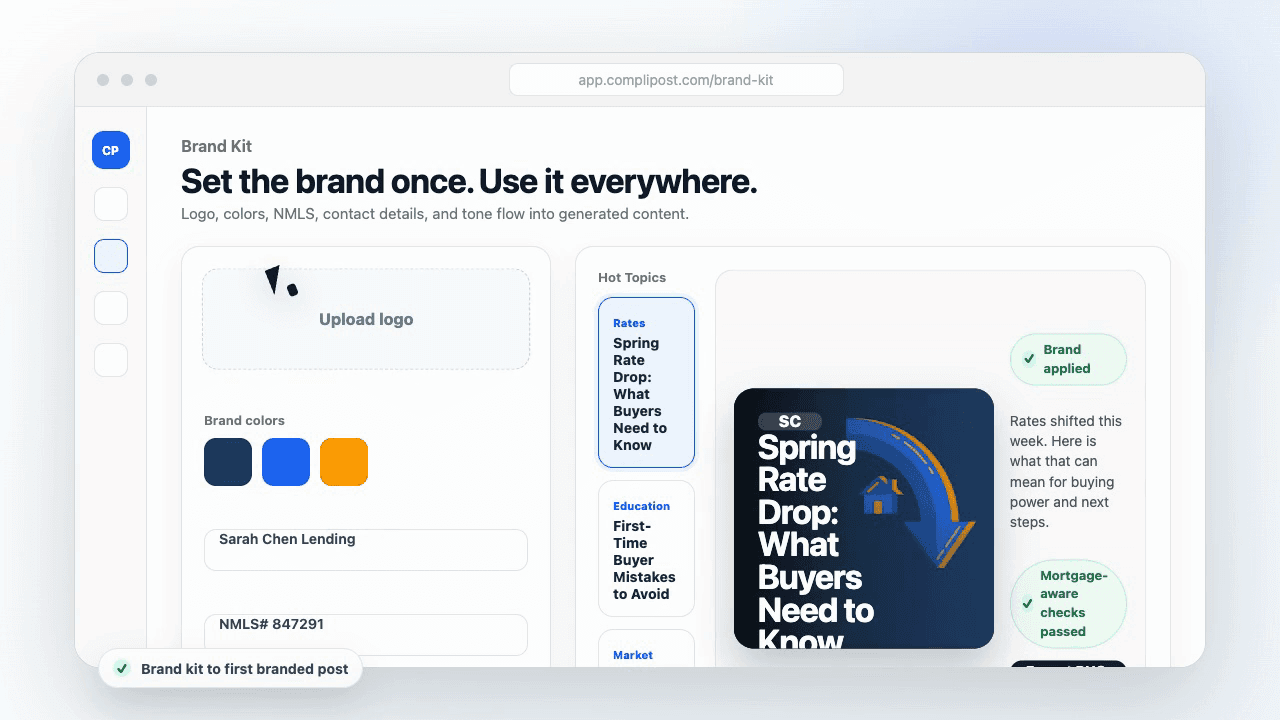
Product workflow
From blank page to export-ready mortgage content
- Start with a borrower topic
- Generate copy and a visual direction
- Review, save, and export the finished asset
These previews reflect the core CompliPost workflow: create, review, save, and export assets for use in your own channels.
Workflow comparison
| Content approach | What happens | Why it matters |
|---|---|---|
| Random posting | One-off ideas created when there is spare time | Inconsistent visibility and weak reuse |
| Template-only posting | Faster design but still requires rewriting and review | Helpful starting point, but not a full system |
| CompliPost workflow | Plan, generate, review, save, and export from one place | Better consistency with mortgage-aware review context |
| Done-for-you service | Someone else creates much of the content | Useful for some teams, but less control and less immediate reuse |
Who this guide helps
This guide is for loan officers working on solo loan officers who need a repeatable mortgage content workflow. The goal is to turn a broad mortgage topic into one borrower question, one useful takeaway, and one asset that can be reviewed before it is shared.
- You need content that sounds like a loan officer, not a generic brand account
- You want examples that can become captions, graphics, GIFs, or PDFs
- You need a clear place to review claims before export
- You want finished work saved for reuse, not lost in a chat thread
A practical workflow for this use case
Start with a narrow scenario, then move through planning, drafting, visual creation, review, and export. For down payment assistance eligibility requirements, that means the topic should be specific enough that a borrower or referral partner can immediately understand what decision the content helps with.
- Choose the borrower type, loan topic, or platform before generating copy
- Draft the caption and visual together so the asset feels cohesive
- Use the federal baseline review aid to flag claims and disclosure gaps
- Export the finished asset and save the post as a reusable starting point
What makes the content stronger
Strong mortgage content is usually specific, plain-spoken, and calm. It explains tradeoffs without pretending one answer fits every borrower. That is especially important on public social channels, where a short post can be interpreted without the full context of a loan conversation.
- Name the borrower question in the first line
- Explain one decision or tradeoff instead of covering everything
- Use examples without implying approval, savings, or rate outcomes
- End with a soft next step, checklist, or guide rather than pressure
Compliance-aware review notes
CompliPost should be treated as a review aid, not a compliance approval system. The public page, generated draft, graphic, and exported asset should all stay honest about that boundary.
- Review specific payment, APR, rate, savings, and qualification language
- Avoid “best,” “lowest,” “guaranteed,” “free,” and urgency claims unless approved
- Check NMLS, Equal Housing, company, and state-specific requirements
- Use company or legal review for anything outside the federal baseline
How this connects to the rest of CompliPost
A focused guide should leave you with a usable next step. After you understand the topic, you can turn it into a calendar slot, a reviewed social post, a downloadable guide, or a platform-specific version for the channel where your audience already spends time.
- Use the content calendar to turn the idea into a weekly plan
- Use the compliance page when claims or disclosures need a slower pass
- Use lead magnets when the topic deserves a deeper PDF guide
- Use platform pages to adapt the same idea for LinkedIn, Facebook, or Instagram
Recommended next steps
Down payment assistance hub
Create borrower education around down payment help.
Down Payment Help for First-Time Buyers
Explore programs specifically designed for borrowers buying their first home.
Down Payment Help: Common Myths and Misconceptions
Clear up misconceptions about who can and cannot qualify for assistance.
Down Payment Help: Questions to Ask Your Lender
Know what questions to ask so you understand your options.
Examples
FAQ
If I owned a home 5 years ago but sold it, am I still a first-time buyer?+
It depends on the program. Some programs define first-time buyer as no ownership in the past 3 years, which would make you ineligible. Others use a 5-year or 10-year lookback. A few programs don't have a first-time buyer requirement at all. You may qualify for some programs but not others. Always ask the program administrator directly about your specific situation; don't assume you're ineligible based on the name alone.
What if my household income is slightly above the program's limit?+
If you're just over the limit, explore other programs—there may be alternatives with higher income caps or different eligibility rules. Some programs also allow for calculation variations (such as excluding overtime income or counting only one spouse's income if you're filing separately). It's worth asking, but ultimately, if you exceed the income cap, that program won't assist you. Don't claim lower income than you earn; that's fraud.
Does my credit score have to be perfect to qualify for down payment help?+
No. While conventional loans often require a 740+ score, assistance programs typically accept scores in the 620–660 range. Some programs have no credit score minimum but may require a credit counseling course or may have waiting periods if you've had recent delinquencies or bankruptcy. Talk to the program administrator about your credit history; it may be less of a barrier than you think.
Can I use down payment assistance if I'm buying an investment property?+
Almost never. Down payment assistance programs are designed for primary residences because they target homeownership and community stability. Investment properties are excluded from nearly all programs. If you're a borrower planning to buy an investment property later, secure your primary residence first with available assistance, then explore investment financing separately.
Are there different rules if I have a co-borrower?+
Yes. Some programs require both borrowers to meet the first-time buyer definition; others require only one. Income limits may change—some count combined income, others count only the primary applicant. Credit requirements may apply to both or just the primary applicant. Always ask the program how co-borrowers affect eligibility; don't assume it's all-or-nothing.
Create mortgage content with a calmer workflow
CompliPost helps you plan, generate, review, save, and export useful mortgage content without pretending compliance or social distribution is automatic.
Start free