First-Time Buyers
Down Payment Assistance for First-Time Homebuyers: Your Roadmap
First-time buyers often face the biggest barrier to homeownership: saving enough for a down payment while managing rent, student loans, and living expenses. The good news is that down payment assistance programs prioritize first-time buyers with grants, low-rate loans, and favorable terms. These programs exist at federal, state, local, and nonprofit levels. Understanding what's available and how to access it is the key to homeownership for many first-time buyers.
Why first-time buyers are the focus of most programs
Governments and nonprofits want to increase homeownership because it builds community wealth and stability. First-time buyers are the target because they face the biggest financial hurdle: saving a down payment while building credit and income. Programs make homeownership possible for borrowers who wouldn't otherwise qualify or afford it. First-time buyer status can support access to grants, favorable loan terms, and sometimes rate discounts. This is a genuine policy effort to expand access to homeownership, not a sales gimmick.
- Federal, state, and local programs target first-time buyers explicitly
- Nonprofits focus on first-time buyers to increase community homeownership
- Down payment help makes homeownership possible when saving is difficult
- First-time buyer programs often stack: down payment grant + rate discount + reduced fees
Common types of first-time buyer assistance
First-time buyer programs vary, but common options include down payment grants (free money), second mortgages (low-rate loans), employer matching, and nonprofit grants. Some programs combine multiple benefits: a 3% down payment option plus a $10,000 grant plus a reduced interest rate. State and local programs are often more generous than federal programs because they target specific regions. The key is to know what's available in your state and county—assistance varies dramatically by location.
- Down payment grants: free money, no repayment
- Second mortgages: low-rate loans, often 0% for 5–7 years
- Employer programs: matching contributions or direct grants
- Nonprofit grants: often income-restricted to low/moderate income first-time buyers
How to find first-time buyer programs in your area
Start with HUD.gov and your state's housing authority—both maintain searchable databases of programs. Ask your lender: they work with first-time buyer programs daily and can point you to active options in your state. Employers often have programs; check your benefits guide or ask HR. Local nonprofits (community development organizations, housing authorities) often run programs specific to your city or county. Don't stop at the first program; check several to find the one with the best terms for your situation.
- HUD.gov: search for programs by state and zip code
- State housing authority: primary source for state programs and grants
- Your lender: knows which programs are current and easiest to access
- Employers: check benefits guide or ask HR about down payment help
- Local nonprofits: search 'housing assistance' + your city name
Key questions to ask before applying
Before investing time in an application, confirm: Do I meet the income limit for my county (not a national average)? Am I a first-time buyer by this program's definition? What's the timeline for approval? Are there geographic restrictions (only certain neighborhoods or counties)? How much assistance am I eligible for? Do I have to repay anything? Can I combine this with other assistance? Is there a processing fee or upfront cost? A few quick questions now prevent wasted effort and manage expectations.
- Income limit: confirm your household income against the specific county/city limit
- First-time buyer definition: check if you qualify (typically no ownership in past 2–3 years)
- Timeline: ask how long approval takes so you can plan your closing date
- Amount available: know what maximum assistance is offered
- Repayment: understand whether it's a grant (free) or a loan (must repay)
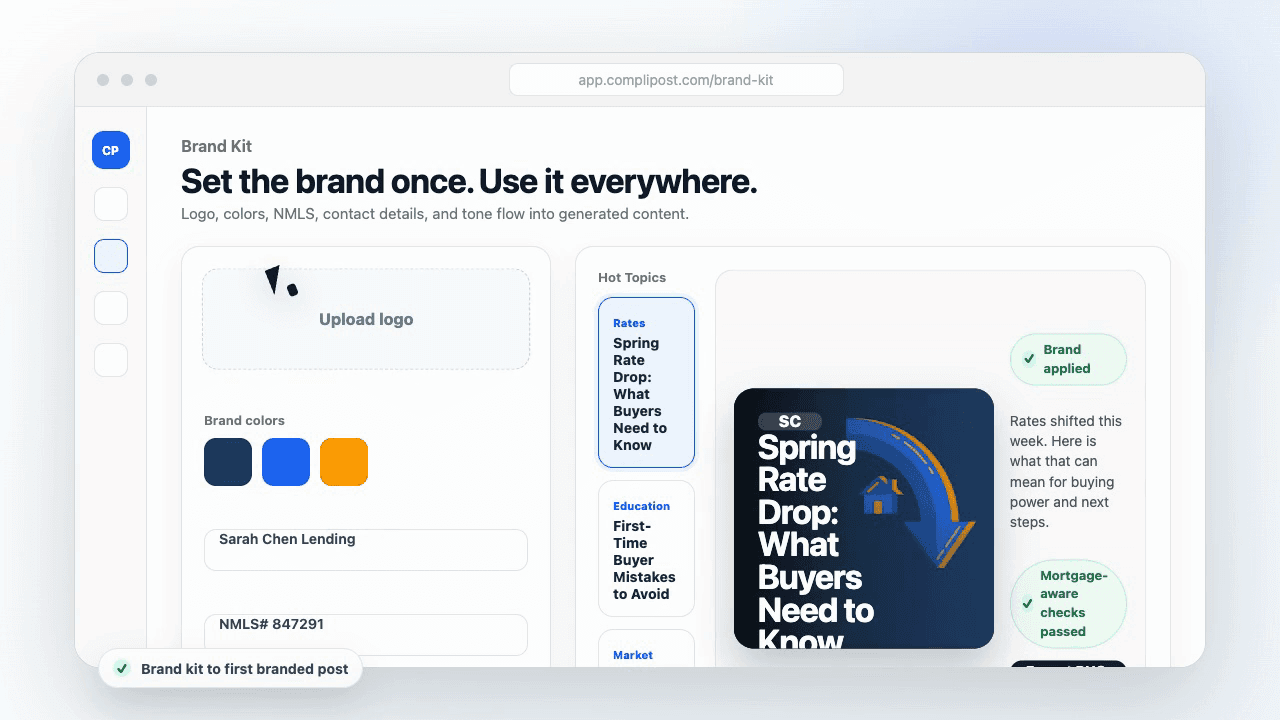
Product workflow
From blank page to export-ready mortgage content
- Start with a borrower topic
- Generate copy and a visual direction
- Review, save, and export the finished asset
These previews reflect the core CompliPost workflow: create, review, save, and export assets for use in your own channels.
Workflow comparison
| Content approach | What happens | Why it matters |
|---|---|---|
| Random posting | One-off ideas created when there is spare time | Inconsistent visibility and weak reuse |
| Template-only posting | Faster design but still requires rewriting and review | Helpful starting point, but not a full system |
| CompliPost workflow | Plan, generate, review, save, and export from one place | Better consistency with mortgage-aware review context |
| Done-for-you service | Someone else creates much of the content | Useful for some teams, but less control and less immediate reuse |
Who this guide helps
This guide is for loan officers working on first-time buyers who need simple next steps. The goal is to turn a broad mortgage topic into one borrower question, one useful takeaway, and one asset that can be reviewed before it is shared.
- You need content that sounds like a loan officer, not a generic brand account
- You want examples that can become captions, graphics, GIFs, or PDFs
- You need a clear place to review claims before export
- You want finished work saved for reuse, not lost in a chat thread
A practical workflow for this use case
Start with a narrow scenario, then move through planning, drafting, visual creation, review, and export. For down payment assistance first-time buyers, that means the topic should be specific enough that a borrower or referral partner can immediately understand what decision the content helps with.
- Choose the borrower type, loan topic, or platform before generating copy
- Draft the caption and visual together so the asset feels cohesive
- Use the federal baseline review aid to flag claims and disclosure gaps
- Export the finished asset and save the post as a reusable starting point
What makes the content stronger
Strong mortgage content is usually specific, plain-spoken, and calm. It explains tradeoffs without pretending one answer fits every borrower. That is especially important on public social channels, where a short post can be interpreted without the full context of a loan conversation.
- Name the borrower question in the first line
- Explain one decision or tradeoff instead of covering everything
- Use examples without implying approval, savings, or rate outcomes
- End with a soft next step, checklist, or guide rather than pressure
Compliance-aware review notes
CompliPost should be treated as a review aid, not a compliance approval system. The public page, generated draft, graphic, and exported asset should all stay honest about that boundary.
- Review specific payment, APR, rate, savings, and qualification language
- Avoid “best,” “lowest,” “guaranteed,” “free,” and urgency claims unless approved
- Check NMLS, Equal Housing, company, and state-specific requirements
- Use company or legal review for anything outside the federal baseline
How this connects to the rest of CompliPost
A focused guide should leave you with a usable next step. After you understand the topic, you can turn it into a calendar slot, a reviewed social post, a downloadable guide, or a platform-specific version for the channel where your audience already spends time.
- Use the content calendar to turn the idea into a weekly plan
- Use the compliance page when claims or disclosures need a slower pass
- Use lead magnets when the topic deserves a deeper PDF guide
- Use platform pages to adapt the same idea for LinkedIn, Facebook, or Instagram
Recommended next steps
First-time buyer content hub
Build clear education for first-time buyers.
Down Payment Help Types: Grants, Loans, and Gifts Explained
Understand all the major types of down payment assistance available.
Down Payment Help: Eligibility Basics
Learn income, credit, and first-time buyer requirements.
Down Payment Help: Questions to Ask Your Lender
Know what to ask so you get the right information about programs available.
Examples
FAQ
What's the difference between a first-time buyer program and regular down payment assistance?+
Most down payment assistance IS first-time buyer programs. Programs use 'first-time buyer' and 'down payment assistance' interchangeably. The key is that the program targets borrowers buying their first home (or within a specific timeframe after owning). Some programs serve repeat buyers or other groups, but most prioritize first-time buyers. Ask the program what populations it serves; if you fit the definition, apply.
If I don't qualify for the maximum down payment grant, can I still use the program?+
No. Programs award a specific amount or nothing. If you don't meet income limits or other requirements, you're ineligible. However, this doesn't mean you have no options. Other programs may have higher income limits or different requirements. Also, you can combine partial help from one program with a gift, second mortgage, or other source. The key is exploring all available programs, not assuming the first rejection means no help exists.
How much can a first-time buyer typically receive?+
Amounts vary widely: $2,000 to $50,000 depending on the program and location. Federal programs typically offer smaller amounts (often capped at $15,000–$25,000). State and local programs can be more generous. Nonprofit programs range from modest ($2,000–$5,000) to substantial ($25,000+). Ask the program what the maximum award is, then plan your down payment and closing costs accordingly.
Do I have to be employed to qualify for first-time buyer assistance?+
Most programs require stable income, which typically means employment, self-employment, Social Security, or other documented income sources. Unemployment alone usually doesn't qualify, but income from unemployment benefits, disability, or retirement does in many programs. Ask the specific program about income verification requirements. Some programs are flexible about income sources; others require traditional W-2 employment.
Can I combine a first-time buyer grant with a low down payment loan option?+
Often yes, but check the program rules. For example, you might use a $10,000 grant plus an FHA loan with 3.5% down, reducing your total out-of-pocket costs. Some programs allow combinations; others don't. Lenders will need to approve both simultaneously. Always ask the program and your lender before assuming you can layer multiple benefits.
Create mortgage content with a calmer workflow
CompliPost helps you plan, generate, review, save, and export useful mortgage content without pretending compliance or social distribution is automatic.
Start free