Myths
Down Payment Assistance Myths: Separating Fact from Fiction
Misconceptions about down payment help are rampant. Borrowers often believe they don't qualify when they do, or they think assistance is a scam. Some myths make borrowers overly cautious; others set false expectations. As a loan officer, you're in the best position to educate borrowers and clear away confusion. This guide covers the most common myths and the facts behind them.
Myth: Down payment help is a scam.
Reality: Legitimate down payment assistance programs exist and are funded by nonprofits, government agencies, and housing authorities. However, scams do exist—usually in the form of upfront fees or guarantees of approval. Legitimate programs don't charge fees upfront, don't promise approval, and don't pressure you to apply. Red flags include aggressive salespeople, promises of approval without verification, or requests for payment before assistance is disbursed. Teach borrowers to research programs through official government websites and your lender, not through random internet ads.
- Legitimate programs: nonprofits, state agencies, housing authorities, employer programs
- Red flags: upfront fees, approval promises, high-pressure sales, email-only communication
- Check programs through HUD.gov, your state housing agency, or your lender's resources
- If it sounds too good to be true, it probably is—verify before you trust it
Myth: If you earn too much, you can't get any help.
Reality: Income limits vary widely. Some programs serve low-income borrowers only (under 50% or 80% of area median income), but others serve borrowers earning up to 120% of AMI or have no income limit. A borrower earning $75,000 in a rural area might exceed one program's limit but qualify easily for another. The solution is to check multiple programs, not assume that one rejection means you're ineligible for all assistance.
- Income limits range from 50% AMI to 120% AMI or higher
- Rural areas often have lower absolute income limits but higher AMI thresholds
- Multiple programs exist in most markets; if one rejects you, others may accept you
- Always check the specific program's limit for your county or city, not national averages
Myth: Down payment grants must be repaid.
Reality: The whole point of a grant is that it's free money—no repayment required. If someone is telling you a 'grant' must be repaid, it's not a grant, it's a loan (possibly a second mortgage or employer loan). Grants are gifts; they forgive the down payment amount entirely. This is a critical distinction because it affects the borrower's debt-to-income ratio and monthly budget. If the assistance requires repayment, it's a loan, not a grant.
- Grants = free money, no repayment
- Loans = must be repaid with interest
- If repayment is required, it's not a grant—it's a loan or second mortgage
- Don't confuse the terms; they have very different financial impacts
Myth: Only first-time buyers can get down payment help.
Reality: While many programs target first-time buyers, some don't. Repeat homebuyers (who haven't owned in the past 3–5 years), investors in certain programs, and borrowers of underrepresented backgrounds may qualify for assistance even if they've owned before. Additionally, some state and local programs prioritize other categories (teachers, public servants, low-income families) over first-time buyer status. Always check the specific program; you might be eligible even if you're not a first-time buyer.
- Many programs serve first-time buyers, but not all
- Some programs prioritize underrepresented groups, low income, or occupations
- Repeat homebuyers can qualify if they haven't owned in 3–5 years (program-dependent)
- Check multiple programs; you're likely eligible for at least one
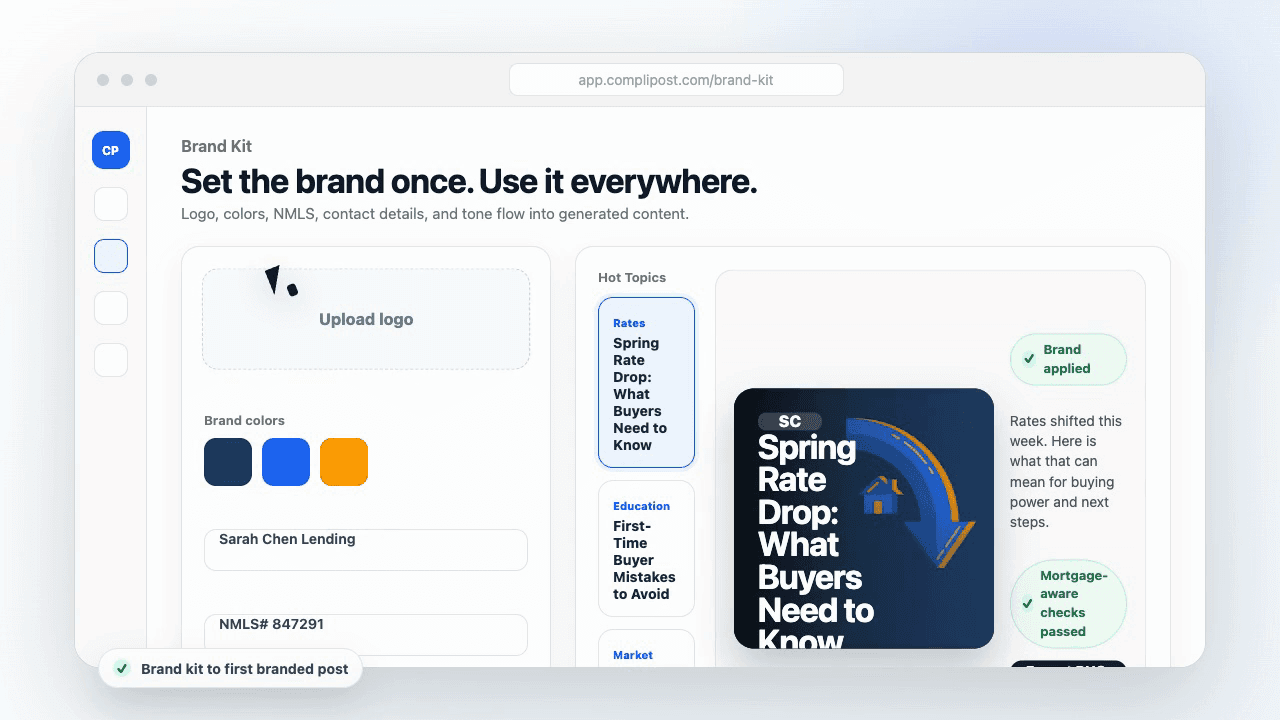
Product workflow
From blank page to export-ready mortgage content
- Start with a borrower topic
- Generate copy and a visual direction
- Review, save, and export the finished asset
These previews reflect the core CompliPost workflow: create, review, save, and export assets for use in your own channels.
Workflow comparison
| Content approach | What happens | Why it matters |
|---|---|---|
| Random posting | One-off ideas created when there is spare time | Inconsistent visibility and weak reuse |
| Template-only posting | Faster design but still requires rewriting and review | Helpful starting point, but not a full system |
| CompliPost workflow | Plan, generate, review, save, and export from one place | Better consistency with mortgage-aware review context |
| Done-for-you service | Someone else creates much of the content | Useful for some teams, but less control and less immediate reuse |
Who this guide helps
This guide is for loan officers working on solo loan officers who need a repeatable mortgage content workflow. The goal is to turn a broad mortgage topic into one borrower question, one useful takeaway, and one asset that can be reviewed before it is shared.
- You need content that sounds like a loan officer, not a generic brand account
- You want examples that can become captions, graphics, GIFs, or PDFs
- You need a clear place to review claims before export
- You want finished work saved for reuse, not lost in a chat thread
A practical workflow for this use case
Start with a narrow scenario, then move through planning, drafting, visual creation, review, and export. For down payment assistance myths, that means the topic should be specific enough that a borrower or referral partner can immediately understand what decision the content helps with.
- Choose the borrower type, loan topic, or platform before generating copy
- Draft the caption and visual together so the asset feels cohesive
- Use the federal baseline review aid to flag claims and disclosure gaps
- Export the finished asset and save the post as a reusable starting point
What makes the content stronger
Strong mortgage content is usually specific, plain-spoken, and calm. It explains tradeoffs without pretending one answer fits every borrower. That is especially important on public social channels, where a short post can be interpreted without the full context of a loan conversation.
- Name the borrower question in the first line
- Explain one decision or tradeoff instead of covering everything
- Use examples without implying approval, savings, or rate outcomes
- End with a soft next step, checklist, or guide rather than pressure
Compliance-aware review notes
CompliPost should be treated as a review aid, not a compliance approval system. The public page, generated draft, graphic, and exported asset should all stay honest about that boundary.
- Review specific payment, APR, rate, savings, and qualification language
- Avoid “best,” “lowest,” “guaranteed,” “free,” and urgency claims unless approved
- Check NMLS, Equal Housing, company, and state-specific requirements
- Use company or legal review for anything outside the federal baseline
How this connects to the rest of CompliPost
A focused guide should leave you with a usable next step. After you understand the topic, you can turn it into a calendar slot, a reviewed social post, a downloadable guide, or a platform-specific version for the channel where your audience already spends time.
- Use the content calendar to turn the idea into a weekly plan
- Use the compliance page when claims or disclosures need a slower pass
- Use lead magnets when the topic deserves a deeper PDF guide
- Use platform pages to adapt the same idea for LinkedIn, Facebook, or Instagram
Recommended next steps
Down payment assistance hub
Create borrower education around down payment help.
Down Payment Help: Eligibility Basics
Understand income limits, credit requirements, and who qualifies for assistance.
Down Payment Help Types: Grants, Loans, and Gifts Explained
Learn the categories of down payment assistance and how they differ.
Down Payment Help: Questions to Ask Your Lender
Know what to ask so you get straight answers about your options.
Examples
FAQ
How do I know if a down payment assistance program is legitimate?+
Legitimate programs are backed by nonprofits, government agencies, HUD, state housing agencies, or employers. They don't charge upfront fees, don't promise approval, and provide clear documentation. Check programs on HUD.gov, your state housing authority website, or ask your lender for referrals. Be suspicious of unsolicited emails, aggressive salespeople, and anyone who guarantees approval without reviewing your finances. If you're unsure, ask your lender—they work with legitimate programs regularly.
Can I use multiple programs at once?+
Sometimes. Some borrowers stack a grant from one program with a second mortgage from another, or combine an employer grant with a state grant. However, some programs exclude borrowers using other assistance. Always disclose all assistance sources to your lender and ask whether the combination is allowed. Hiding assistance sources violates lending rules and can void the loan, so transparency is essential.
What if a program denies me—does that mean I should give up?+
No. One denial doesn't mean you're ineligible for all programs. Programs have different criteria, income thresholds, and eligibility rules. If one rejects you, ask why and then explore other programs that may have different requirements. A borrower might not qualify for a state grant but could qualify for a local nonprofit program or an employer program. Keep asking until you've exhausted all available options.
Do down payment assistance programs always take a long time to approve?+
Processing times vary. Employer programs might approve in days; government grants might take weeks or months. Nonprofit programs fall somewhere in between. Timeline matters because your mortgage closing date is fixed. If a grant program takes 90 days to process and you're closing in 45 days, you'll need a backup plan (like a second mortgage) to close on time. Ask about timelines when applying and plan accordingly.
Is there a difference between down payment assistance and a first-time buyer program?+
Not really—they're often the same thing. Most down payment assistance is marketed toward first-time buyers, though some programs serve repeat buyers. The term 'first-time buyer program' usually means a program offering various benefits (lower rates, smaller down payment, assistance funding) to borrowers buying their first home. Ask what the program includes: down payment assistance, rate discounts, or both. Some offer all three.
Create mortgage content with a calmer workflow
CompliPost helps you plan, generate, review, save, and export useful mortgage content without pretending compliance or social distribution is automatic.
Start free