Self-Employed
Down Payment Help for Self-Employed Borrowers: Proving Income and Qualifying
Self-employed borrowers face extra scrutiny when applying for mortgages and down payment assistance. Lenders want proof of stable, consistent business income, usually requiring 2+ years of tax returns. Once income is documented, self-employed borrowers access the same assistance as W-2 employees. This guide helps loan officers guide self-employed borrowers through the documentation process and down payment assistance options.
Income documentation for self-employed borrowers
Lenders require 2+ years of personal tax returns and 2+ years of business tax returns (or bank statements) to verify self-employed income. They calculate average income over the period and use a percentage (often 80–90%) of that average for qualification. This is more rigorous than W-2 verification because income variability is higher. Borrowers who show consistent or growing income over 2 years are most likely to qualify. Borrowers with declining income or inconsistent income face challenges. Document your business finances carefully to support your down payment assistance application.
- Typically require: 2 years of personal and business tax returns
- Alternative: 2 years of business bank statements if returns aren't recent
- Lenders average income over the period and apply 80–90% for qualification
- Consistent or growing income = stronger qualification
- Declining income may reduce qualification and assistance eligibility
Which down payment programs work for self-employed borrowers?
Grants and most down payment assistance programs work for self-employed borrowers if income is documented. Some programs prefer W-2 employees but will accept self-employed with proper documentation. State and local programs are often more flexible than federal programs; ask your state housing authority which programs accept self-employed applicants. Nonprofit programs frequently serve self-employed borrowers. Your lender is key: ask directly which programs they have experience with for self-employed borrowers.
- Grants: accept self-employed borrowers if income is documented
- Second mortgages: accept self-employed if income is verified
- State/local programs: often more flexible than federal
- Nonprofit programs: frequently serve self-employed borrowers
- Ask lender: which programs have you approved for self-employed borrowers?
Income stability and qualification challenges
Lenders want to see 2+ years of stable income because the 2-year history demonstrates that your business is viable. Business owners with less than 2 years are generally ineligible. If your income has declined over the 2-year period, lenders may qualify you at a lower amount. If your income is seasonal or highly variable, document the full-year income to show the average. Being transparent about income variability and demonstrating that it's normal for your business helps. Self-employed borrowers should prepare detailed financial documentation that tells a story of stable, sustainable business income.
- 2+ years business history required for most programs
- Less than 2 years = ineligible for most down payment assistance
- Declining income = lower qualification amount
- Seasonal income: document full-year average, not seasonal low point
- Prepare narrative: explain any variability and demonstrate stability
Strategic timing and documentation prep
If you've recently become self-employed, wait 2 years before applying for down payment assistance. Use that time to build business revenue and complete 2 full years of tax returns. If you've been self-employed 2+ years but income has been variable, wait for a year of stronger income before applying—recent strong income improves qualification. Prepare your documentation now: organize tax returns, business bank statements, profit and loss statements, and balance sheets. The more organized your documentation, the faster lenders process your application.
- Recently self-employed? Wait 2 years before applying for assistance
- Variable income? Wait for a strong income year to improve qualification
- Prepare documentation in advance: returns, P&L, bank statements, balance sheet
- Work with a CPA or bookkeeper to organize finances clearly
- Timing matters: apply when your income story is strongest
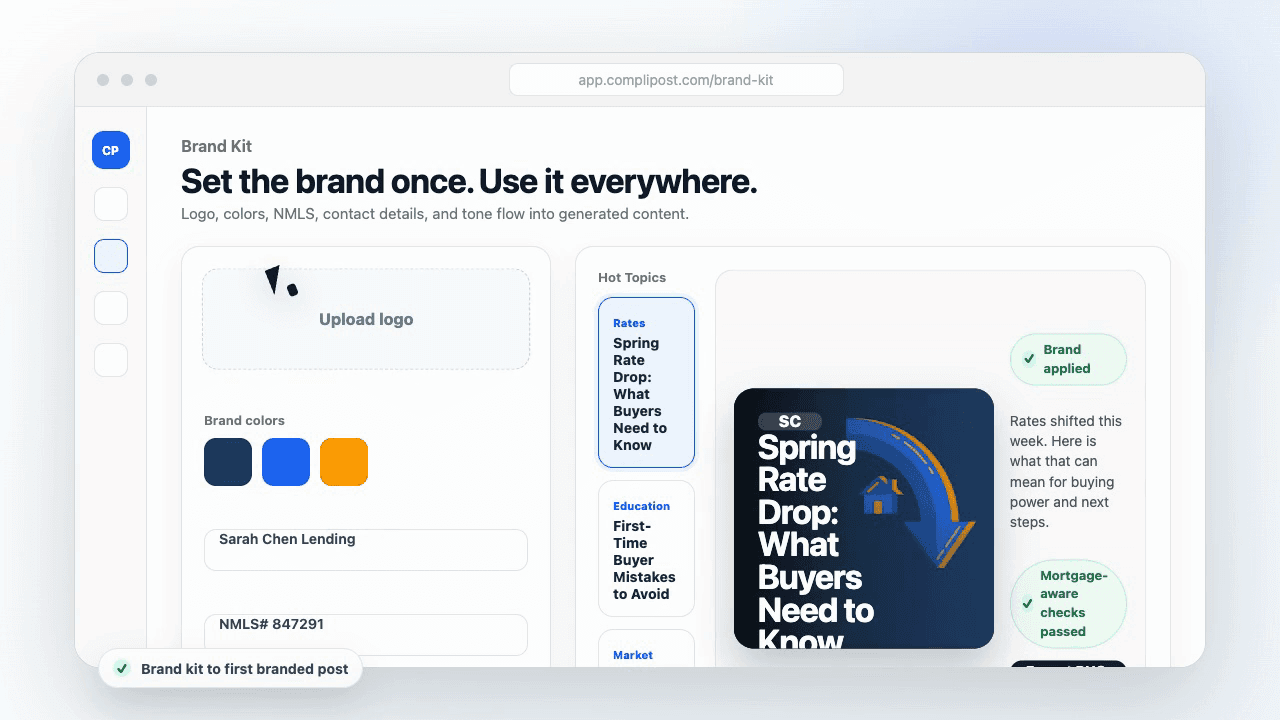
Product workflow
From blank page to export-ready mortgage content
- Start with a borrower topic
- Generate copy and a visual direction
- Review, save, and export the finished asset
These previews reflect the core CompliPost workflow: create, review, save, and export assets for use in your own channels.
Workflow comparison
| Content approach | What happens | Why it matters |
|---|---|---|
| Random posting | One-off ideas created when there is spare time | Inconsistent visibility and weak reuse |
| Template-only posting | Faster design but still requires rewriting and review | Helpful starting point, but not a full system |
| CompliPost workflow | Plan, generate, review, save, and export from one place | Better consistency with mortgage-aware review context |
| Done-for-you service | Someone else creates much of the content | Useful for some teams, but less control and less immediate reuse |
Who this guide helps
This guide is for loan officers working on solo loan officers who need a repeatable mortgage content workflow. The goal is to turn a broad mortgage topic into one borrower question, one useful takeaway, and one asset that can be reviewed before it is shared.
- You need content that sounds like a loan officer, not a generic brand account
- You want examples that can become captions, graphics, GIFs, or PDFs
- You need a clear place to review claims before export
- You want finished work saved for reuse, not lost in a chat thread
A practical workflow for this use case
Start with a narrow scenario, then move through planning, drafting, visual creation, review, and export. For down payment assistance self-employed borrowers, that means the topic should be specific enough that a borrower or referral partner can immediately understand what decision the content helps with.
- Choose the borrower type, loan topic, or platform before generating copy
- Draft the caption and visual together so the asset feels cohesive
- Use the federal baseline review aid to flag claims and disclosure gaps
- Export the finished asset and save the post as a reusable starting point
What makes the content stronger
Strong mortgage content is usually specific, plain-spoken, and calm. It explains tradeoffs without pretending one answer fits every borrower. That is especially important on public social channels, where a short post can be interpreted without the full context of a loan conversation.
- Name the borrower question in the first line
- Explain one decision or tradeoff instead of covering everything
- Use examples without implying approval, savings, or rate outcomes
- End with a soft next step, checklist, or guide rather than pressure
Compliance-aware review notes
CompliPost should be treated as a review aid, not a compliance approval system. The public page, generated draft, graphic, and exported asset should all stay honest about that boundary.
- Review specific payment, APR, rate, savings, and qualification language
- Avoid “best,” “lowest,” “guaranteed,” “free,” and urgency claims unless approved
- Check NMLS, Equal Housing, company, and state-specific requirements
- Use company or legal review for anything outside the federal baseline
How this connects to the rest of CompliPost
A focused guide should leave you with a usable next step. After you understand the topic, you can turn it into a calendar slot, a reviewed social post, a downloadable guide, or a platform-specific version for the channel where your audience already spends time.
- Use the content calendar to turn the idea into a weekly plan
- Use the compliance page when claims or disclosures need a slower pass
- Use lead magnets when the topic deserves a deeper PDF guide
- Use platform pages to adapt the same idea for LinkedIn, Facebook, or Instagram
Recommended next steps
Self-employed borrower hub
Create income-documentation education for self-employed borrowers.
Down Payment Help: Eligibility Basics
Understand income requirements and how they're verified.
Down Payment Help for First-Time Buyers
Explore programs available to first-time buyers (including self-employed).
Down Payment Help: Questions to Ask Your Lender
Ask your lender about programs that work well for self-employed borrowers.
Examples
FAQ
Can I get down payment assistance if I've been self-employed for only 1 year?+
No. Most programs require 2+ years of documented self-employment income (via tax returns or business bank statements). If you're near the 2-year mark, wait a few more months to complete your second full year. Then apply with both years of documentation.
What if my self-employed income fluctuates from year to year?+
Lenders will use your average income over 2+ years for qualification. If you earned $50,000 year 1 and $60,000 year 2, lenders might use $55,000 average (or apply a percentage like 80%). If your income is declining, they use the lower figure for qualification. If your income is growing, show that growth—it strengthens your application. Be transparent about income variability and explain what's normal for your industry.
Do I need to file business tax returns, or are personal returns enough?+
Most lenders want both: your personal tax return (1040) and your business returns (Schedule C, partnership returns, corporate returns depending on business structure). If you recently filed and business returns aren't ready, business bank statements for the full 2-year period are often acceptable as an alternative. Ask your lender which documents they need most.
If my business just had a strong year, does that help my qualification?+
Yes, somewhat. Most lenders use a 2-year average, so one strong year improves the average. However, they typically don't count the most recent year fully if it's unusual. Wait to file that strong year's tax return, then apply. The most recent tax return has the most impact on qualification, so timing your application with a strong fiscal year helps.
Are some down payment programs easier for self-employed borrowers?+
Yes. Some state and local programs and nonprofits are more flexible with self-employed applicants. Federal programs tend to be more rigid. Ask your lender which programs in your area have experience with self-employed borrowers. They often have relationships with programs that understand self-employed income documentation and are faster at approval.
Create mortgage content with a calmer workflow
CompliPost helps you plan, generate, review, save, and export useful mortgage content without pretending compliance or social distribution is automatic.
Start free