Legal Professional
Mortgage Content for Attorneys with K-1 Partnership Income
K-1 income—partnership distributions and guaranteed payments—looks different to mortgage lenders than W-2 employment. Your content for this segment should explain that K-1 income is absolutely legitimate, while also addressing the volatility and documentation requirements that come with it. Position yourself as the lender who understands partnership structures and knows how to present K-1 income most favorably.
How do lenders evaluate K-1 income from partnerships?
K-1 income requires tax return documentation and historical analysis. Lenders want to see consistency or growth; they're wary of sharp declines. Social content should demystify the process and show that K-1 borrowers can qualify if they understand the documentation path.
- Two-year average: most lenders average K-1 income over two years unless year one is stronger
- Documentation: K-1 forms, partnership agreement, possibly Schedule K (Form 1065)
- Guaranteed payments vs. distributions: guaranteed income is more stable; distributions can fluctuate
- Draws and retentions: some partnerships retain earnings; lenders typically use the K-1 income reported, not retained earnings
- Business profitability matters: lenders want to see the partnership is profitable and stable
What strategies improve K-1 income qualification?
K-1 borrowers benefit from clear documentation and strategic presentation. Content should offer practical guidance on how to strengthen the application and what documentation makes the biggest difference.
- Bring your partnership agreement: shows your profit-sharing percentage and role in the firm
- Provide a letter from the partnership CPA: confirms income, stability, and your profit-sharing percentage
- Document the two-year trend: if income is growing, show it; if it's declining, be prepared to explain
- Show business bank statements: demonstrate that partnership distributions are real cash flowing to you
- Highlight your seniority: newer partners carry more uncertainty; established partners with longer track records are viewed more favorably
What messaging helps K-1 borrowers feel confident in the mortgage process?
K-1 borrowers often feel less confident than W-2 employees, even though their income is legitimate. Content should normalize K-1 income and show that you understand the documentation and timing challenges specific to partnership structures.
- Share stories of K-1 borrowers who qualified easily with the right documentation
- Explain the difference between K-1 income and self-employment; position it as corporate income (more stable)
- Address the myth that variable income disqualifies you; reframe it as different documentation
- Offer a consultation specifically for K-1 borrowers; highlight your experience with partnership structures
- Create content comparing K-1 income to W-2 income; show that both can support strong mortgages
How do you help K-1 borrowers prepare for underwriting?
Preparation is the difference between smooth underwriting and requests for additional documentation. Export content that guides K-1 borrowers through the preparation process and positions you as the expert who removes friction.
- Create a K-1 documentation checklist: forms, partnership agreement, CPA letter, tax returns
- Develop a pre-application consultation framework: ask about draws, distributions, guaranteed payments, and firm stability
- Build email sequences that walk K-1 borrowers through the underwriting timeline
- Offer to communicate directly with the partnership or the firm's CPA; reduce back-and-forth for the borrower
- Create a guide: K-1 income qualification for different partnership types (law firms, investment partnerships, etc.)
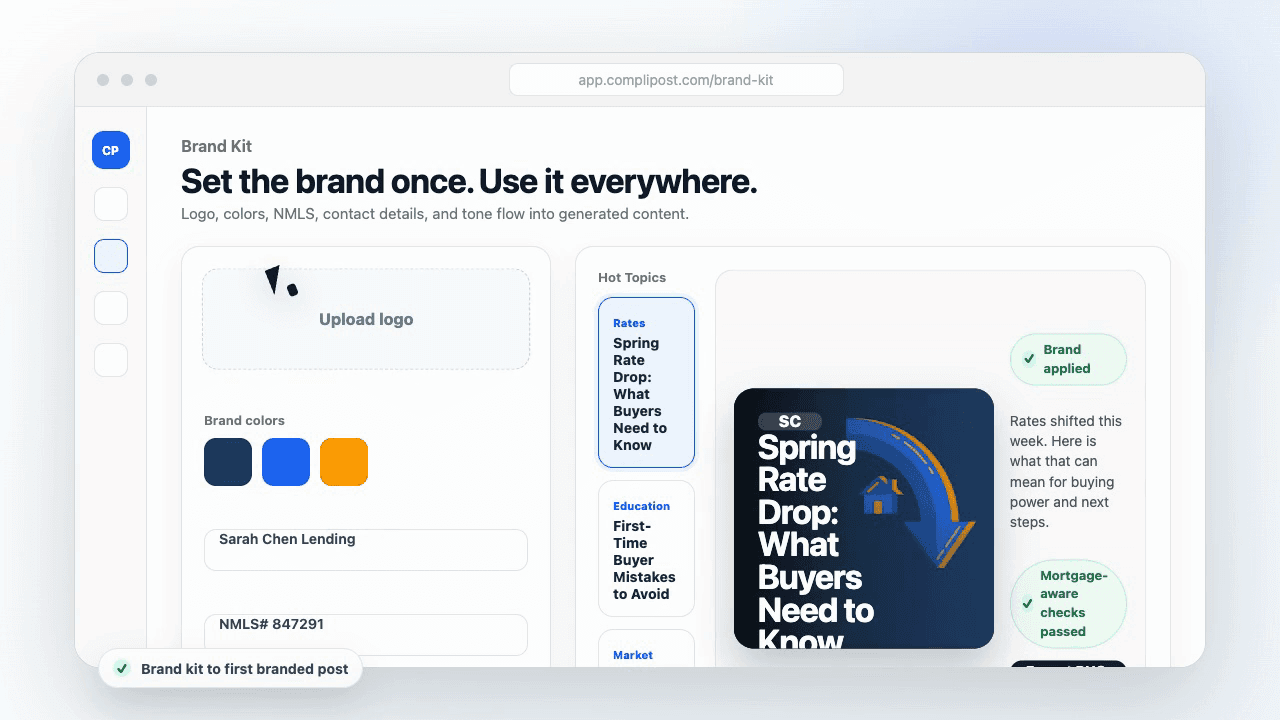
Product workflow
From blank page to export-ready mortgage content
- Start with a borrower topic
- Generate copy and a visual direction
- Review, save, and export the finished asset
These previews reflect the core CompliPost workflow: create, review, save, and export assets for use in your own channels.
Workflow comparison
| Content approach | What happens | Why it matters |
|---|---|---|
| Random posting | One-off ideas created when there is spare time | Inconsistent visibility and weak reuse |
| Template-only posting | Faster design but still requires rewriting and review | Helpful starting point, but not a full system |
| CompliPost workflow | Plan, generate, review, save, and export from one place | Better consistency with mortgage-aware review context |
| Done-for-you service | Someone else creates much of the content | Useful for some teams, but less control and less immediate reuse |
Who this guide helps
This guide is for loan officers working on solo loan officers who need a repeatable mortgage content workflow. The goal is to turn a broad mortgage topic into one borrower question, one useful takeaway, and one asset that can be reviewed before it is shared.
- You need content that sounds like a loan officer, not a generic brand account
- You want examples that can become captions, graphics, GIFs, or PDFs
- You need a clear place to review claims before export
- You want finished work saved for reuse, not lost in a chat thread
A practical workflow for this use case
Start with a narrow scenario, then move through planning, drafting, visual creation, review, and export. For K-1 partnership income attorney mortgage content, that means the topic should be specific enough that a borrower or referral partner can immediately understand what decision the content helps with.
- Choose the borrower type, loan topic, or platform before generating copy
- Draft the caption and visual together so the asset feels cohesive
- Use the federal baseline review aid to flag claims and disclosure gaps
- Export the finished asset and save the post as a reusable starting point
What makes the content stronger
Strong mortgage content is usually specific, plain-spoken, and calm. It explains tradeoffs without pretending one answer fits every borrower. That is especially important on public social channels, where a short post can be interpreted without the full context of a loan conversation.
- Name the borrower question in the first line
- Explain one decision or tradeoff instead of covering everything
- Use examples without implying approval, savings, or rate outcomes
- End with a soft next step, checklist, or guide rather than pressure
Compliance-aware review notes
CompliPost should be treated as a review aid, not a compliance approval system. The public page, generated draft, graphic, and exported asset should all stay honest about that boundary.
- Review specific payment, APR, rate, savings, and qualification language
- Avoid “best,” “lowest,” “guaranteed,” “free,” and urgency claims unless approved
- Check NMLS, Equal Housing, company, and state-specific requirements
- Use company or legal review for anything outside the federal baseline
How this connects to the rest of CompliPost
A focused guide should leave you with a usable next step. After you understand the topic, you can turn it into a calendar slot, a reviewed social post, a downloadable guide, or a platform-specific version for the channel where your audience already spends time.
- Use the content calendar to turn the idea into a weekly plan
- Use the compliance page when claims or disclosures need a slower pass
- Use lead magnets when the topic deserves a deeper PDF guide
- Use platform pages to adapt the same idea for LinkedIn, Facebook, or Instagram
Recommended next steps
Self-employed borrower hub
Create income-documentation education for self-employed borrowers.
Attorney Mortgage Guide
Comprehensive guide for attorney borrowers including partnership income strategies.
Income Documentation and Qualification Requirements
Detailed breakdown of documentation required for different income types.
Debt-to-Income Ratio Calculation and Qualification
In-depth guide to DTI math and income evaluation for mortgage qualification.
Examples
"Partner, K-1 income from two partnerships, approved in 3 weeks. Here's what made it fast."
Share as a case study on LinkedIn; detail the documentation and the approval timeline.
"K-1 income—it's not self-employment. Here's why lenders treat it differently (and more favorably)."
Educational post explaining the difference between K-1 and Schedule C income.
"Partnership income is stable—when you document it right. Here's the checklist."
Share as a downloadable checklist or email guide specific to K-1 borrowers.
"Two partnerships, different profit margins. Here's how lenders evaluate multiple K-1 incomes."
Write as a detailed breakdown for borrowers with income from multiple partnerships.
FAQ
How does K-1 income from a law partnership differ from self-employment income on a Schedule C?+
K-1 income is corporate income from a partnership or S-corporation. Schedule C income is self-employment income from a sole proprietorship or single-member LLC. Lenders generally view K-1 income as more stable because it's from a larger entity with multiple partners sharing profits; there's institutional continuity beyond just you. Self-employment income looks more vulnerable to personal circumstances. Both are financeable, but K-1 borrowers often have an easier time qualifying if the partnership is stable. You'll still need two years of K-1 forms and tax returns, but the process is often smoother than for Schedule C borrowers because the income source isn't dependent solely on your effort.
What if my K-1 income declined in the most recent year?+
Lenders will ask why. A decline signals either reduced profitability in the partnership or a change in your profit-sharing percentage. If the decline is firm-wide (the partnership had a down year), lenders understand—recessions and market cycles affect all firms. If the decline is personal (your percentage was reduced, or you're taking a smaller draw), be prepared to explain. A CPA letter explaining the reason for the decline is helpful. Lenders typically average the two years, so if year one was $150K and year two was $120K, your income-qualifying amount is roughly $135K. If year two shows recovery, you can highlight the trend positively.
Should I increase my K-1 distribution right before applying for a mortgage?+
No—avoid this. Lenders want to see sustainable, historical income. A sudden spike in distribution looks manufactured and raises red flags. Stick with your normal draws and distributions; that's what lenders evaluate. If you're planning a major increase in draws, do it well before you apply (ideally showing a full year of the new amount on your tax return). Lenders are looking for consistent, reliable income, not one-time boosts. If you've recently increased your draws or changed your profit-sharing percentage as part of a normal firm evolution, document that as part of your partnership agreement and explain it to your loan officer.
What documentation should the law firm or partnership provide?+
Ideally, a letter from the partnership or its CPA confirming: (1) your role and title, (2) your profit-sharing percentage or guaranteed payment amount, (3) the firm's stability and profitability, and (4) confirmation of the K-1 income shown on your tax returns. If the partnership's CPA prepared your tax returns, they can provide this letter easily—it's a standard request. Some lenders will want to speak with the firm's accountant directly. Having the partnership's CPA on speed dial to answer underwriting questions accelerates the process. The better documented your K-1 income, the smoother underwriting goes.
Can I combine K-1 income with other income sources to qualify for a larger mortgage?+
Yes. If you have K-1 income from a law partnership and also receive a salary from in-house counsel work, or have rental income, or consulting fees with two years of documentation, all of it can be combined for qualification. Each income source needs appropriate documentation (K-1 plus tax returns for partnership income, W-2s and paystubs for employment, Schedule E for rental income), but lenders will add them together. This is one reason it's worth documenting all your income sources meticulously—it increases your borrowing power. Work with your CPA and loan officer to determine what income qualifies and what documentation is needed.
Create mortgage content with a calmer workflow
CompliPost helps you plan, generate, review, save, and export useful mortgage content without pretending compliance or social distribution is automatic.
Start free