Legal Professional
Mortgage Content for Government and Federal Attorneys
Government attorneys operate outside the law firm world. Federal employment, civil service rules, and government compensation structures create a unique financial picture. Your content for this segment should emphasize the stability advantage government attorneys have while addressing their specific questions: benefits, leave, FEHB, and long-term financial planning.
What advantages does government employment provide in a mortgage application?
Government attorneys have significant advantages: stable income, job security, benefits, and predictability. Social content should highlight these strengths and position government employment as favorable to lenders.
- Income stability: government salaries are fixed by pay scale; no commission, no bonus volatility, high predictability
- Job security: civil service protections mean employment termination is difficult; lenders value this stability
- Benefits: federal health insurance, retirement (FERS/CSRS), life insurance; lenders evaluate overall compensation package
- Tenure potential: unlike private sector, government positions often offer long-term career stability
- Income transparency: GS schedules and pay scales are public; lenders can easily verify salary and growth trajectory
How do lenders evaluate government compensation and benefits?
Government compensation is straightforward, but it includes benefits that affect overall financial picture. Content should explain how lenders view government pay and benefits.
- Base salary: what counts for DTI; paystubs and offer letters clearly show this
- Benefits value: health insurance, retirement contributions are understood by lenders, but don't add to income-qualifying amount
- TSP (Thrift Savings Plan): retirement savings account; not counted as income, but shows financial discipline
- Locality pay: geographic adjustments to base salary; documented and recurring
- Overtime or standby pay: if government work includes overtime or shift differentials, document whether it's recurring
What messaging resonates with government attorneys and federal employees?
Government attorneys value stability, fairness, and strategic career planning. Content should respect their values and position homeownership as compatible with public service.
- Emphasize stability: position government employment as an advantage in mortgage qualification
- Address common concerns: many government attorneys worry about lower pay relative to private practice; show that stability compensates
- Share stories of government attorneys who bought homes on government salaries; normalize it
- Create content on federal benefits: FEHB, TSP, and how they factor into overall financial planning
- Partner with federal employee credit unions and government employee benefits organizations
How do you help government attorneys plan mortgages around government career stages?
Government careers have clear pay scales and progression. Export content that helps government attorneys plan mortgages alongside their career trajectory. This is where strategic value emerges.
- Create content on GS pay scales: show salary progression and how it affects borrowing power over time
- Develop email sequences: help attorneys think through buying timing relative to career stage
- Build partnerships with federal agencies' HR departments; position yourself as a resource for federal employees
- Export content as downloadable guides specific to federal employment and government benefits
- Create content on loan programs designed for federal employees (some lenders specialize in this)
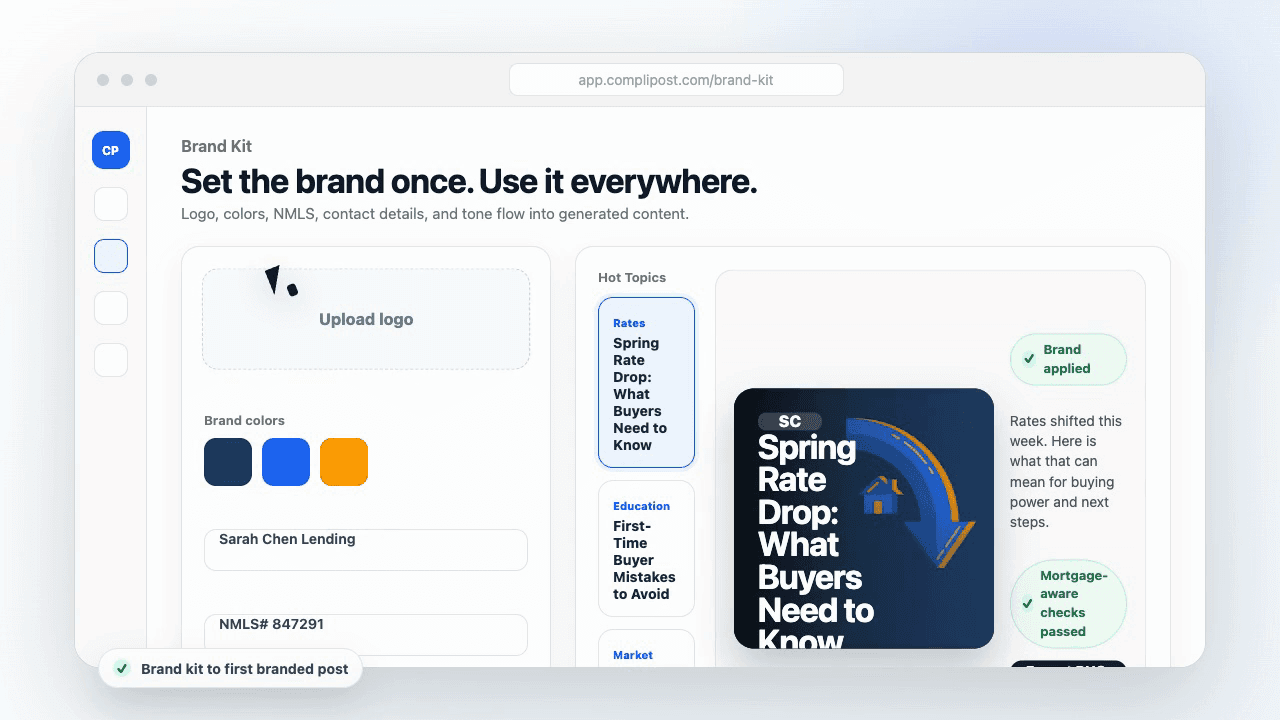
Product workflow
From blank page to export-ready mortgage content
- Start with a borrower topic
- Generate copy and a visual direction
- Review, save, and export the finished asset
These previews reflect the core CompliPost workflow: create, review, save, and export assets for use in your own channels.
Workflow comparison
| Content approach | What happens | Why it matters |
|---|---|---|
| Random posting | One-off ideas created when there is spare time | Inconsistent visibility and weak reuse |
| Template-only posting | Faster design but still requires rewriting and review | Helpful starting point, but not a full system |
| CompliPost workflow | Plan, generate, review, save, and export from one place | Better consistency with mortgage-aware review context |
| Done-for-you service | Someone else creates much of the content | Useful for some teams, but less control and less immediate reuse |
Who this guide helps
This guide is for loan officers working on solo loan officers who need a repeatable mortgage content workflow. The goal is to turn a broad mortgage topic into one borrower question, one useful takeaway, and one asset that can be reviewed before it is shared.
- You need content that sounds like a loan officer, not a generic brand account
- You want examples that can become captions, graphics, GIFs, or PDFs
- You need a clear place to review claims before export
- You want finished work saved for reuse, not lost in a chat thread
A practical workflow for this use case
Start with a narrow scenario, then move through planning, drafting, visual creation, review, and export. For government attorney federal lawyer mortgage content, that means the topic should be specific enough that a borrower or referral partner can immediately understand what decision the content helps with.
- Choose the borrower type, loan topic, or platform before generating copy
- Draft the caption and visual together so the asset feels cohesive
- Use the federal baseline review aid to flag claims and disclosure gaps
- Export the finished asset and save the post as a reusable starting point
What makes the content stronger
Strong mortgage content is usually specific, plain-spoken, and calm. It explains tradeoffs without pretending one answer fits every borrower. That is especially important on public social channels, where a short post can be interpreted without the full context of a loan conversation.
- Name the borrower question in the first line
- Explain one decision or tradeoff instead of covering everything
- Use examples without implying approval, savings, or rate outcomes
- End with a soft next step, checklist, or guide rather than pressure
Compliance-aware review notes
CompliPost should be treated as a review aid, not a compliance approval system. The public page, generated draft, graphic, and exported asset should all stay honest about that boundary.
- Review specific payment, APR, rate, savings, and qualification language
- Avoid “best,” “lowest,” “guaranteed,” “free,” and urgency claims unless approved
- Check NMLS, Equal Housing, company, and state-specific requirements
- Use company or legal review for anything outside the federal baseline
How this connects to the rest of CompliPost
A focused guide should leave you with a usable next step. After you understand the topic, you can turn it into a calendar slot, a reviewed social post, a downloadable guide, or a platform-specific version for the channel where your audience already spends time.
- Use the content calendar to turn the idea into a weekly plan
- Use the compliance page when claims or disclosures need a slower pass
- Use lead magnets when the topic deserves a deeper PDF guide
- Use platform pages to adapt the same idea for LinkedIn, Facebook, or Instagram
Recommended next steps
Self-employed borrower hub
Create income-documentation education for self-employed borrowers.
Attorney Mortgage Guide
Comprehensive guide for attorney borrowers across practice types, including government service.
Income Documentation and Qualification Requirements
Detailed breakdown of income documentation for different employment types.
Public Interest Attorney Mortgage Content
Content for public interest and government attorneys addressing PSLF and government employment.
Examples
"Federal prosecutor, stable salary, excellent credit, zero job risk. Here's how stability changes her mortgage options."
Share as a LinkedIn post or case study highlighting the advantages of government employment.
"Government attorney salary lower than law firm? Here's the advantage that matters: stability and job security."
Create a comparison post showing total value (stability + benefits + income security) vs. higher private sector salary.
"GS pay scale + mortgage planning = here's the timeline that matches your career progression."
Write as a strategic guide for federal attorneys matching home purchase to career stage.
"FERS retirement, federal benefits, stable income. Here's what makes government attorneys attractive to lenders."
Educational post explaining why government employment is viewed favorably by mortgage lenders.
FAQ
Does working for the federal government help or hurt my mortgage qualification?+
Help, significantly. Federal employment provides income stability, job security (civil service protection), and predictable benefits that lenders love. Your salary is determined by your GS level and within-grade step; there's no commission, no bonus, and no mystery about your income. To lenders, this is gold. Yes, federal salaries may be lower than big law, but the stability premium is real. A federal attorney on GS-15 with solid credit and assets has an excellent mortgage profile. Bring your current paystubs, offer letter (or SF-50 showing your appointment and salary), and be prepared to explain your civil service status. Lenders will evaluate you favorably relative to borrowers with comparable income but higher job uncertainty.
What documentation do I need from a federal employer for a mortgage?+
You'll need: (1) recent paystubs (typically two to three months showing your regular salary); (2) an SF-50 (Standard Form 50) or offer letter showing your position, GS level, and salary; and (3) if applicable, any documentation of special pay or locality adjustments. Federal employers are cooperative with lender verification; most HR departments will provide these forms quickly. Your paystubs should clearly show your base salary, taxes, and any deductions. That's usually all lenders need. If you're newly hired (within 30 days), bring your appointment letter. If you've recently been promoted, bring the SF-50 documenting the promotion. Federal employment is straightforward—get organized, bring the documents, and lenders will move quickly.
Can I use my federal employee benefits (FEHB, TSP) in mortgage qualification?+
No, not directly. Health insurance, retirement contributions, and life insurance don't add to your income-qualifying amount. However, they're part of your overall compensation package and demonstrate financial health. If you have significant TSP savings, those count as assets for down payment or reserves. Having maxed-out TSP or other retirement savings shows financial discipline and can help offset other concerns. Talk to your loan officer; they'll evaluate your overall financial picture. The benefits don't increase your borrowing power directly, but they contribute to a strong overall profile.
How does my GS level and within-grade step affect my mortgage qualification?+
Your current GS level and step determine your current salary, which is what matters for qualification. Lenders use your documented current salary for DTI calculation. However, if you're on a clear within-grade step progression (e.g., GS-13 step 1 moving to step 2 within 30 days of closing), some lenders will use the higher step if it's documented in your SF-50 or HR letter. Within-grade raises are small (about 1-3% annually), so they rarely change qualification significantly. Larger raises come from promotions; if you have a promotion offer in hand, bring it. Regular step increases are expected and documented; ask your HR department for a GS pay scale showing your progression over the next few years. This helps with financial planning, but your current step is what matters for mortgage qualification.
What if I'm planning to retire soon and transition to private practice?+
Lenders care about your income going forward. If you're retiring from federal service soon and transitioning to private practice or consulting, you'll need to document the next income source. If you have a signed offer from a law firm or contract with a consulting client showing income post-retirement, bring that. If you're retiring without a clearly documented next income source, lenders will be wary. Ideally, you have the next job or contract lined up before you apply for the mortgage. If you're retiring soon but don't have the next gig yet, wait until you do. Retirement alone doesn't disqualify you if you have assets or documented post-retirement income, but it complicates underwriting. Plan ahead and line up the next opportunity before you apply.
Create mortgage content with a calmer workflow
CompliPost helps you plan, generate, review, save, and export useful mortgage content without pretending compliance or social distribution is automatic.
Start free