Legal Professional
Mortgage Content for Public Interest Attorneys and Government Lawyers
Public interest attorneys operate within income constraints that are very different from private practice. Many carry substantial student debt and rely on Public Service Loan Forgiveness (PSLF) or similar programs. Your content for this segment should acknowledge the financial realities of public service work while positioning homeownership as achievable and strategically compatible with career goals.
What makes a public interest attorney's financial picture unique?
Public interest and government attorneys have lower salaries but higher stability than many private practitioners. They're often more burdened by student debt but may benefit from forgiveness programs. Social content should normalize their financial situation and show that loan officers understand PSLF, income-driven repayment, and the long-term strategy of public service employment.
- Income is lower but stable: government salaries are predictable; lenders like predictability even if the absolute number is modest
- Student debt is higher: many public interest lawyers carry significant education debt; this is expected in the lending community
- PSLF is a factor: Public Service Loan Forgiveness programs affect cash flow and should be factored into mortgage planning
- Income-driven repayment impacts DTI: if borrowers use PAYE, REPAYE, or similar plans, their monthly student loan payment may be lower than the standard payment—this improves qualification
- Career stability is an asset: government positions offer security that lenders value; position this as a strength
How do PSLF and income-driven repayment affect mortgage qualification?
This is where you differentiate yourself as a knowledgeable lender. Content should explain that strategic management of student loans—particularly using income-driven repayment while working toward PSLF—is a legitimate financial planning tool, not a red flag. Lenders understand this strategy; position yourself as an advocate for it.
- PAYE and REPAYE reduce monthly payments: use the income-driven payment amount for DTI, not the standard payment
- Ten-year PSLF timeline: help borrowers understand the calendar; if they're five years in, forgiveness is realistic planning
- DTI improvement: by using income-driven repayment, a public interest attorney may qualify for a larger mortgage than standard repayment would allow
- Debt forgiveness planning: explain that forgiven debt is treated as taxable income in the year of forgiveness; plan accordingly with your accountant
- Program risk: acknowledge that PSLF policy could change; help borrowers think through scenarios
What messaging appeals to public interest and government attorneys?
This audience values purpose-driven work and often makes trade-offs between income and mission. Social content should respect their choice and position homeownership as compatible with their values. Avoid messaging that frames low income as a problem; frame it as a reality you're equipped to navigate.
- Acknowledge the student debt reality without judgment; show that lenders work with it all the time
- Highlight stability: government attorneys have job security that private borrowers may lack
- Reference financial planning around PSLF; position yourself as an advisor, not just a lender
- Share stories of public interest attorneys who bought homes while managing student debt strategically
- Create content specific to federal, state, or local government employment structures and income documentation
How do you help public interest attorneys plan the mortgage + student debt strategy?
This is where you add real value. Content should guide public interest borrowers through the decision: should they aggressively pay down student debt or invest in a home? Export this as educational material, webinars for public interest organizations, and direct consultation frameworks.
- Create a worksheet: mortgage payment vs. student loan payment vs. income; help borrowers visualize the tradeoff
- Develop educational content on PSLF timelines and borrowing strategy; position yourself as a strategic partner
- Partner with public interest law organizations, bar associations, and government employer HR departments
- Host webinars: 'Homeownership Strategy for Public Service Attorneys' with a tax professional and financial planner
- Export content as downloadable guides specifically for government employees and public interest organizations
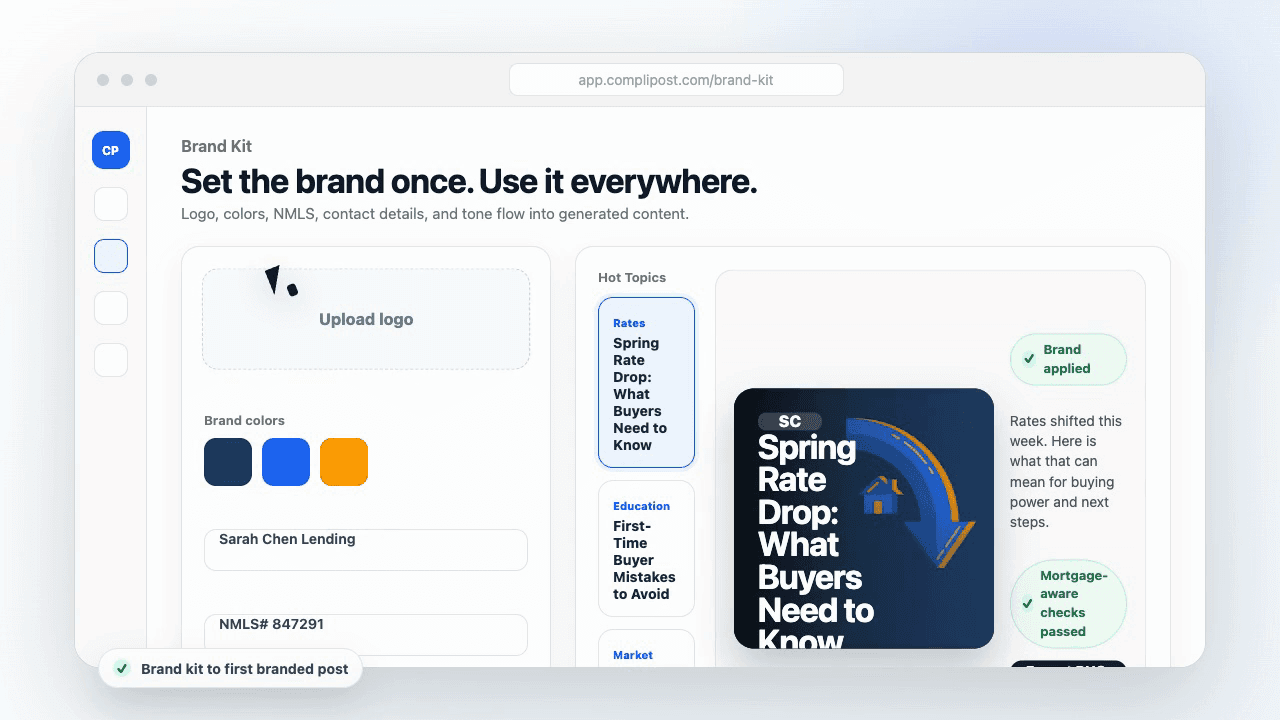
Product workflow
From blank page to export-ready mortgage content
- Start with a borrower topic
- Generate copy and a visual direction
- Review, save, and export the finished asset
These previews reflect the core CompliPost workflow: create, review, save, and export assets for use in your own channels.
Workflow comparison
| Content approach | What happens | Why it matters |
|---|---|---|
| Random posting | One-off ideas created when there is spare time | Inconsistent visibility and weak reuse |
| Template-only posting | Faster design but still requires rewriting and review | Helpful starting point, but not a full system |
| CompliPost workflow | Plan, generate, review, save, and export from one place | Better consistency with mortgage-aware review context |
| Done-for-you service | Someone else creates much of the content | Useful for some teams, but less control and less immediate reuse |
Who this guide helps
This guide is for loan officers working on solo loan officers who need a repeatable mortgage content workflow. The goal is to turn a broad mortgage topic into one borrower question, one useful takeaway, and one asset that can be reviewed before it is shared.
- You need content that sounds like a loan officer, not a generic brand account
- You want examples that can become captions, graphics, GIFs, or PDFs
- You need a clear place to review claims before export
- You want finished work saved for reuse, not lost in a chat thread
A practical workflow for this use case
Start with a narrow scenario, then move through planning, drafting, visual creation, review, and export. For public interest attorney government lawyer mortgage content, that means the topic should be specific enough that a borrower or referral partner can immediately understand what decision the content helps with.
- Choose the borrower type, loan topic, or platform before generating copy
- Draft the caption and visual together so the asset feels cohesive
- Use the federal baseline review aid to flag claims and disclosure gaps
- Export the finished asset and save the post as a reusable starting point
What makes the content stronger
Strong mortgage content is usually specific, plain-spoken, and calm. It explains tradeoffs without pretending one answer fits every borrower. That is especially important on public social channels, where a short post can be interpreted without the full context of a loan conversation.
- Name the borrower question in the first line
- Explain one decision or tradeoff instead of covering everything
- Use examples without implying approval, savings, or rate outcomes
- End with a soft next step, checklist, or guide rather than pressure
Compliance-aware review notes
CompliPost should be treated as a review aid, not a compliance approval system. The public page, generated draft, graphic, and exported asset should all stay honest about that boundary.
- Review specific payment, APR, rate, savings, and qualification language
- Avoid “best,” “lowest,” “guaranteed,” “free,” and urgency claims unless approved
- Check NMLS, Equal Housing, company, and state-specific requirements
- Use company or legal review for anything outside the federal baseline
How this connects to the rest of CompliPost
A focused guide should leave you with a usable next step. After you understand the topic, you can turn it into a calendar slot, a reviewed social post, a downloadable guide, or a platform-specific version for the channel where your audience already spends time.
- Use the content calendar to turn the idea into a weekly plan
- Use the compliance page when claims or disclosures need a slower pass
- Use lead magnets when the topic deserves a deeper PDF guide
- Use platform pages to adapt the same idea for LinkedIn, Facebook, or Instagram
Recommended next steps
Self-employed borrower hub
Create income-documentation education for self-employed borrowers.
Attorney Mortgage Guide
Comprehensive guide covering attorney borrowers across all sectors, including government and public interest.
Student Loan Debt and Mortgage Qualification
Detailed breakdown of how student loans affect DTI and qualification strategies.
Debt-to-Income Ratio Calculation and Qualification
In-depth guide to DTI math and how various income and debt factors affect mortgage qualification.
Examples
"Public interest attorney, $120K salary, $160K student debt. Here's how income-driven repayment changed her home-buying potential."
Share as a detailed case study; show the DTI math with both standard and PAYE-based payments.
"PSLF in 7 years. Buy a home now? Here's the financial math that matters."
Create a LinkedIn post or email guide addressing the decision to purchase before PSLF forgiveness.
"Government attorney salary isn't a dealbreaker—it's just different. Here's how lenders evaluate government employment."
Educational post or video explaining the stability premium lenders give to government employment.
"Income-driven student loan repayment can improve your mortgage qualification. Here's why and how."
Write as a comprehensive educational piece for public interest and government employees.
FAQ
How does PSLF affect my ability to qualify for a mortgage?+
PSLF itself doesn't disqualify you; in fact, many lenders view it as a positive sign because it shows you're committed to public service and managing your debt strategically. What matters is your current monthly student loan payment. If you're on an income-driven repayment plan (PAYE, REPAYE, IBR, ICR), your monthly payment may be significantly lower than it would be under standard repayment. Lenders use your *actual* monthly payment for debt-to-income calculation. So if you're five years into a PSLF program and your income-driven payment is $500 a month, that's what counts toward DTI—not a $1,200 standard payment. Bring your loan servicer statement showing your current payment amount and your PSLF certification form to your application meeting.
Should I stay on PAYE or switch to a different income-driven repayment plan before applying for a mortgage?+
No—don't change plans just for the mortgage application. Stay on the plan your tax and financial advisors recommend for your long-term situation. Most lenders will evaluate your qualification using your current plan's payment, so switching briefly to manipulate DTI could backfire (and may not work anyway). What matters is documented income and actual monthly payment. If you're considering a change for legitimate reasons (your income changed, your family size changed, you're reconsidering PSLF strategy), do that through your loan servicer before you apply—not during the application. Let your loan officer see the plan you're actually using.
What income documentation do government employers provide for mortgage applications?+
Government employers typically provide a verification of employment (VOE) form, recent paystubs, and tax returns. If you're newly hired (within 30 days), bring an offer letter. Government positions are straightforward from a lending perspective: salary is fixed, there's no commission or bonus (unless specified in your hire letter), and employment is considered stable. Make sure your paystubs are recent and clearly show your salary, taxes, and deductions. If you have deferred compensation or special pay (locality adjustments, hazard pay, etc.), bring documentation showing that it's recurring, not one-time. Government employers are usually cooperative with lender verification requests; most have standard forms.
Can I use the PSLF forgiveness amount as an asset for qualification?+
No, not directly. PSLF forgiveness is a future liability reduction, not a current asset. However, you *can* incorporate it into financial planning conversations. If you're five years into a ten-year PSLF plan and you have $80K remaining in student debt, you can discuss with your lender and accountant how that forgiveness shapes your financial picture. Some lenders may be more comfortable with your overall debt load if PSLF is imminent. But for qualification purposes, lenders use your current debt, not future forgiveness. If you have investments, savings, or assets, *those* count toward qualification and can help offset the impact of remaining student debt.
What happens to my mortgage if I leave public service before PSLF kicks in?+
Your mortgage is completely separate from PSLF. Leaving your government job doesn't affect your mortgage at all. What *does* change is your student loan situation: if you leave before the ten-year PSLF timeline, you lose the forgiveness benefit and your loans revert to standard repayment (or whatever plan you choose). This is why it's important to think about your career plans alongside your home purchase plans. If you're genuinely committed to public service for ten years, PSLF planning makes sense. If you're unsure about your long-term trajectory, work with your financial advisor and loan officer to plan for flexibility. Your mortgage lender only cares about your current income and employment; PSLF strategy is between you and your accountant.
Create mortgage content with a calmer workflow
CompliPost helps you plan, generate, review, save, and export useful mortgage content without pretending compliance or social distribution is automatic.
Start free