Legal Professional
Social Content for Attorneys Changing Careers and Transitioning Between Law Practices
Career changes and practice-area transitions are common in the legal profession. Moving from big law to in-house counsel, from litigation to transactional work, or between firms involves income and employment documentation challenges. Your content for this segment should normalize transitions and show that borrowers with clear, documented next positions can absolutely qualify for mortgages.
How do job changes and career transitions affect mortgage qualification?
Job changes create underwriting scrutiny but don't disqualify borrowers with clear next positions. Social content should explain the documentation path and show that transitions are manageable.
- Recent employment: if you've been in a job less than 30 days, lenders want documentation of your new position
- Offer letter matters: a signed offer from your new employer is your strongest documentation tool
- Continuous employment: ideally, your new job starts before or immediately after your current job ends (no gap)
- Salary changes: if your new salary is higher, great; if it's lower, lenders evaluate the decrease
- Practice area changes: moving from litigation to in-house counsel (or vice versa) doesn't disqualify you
What documentation strengthens qualification during a career transition?
Clear, signed offer letters are your best tool. Content should guide attorneys through the documentation they need.
- Offer letter from new employer: showing position, start date, and salary
- Employment history: showing your law practice background and professional stability
- Current employment letter: from your current employer confirming your role and salary
- Written explanation: brief note explaining the transition and why it's a positive move
- References or prior performance: if available, shows continuity of professional credibility
What messaging speaks to attorneys navigating career transitions?
Attorneys understand that career moves are strategic and normal. Content should acknowledge ambition while showing stability.
- Position career transitions as a sign of professional growth and opportunity
- Show that lenders understand attorney career progression and market movement
- Share stories of attorneys who moved jobs and closed mortgages simultaneously
- Address common concerns: gap fears, salary decrease concerns, employer-switching anxiety
- Position yourself as the lender who supports attorney career moves
How do you help attorneys coordinate mortgage applications with job transitions?
Export content that guides attorneys through timing and coordination. This is where you add strategic value.
- Create a timeline template: when to apply relative to job transition timing
- Develop content on three scenarios: apply before transition, during transition, after new job starts
- Build email sequences: guide attorneys through transition coordination
- Offer to communicate with new employers; reduce friction for the borrower
- Export content as downloadable guides and timelines
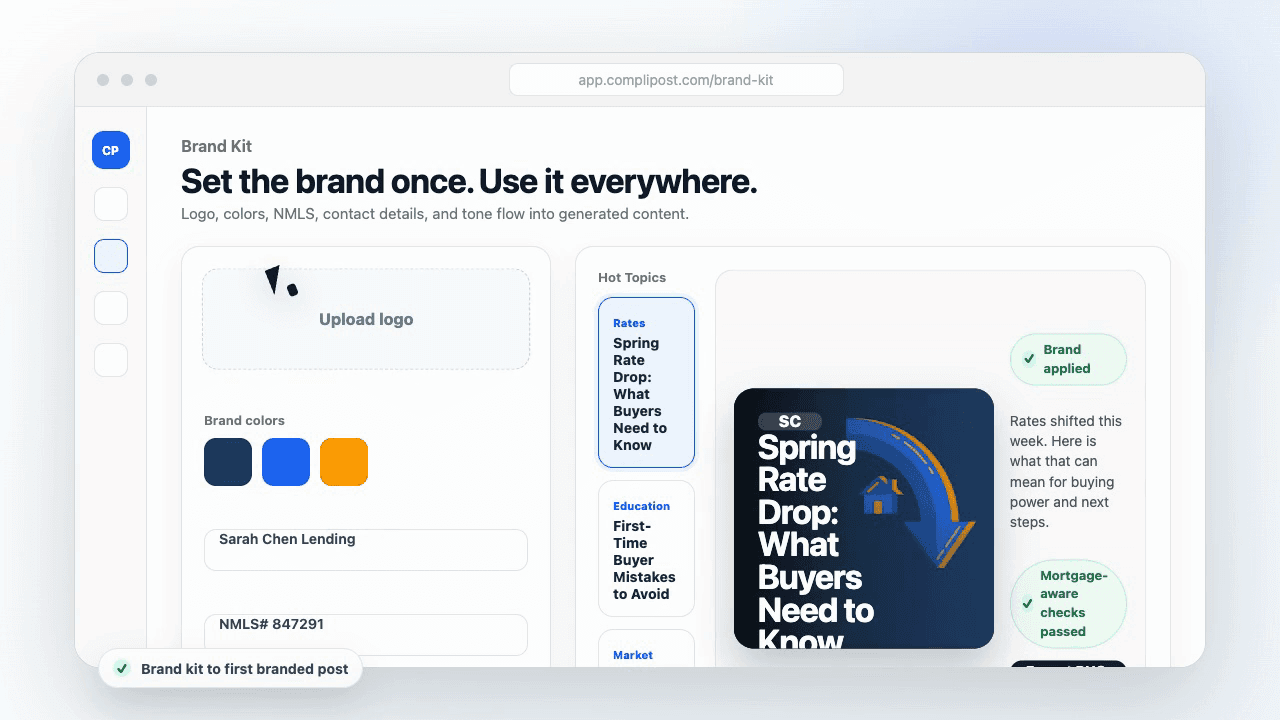
Product workflow
From blank page to export-ready mortgage content
- Start with a borrower topic
- Generate copy and a visual direction
- Review, save, and export the finished asset
These previews reflect the core CompliPost workflow: create, review, save, and export assets for use in your own channels.
Workflow comparison
| Content approach | What happens | Why it matters |
|---|---|---|
| Random posting | One-off ideas created when there is spare time | Inconsistent visibility and weak reuse |
| Template-only posting | Faster design but still requires rewriting and review | Helpful starting point, but not a full system |
| CompliPost workflow | Plan, generate, review, save, and export from one place | Better consistency with mortgage-aware review context |
| Done-for-you service | Someone else creates much of the content | Useful for some teams, but less control and less immediate reuse |
Who this guide helps
This guide is for loan officers working on solo loan officers who need a repeatable mortgage content workflow. The goal is to turn a broad mortgage topic into one borrower question, one useful takeaway, and one asset that can be reviewed before it is shared.
- You need content that sounds like a loan officer, not a generic brand account
- You want examples that can become captions, graphics, GIFs, or PDFs
- You need a clear place to review claims before export
- You want finished work saved for reuse, not lost in a chat thread
A practical workflow for this use case
Start with a narrow scenario, then move through planning, drafting, visual creation, review, and export. For attorney career transition job change mortgage content, that means the topic should be specific enough that a borrower or referral partner can immediately understand what decision the content helps with.
- Choose the borrower type, loan topic, or platform before generating copy
- Draft the caption and visual together so the asset feels cohesive
- Use the federal baseline review aid to flag claims and disclosure gaps
- Export the finished asset and save the post as a reusable starting point
What makes the content stronger
Strong mortgage content is usually specific, plain-spoken, and calm. It explains tradeoffs without pretending one answer fits every borrower. That is especially important on public social channels, where a short post can be interpreted without the full context of a loan conversation.
- Name the borrower question in the first line
- Explain one decision or tradeoff instead of covering everything
- Use examples without implying approval, savings, or rate outcomes
- End with a soft next step, checklist, or guide rather than pressure
Compliance-aware review notes
CompliPost should be treated as a review aid, not a compliance approval system. The public page, generated draft, graphic, and exported asset should all stay honest about that boundary.
- Review specific payment, APR, rate, savings, and qualification language
- Avoid “best,” “lowest,” “guaranteed,” “free,” and urgency claims unless approved
- Check NMLS, Equal Housing, company, and state-specific requirements
- Use company or legal review for anything outside the federal baseline
How this connects to the rest of CompliPost
A focused guide should leave you with a usable next step. After you understand the topic, you can turn it into a calendar slot, a reviewed social post, a downloadable guide, or a platform-specific version for the channel where your audience already spends time.
- Use the content calendar to turn the idea into a weekly plan
- Use the compliance page when claims or disclosures need a slower pass
- Use lead magnets when the topic deserves a deeper PDF guide
- Use platform pages to adapt the same idea for LinkedIn, Facebook, or Instagram
Recommended next steps
Self-employed borrower hub
Create income-documentation education for self-employed borrowers.
Attorney Mortgage Guide
Comprehensive guide for attorney borrowers including employment transitions.
Big Law Associate Relocation Mortgage Content
Related content on relocating attorneys and job transitions.
Income Documentation and Qualification Requirements
Detailed breakdown of employment and income documentation.
Examples
"Attorney moving from big law to in-house counsel, salary decrease from $180K to $140K, closed using offer letter. Here's how."
Case study showing transition with salary change and qualification strategy.
"Job offer in hand? Here's when to start the mortgage process relative to your start date."
Practical timing guide for attorneys coordinating job changes with home purchases.
"Career transitions don't disqualify you. Here's what lenders need to see."
Educational post normalizing job changes and transition documentation.
"Moving to a new law firm? Coordinate the mortgage with your transition—here's how."
Strategic guide for attorneys timing mortgages around employment changes.
FAQ
Can I apply for a mortgage before I start my new job?+
Yes, if you have a signed offer letter. Bring the offer letter showing your new position, start date, and salary. Most lenders will evaluate you based on the offer (not your current job) if the offer is clear and signed. Some lenders require a brief gap between jobs; others prefer you to have already started. Ask your loan officer about their timeline preferences. The stronger your offer and the clearer the start date, the more comfortable lenders are applying for a mortgage before you officially start.
What if my new salary is lower than my current salary?+
Lenders will use the lower salary for qualification, which may reduce your borrowing power. However, if the decrease is modest (say, $180K to $160K) and you have solid credit and assets, you'll likely still qualify—just for a slightly smaller mortgage. If the decrease is significant, you may need a larger down payment, stronger reserves, or a co-signer. Be transparent with your loan officer about the salary change and the reason (better work-life balance, meaningful work, location preference, etc.). Many attorneys are willing to accept lower pay for better circumstances; lenders understand this. They'll evaluate your overall financial picture, not just salary.
How long do I need to be in my new job before applying for a mortgage?+
If you have a signed offer letter, you can apply before you start. If you've already started, most lenders want at least 30 days of employment (showing a paystub from the new employer). Some lenders are flexible on this timeline; others are strict. The key: documentation of employment. An offer letter before you start, or a paystub from the new employer once you've started, both work. Talk to your loan officer about your specific timeline; they'll tell you exactly what they need and when.
Should I mention my job change to my current lender or employer?+
Your mortgage lender will verify your employment; they'll discover the job change. Be upfront about it rather than hiding it. Your current employer doesn't need to know about your mortgage application unless you give them permission (which lenders may request for verification). When your loan officer verifies employment, they may contact your current employer; be prepared for that. Regarding your new employer: they may be contacted to verify your offer and new position. Most HR departments are accustomed to this and provide standard verification letters. Let your new employer know to expect a lender verification call; it smooths the process.
Can I buy a house while I have a non-compete or restrictive covenant with my old firm?+
Non-competes and restrictive covenants don't directly affect mortgage qualification—lenders care about your income and employment, not the terms of your employment agreement. However, if a non-compete is enforced and it prevents you from working, that affects your income and therefore your qualification. If you're leaving firm A for firm B and there's a non-compete dispute, that's a legal matter between you and firm A—not a mortgage issue. Consult your employment attorney on the non-compete; it may affect your income stability, which affects mortgage qualification. But the mortgage lender won't directly consider the restrictive covenant; they'll just verify your new employment is legitimate and your salary is documented.
Create mortgage content with a calmer workflow
CompliPost helps you plan, generate, review, save, and export useful mortgage content without pretending compliance or social distribution is automatic.
Start free