Legal Professional
Mortgage Content for Big Law Associates and Attorneys Relocating
Big law associates frequently relocate between offices or markets. A promotion, lateral move, or office expansion may trigger a home purchase in a new city. Your content for this segment should address the unique challenges: timing mortgages around transfers, navigating different markets, and capturing income increases that often accompany moves.
What's different about buying a home as a relocating attorney?
Relocating attorneys face timing pressure and often don't know the market. Social content should offer practical guidance on coordinating the move with the mortgage timeline and choosing the right loan officer in the new market.
- Timing is tight: firms often give short notice on relocations; you may need a fast mortgage timeline
- Market unfamiliarity: you're buying in a new city; finding a local loan officer and real estate agent is critical
- Income may change: relocation often brings a salary increase or a change in comp structure; document this clearly
- Loan officer matters: you need someone local who knows the market and can move fast
- Rent-vs.-buy decision: many relocating attorneys rent first; content should address both scenarios
How do you help relocating attorneys move fast without cutting corners?
Speed matters, but quality matters more. Content should show that getting a qualified local loan officer set up *before* the move is the key to a smooth relocation-and-close timeline.
- Get pre-approved before you move: have a pre-approval in hand from a national lender or your new city's lender
- Find a local loan officer early: use your firm's local office, bar association referrals, or attorney networks
- Document the relocation: bring your transfer letter and any updated comp information to your pre-approval
- Understand the market: get connected with a real estate agent early; they know the neighborhoods and can guide your search
- Plan for timeline compression: if you're closing in 60 days instead of 90, communicate that to your loan officer upfront
What messaging resonates with relocating big law associates?
This audience is busy, moving quickly, and often stressed about the logistics of relocation. Content should be pragmatic, efficient, and focused on removing barriers. They respond to loan officers who are responsive and make the process simple.
- Emphasize speed and reliability: position yourself as the lender who can close a relocated attorney's mortgage in 45 days
- Highlight market knowledge: show that you understand the specific market they're moving to
- Offer a streamlined pre-approval process: make it easy for relocating attorneys to get pre-approved before they arrive
- Share stories of smooth relocations: use case studies to show that moving and closing don't have to be chaotic
- Create market-specific content: neighborhoods, schools, market conditions, and local relocation tips
How do you help attorneys balance relocation timing with the mortgage process?
Export content that helps attorneys coordinate the firm's timeline with the mortgage timeline. This is where you add strategic value and position yourself as an advisor, not just a lender.
- Create a relocation timeline template: when to apply, when to close, when to coordinate with the move
- Develop content on temporary housing strategies: some attorneys rent initially, then buy later; others close before moving in
- Build email sequences that guide relocating attorneys through the mortgage process while managing job logistics
- Partner with relocation services and corporate relocation coordinators; cross-refer and build partnerships
- Export content as downloadable relocation guides specific to high-growth legal markets
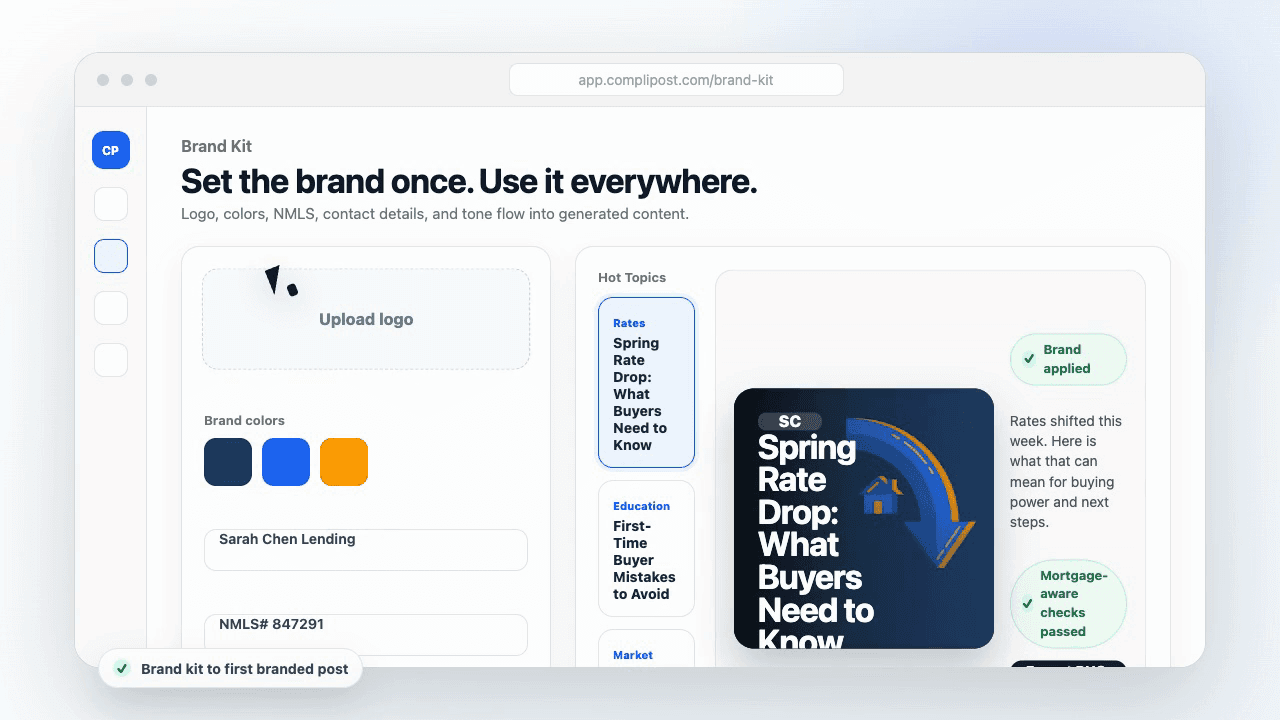
Product workflow
From blank page to export-ready mortgage content
- Start with a borrower topic
- Generate copy and a visual direction
- Review, save, and export the finished asset
These previews reflect the core CompliPost workflow: create, review, save, and export assets for use in your own channels.
Workflow comparison
| Content approach | What happens | Why it matters |
|---|---|---|
| Random posting | One-off ideas created when there is spare time | Inconsistent visibility and weak reuse |
| Template-only posting | Faster design but still requires rewriting and review | Helpful starting point, but not a full system |
| CompliPost workflow | Plan, generate, review, save, and export from one place | Better consistency with mortgage-aware review context |
| Done-for-you service | Someone else creates much of the content | Useful for some teams, but less control and less immediate reuse |
Who this guide helps
This guide is for loan officers working on solo loan officers who need a repeatable mortgage content workflow. The goal is to turn a broad mortgage topic into one borrower question, one useful takeaway, and one asset that can be reviewed before it is shared.
- You need content that sounds like a loan officer, not a generic brand account
- You want examples that can become captions, graphics, GIFs, or PDFs
- You need a clear place to review claims before export
- You want finished work saved for reuse, not lost in a chat thread
A practical workflow for this use case
Start with a narrow scenario, then move through planning, drafting, visual creation, review, and export. For big law relocation mortgage attorney content, that means the topic should be specific enough that a borrower or referral partner can immediately understand what decision the content helps with.
- Choose the borrower type, loan topic, or platform before generating copy
- Draft the caption and visual together so the asset feels cohesive
- Use the federal baseline review aid to flag claims and disclosure gaps
- Export the finished asset and save the post as a reusable starting point
What makes the content stronger
Strong mortgage content is usually specific, plain-spoken, and calm. It explains tradeoffs without pretending one answer fits every borrower. That is especially important on public social channels, where a short post can be interpreted without the full context of a loan conversation.
- Name the borrower question in the first line
- Explain one decision or tradeoff instead of covering everything
- Use examples without implying approval, savings, or rate outcomes
- End with a soft next step, checklist, or guide rather than pressure
Compliance-aware review notes
CompliPost should be treated as a review aid, not a compliance approval system. The public page, generated draft, graphic, and exported asset should all stay honest about that boundary.
- Review specific payment, APR, rate, savings, and qualification language
- Avoid “best,” “lowest,” “guaranteed,” “free,” and urgency claims unless approved
- Check NMLS, Equal Housing, company, and state-specific requirements
- Use company or legal review for anything outside the federal baseline
How this connects to the rest of CompliPost
A focused guide should leave you with a usable next step. After you understand the topic, you can turn it into a calendar slot, a reviewed social post, a downloadable guide, or a platform-specific version for the channel where your audience already spends time.
- Use the content calendar to turn the idea into a weekly plan
- Use the compliance page when claims or disclosures need a slower pass
- Use lead magnets when the topic deserves a deeper PDF guide
- Use platform pages to adapt the same idea for LinkedIn, Facebook, or Instagram
Recommended next steps
Self-employed borrower hub
Create income-documentation education for self-employed borrowers.
Attorney Mortgage Guide
Comprehensive guide for attorney borrowers covering career transitions and income strategies.
Relocation Loan Officer Content
Broader content strategy for relocating professionals across industries.
Income Documentation and Qualification Requirements
Detailed breakdown of employment and income documentation for mortgage qualification.
Examples
"Big law partner transferred to the NYC office, closed on a home before she even arrived. Here's the timeline and strategy."
Share as a case study on LinkedIn with timeline details and coordination strategy.
"Relocating for a job? Here's the mortgage timeline that works with your firm's schedule."
Create a downloadable timeline guide specific to attorney relocation scenarios.
"Your relocation compensation is part of your mortgage qualification. Here's how to present it."
Educational post explaining how signing bonuses, relocation allowances, and comp changes are documented.
"Moving to a new legal market? Here's what loan officers in the top legal markets want you to know."
Write as practical guidance for attorneys relocating to major legal hubs (NYC, SF, DC, Chicago, Boston).
FAQ
Can I get pre-approved before I know which city I'm moving to?+
Sort of. A national lender or a lender with presence in multiple markets can give you a pre-approval that's valid across different locations. The pre-approval will show your borrowing power in general terms, but specific loan products and rates vary by market and property. Once you know your destination, connect with a local lender in that market for a market-specific pre-approval. This refinement takes a few days and sets you up with the local expertise you'll need to close fast. Many firms cover relocation costs, including mortgage costs, so don't shy away from getting pre-approved in your new market even if it means a second pre-approval application.
What if my salary is increasing as part of the relocation?+
Document it. Bring your transfer letter or promotion letter showing the new salary and effective date. Most lenders will use the new salary for qualification if the increase is effective before or at closing. If the increase is effective after closing, lenders may use the current salary or ask for a commitment that the increase will occur. The clearer the documentation of the increase, the more favorably lenders treat it. If your firm provides a relocation package with bonus or signing allowance, document that too—some of it may count as income with proper paperwork.
Can I apply for a mortgage while my job transfer is still pending?+
No. Lenders need verification that your transfer is confirmed. Once you have a formal offer letter or written transfer notice from your firm, you can apply. Verbal confirmations and "likely transfers" don't cut it. Get the written documentation from your firm's HR or partner, then apply. This is when your loan officer timeline starts. Once you have written confirmation of the transfer and the new salary, you're good to move forward.
Should I close before or after I physically move?+
Ideally, close before you move. This lets you move directly into your owned home instead of renting temporarily. However, if the timeline is tight and closing before the move is logistically impossible, you can close after the move. The key: your pre-approval should be in hand and your application should be submitted before the physical move happens. That way, underwriting can proceed while you're managing the relocation logistics. Once you've physically moved, you have an address change to report to your lender, but the underwriting timeline doesn't need to pause.
What documentation do I need from my law firm for a mortgage application when relocating?+
Bring: (1) your current offer letter or employment contract; (2) a transfer letter from your firm confirming the relocation, new office location, and any salary changes; (3) recent paystubs (from before the transfer, to show current income); and (4) if applicable, a letter detailing relocation benefits (bonus, allowance, etc.). If you're a partner or senior associate, bring your partnership agreement or comp documentation. The clearer the documentation of your employment and compensation, the faster underwriting moves. Partner with your firm's HR department; they're usually happy to provide standard verification letters.
Create mortgage content with a calmer workflow
CompliPost helps you plan, generate, review, save, and export useful mortgage content without pretending compliance or social distribution is automatic.
Start free