Legal Professional
Mortgage Content for Attorneys with Bonus and Performance-Based Compensation
Many attorneys receive significant income through bonuses, signing bonuses, or performance incentives. This income is real but requires documentation to count toward mortgage qualification. Your content for this segment should explain the documentation path and show that bonus income can meaningfully improve borrowing power.
How do lenders evaluate bonus income for attorney borrowers?
Bonus income is legitimate and often substantial for attorneys, but lenders require documentation to verify it's recurring and reliable. Social content should explain the process and show that documented bonus income is absolutely usable.
- Two-year history: lenders typically want two years of bonus documentation (pay stubs or tax returns showing the income)
- Firm structure matters: some firms guarantee bonuses; others base them on profitability or individual performance
- Documentation sources: recent pay stubs, offer letter stating bonus amount, tax returns showing bonus reported as income
- Recurring vs. one-time: lenders care whether the bonus is recurring; a signing bonus in year one may not count until you have two years of history
- Stability is key: bonuses tied to firm or personal profitability fluctuate; lenders may use a conservative average
What bonus income documentation strengthens a mortgage application?
Clear documentation makes underwriting fast. Content should guide attorneys through the paperwork that makes bonus income count most favorably.
- Updated offer letter: include bonus amount, structure, and timing; keep this current with any changes
- Two years of paystubs: show bonus payments received; W-2s should also reflect bonus as income
- Firm documentation: a letter from HR or compensation confirming the bonus structure and likelihood of continuation
- Tax returns: Schedule A itemization or W-2 detail showing the bonus as reported income
- Business plan or projections: if bonus is tied to firm growth, evidence of firm financial health helps
What messaging addresses the complexity of variable compensation?
Attorneys with bonus income sometimes worry it complicates qualification. Social content should normalize bonus income and show that you understand it—removing the anxiety.
- Share stories of bonus-earning attorneys who qualified easily with proper documentation
- Explain that bonus income is common in law and lenders expect it; it's not a red flag
- Offer a consultation specifically for attorneys with performance-based compensation
- Create content comparing stated salary plus bonus to evaluate total earning potential
- Position yourself as the lender who knows how to present bonus income to underwriting
How do you help attorneys maximize bonus income in their mortgage application?
Export content that guides attorneys through bonus documentation and strategic presentation. This is where you show expertise and help borrowers get the best outcome.
- Create a bonus documentation checklist: what to gather, what to present, when to apply
- Develop content on timing: should you apply before or after bonus season?
- Build email sequences that walk attorneys through the bonus income qualification process
- Offer to communicate directly with HR or compensation team; reduce friction for the borrower
- Export content as calculators showing base salary plus bonus in qualification scenarios
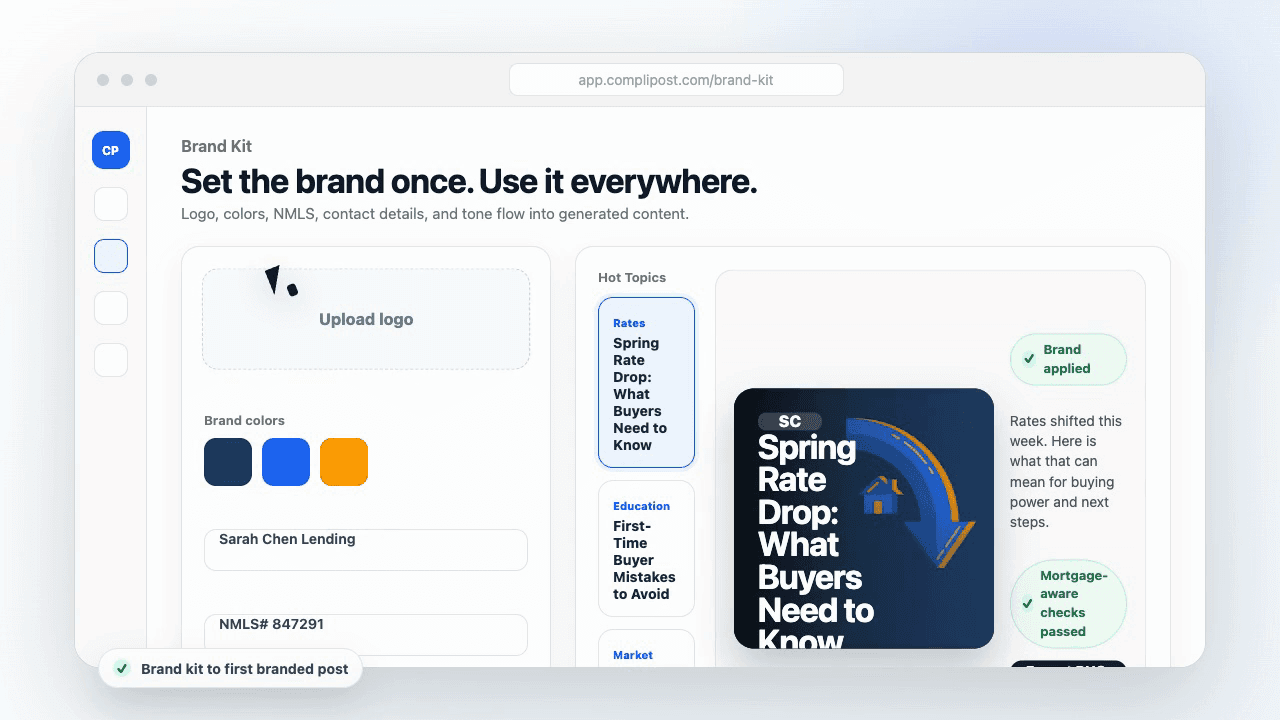
Product workflow
From blank page to export-ready mortgage content
- Start with a borrower topic
- Generate copy and a visual direction
- Review, save, and export the finished asset
These previews reflect the core CompliPost workflow: create, review, save, and export assets for use in your own channels.
Workflow comparison
| Content approach | What happens | Why it matters |
|---|---|---|
| Random posting | One-off ideas created when there is spare time | Inconsistent visibility and weak reuse |
| Template-only posting | Faster design but still requires rewriting and review | Helpful starting point, but not a full system |
| CompliPost workflow | Plan, generate, review, save, and export from one place | Better consistency with mortgage-aware review context |
| Done-for-you service | Someone else creates much of the content | Useful for some teams, but less control and less immediate reuse |
Who this guide helps
This guide is for loan officers working on solo loan officers who need a repeatable mortgage content workflow. The goal is to turn a broad mortgage topic into one borrower question, one useful takeaway, and one asset that can be reviewed before it is shared.
- You need content that sounds like a loan officer, not a generic brand account
- You want examples that can become captions, graphics, GIFs, or PDFs
- You need a clear place to review claims before export
- You want finished work saved for reuse, not lost in a chat thread
A practical workflow for this use case
Start with a narrow scenario, then move through planning, drafting, visual creation, review, and export. For attorney bonus income mortgage qualification content, that means the topic should be specific enough that a borrower or referral partner can immediately understand what decision the content helps with.
- Choose the borrower type, loan topic, or platform before generating copy
- Draft the caption and visual together so the asset feels cohesive
- Use the federal baseline review aid to flag claims and disclosure gaps
- Export the finished asset and save the post as a reusable starting point
What makes the content stronger
Strong mortgage content is usually specific, plain-spoken, and calm. It explains tradeoffs without pretending one answer fits every borrower. That is especially important on public social channels, where a short post can be interpreted without the full context of a loan conversation.
- Name the borrower question in the first line
- Explain one decision or tradeoff instead of covering everything
- Use examples without implying approval, savings, or rate outcomes
- End with a soft next step, checklist, or guide rather than pressure
Compliance-aware review notes
CompliPost should be treated as a review aid, not a compliance approval system. The public page, generated draft, graphic, and exported asset should all stay honest about that boundary.
- Review specific payment, APR, rate, savings, and qualification language
- Avoid “best,” “lowest,” “guaranteed,” “free,” and urgency claims unless approved
- Check NMLS, Equal Housing, company, and state-specific requirements
- Use company or legal review for anything outside the federal baseline
How this connects to the rest of CompliPost
A focused guide should leave you with a usable next step. After you understand the topic, you can turn it into a calendar slot, a reviewed social post, a downloadable guide, or a platform-specific version for the channel where your audience already spends time.
- Use the content calendar to turn the idea into a weekly plan
- Use the compliance page when claims or disclosures need a slower pass
- Use lead magnets when the topic deserves a deeper PDF guide
- Use platform pages to adapt the same idea for LinkedIn, Facebook, or Instagram
Recommended next steps
Self-employed borrower hub
Create income-documentation education for self-employed borrowers.
Attorney Mortgage Guide
Full guide for attorney borrowers covering income documentation and qualification strategies.
Income Documentation and Qualification Requirements
Comprehensive breakdown of income documentation for different compensation structures.
Big Law Associate Relocation Mortgage Content
Content for relocating attorneys, often tied to bonuses and compensation changes.
Examples
"Attorney, $150K base + $50K annual bonus. Bonus documentation made her qualify for $100K more in mortgage. Here's what she brought."
Share as a case study showing the power of documented bonus income.
"Your bonus counts toward mortgage qualification—when you document it right. Here's the checklist."
Share a downloadable documentation checklist specific to bonus income.
"Signing bonus? Here's what lenders need to see before it counts toward your mortgage."
Educational post addressing common questions about signing bonuses in the mortgage process.
"Should you apply for a mortgage before or after bonus season? Here's what makes the difference."
Write as a timing guide specific to attorneys managing bonus income and mortgage applications.
FAQ
Does my signing bonus count toward my mortgage qualification?+
Yes, but with caveats. A signing bonus typically counts toward qualification if you can show it's been received (via paystub or bank statement) and document that it will continue (your offer letter should specify if it's recurring). If it's a one-time signing bonus with no expectation of future bonuses, it may not count for income qualification, but it can count as a down payment source or cash reserves. Get clarification from your loan officer on your specific offer letter language. If your offer specifies a signing bonus plus annual bonuses going forward, both can potentially count. Bring your offer letter and the bank deposit or paystub showing the bonus was received.
Can I use bonus income that I haven't received yet?+
Not for qualification, but possibly for down payment if it's documented in your offer letter. Lenders want to see income that's either been received (shown on recent paystubs) or promised in writing (offer letter) with high certainty of payment. If your offer letter says you'll receive a bonus within 30 days of closing, some lenders may allow you to document it as forthcoming, but this is rare. Better strategy: wait until the bonus is received and you have documentation, then apply. If the timing is tight, talk to your loan officer—they may be able to work with documented expectation if your offer letter is clear.
What if my bonus is variable (based on firm profitability or my performance)?+
Lenders will use a conservative approach. If you have two years of tax returns showing variable bonuses, they'll average them or use the lower year, depending on the trend. If bonuses are trending up, that helps. If they're trending down, lenders may only count a reduced amount. Be transparent about how your bonus works and bring documentation (tax returns, offer letter, firm compensation structures) that shows the range and likelihood of the bonus. A letter from your firm's HR or compensation team explaining the bonus structure (what it's based on, whether it's guaranteed, historical payouts) accelerates underwriting and helps lenders understand the reliability of your bonus income.
How far back do lenders look at bonus history?+
Typically two years. Lenders want to see bonus income on two years of tax returns to confirm it's recurring. If you're in year one at your firm and year-one tax return shows a bonus, you may still need to wait for year two to count it. Some lenders will count signing or relocation bonuses as one-time income even without two-year history; others require the two-year pattern. Ask your loan officer; it varies by lender. If you're just starting a job and received a signing bonus, get clarification on whether it will count for qualification or just for down payment.
Should I lock in my mortgage rate before or after my firm announces the annual bonus?+
This depends on timing and your offer letter certainty. If your offer letter clearly states an annual bonus and you have paystubs or tax returns showing you've received it before, you can apply and lock a rate before the bonus announcement. Your application is based on documented history, not future announcements. However, if you don't yet have documentation of the bonus, wait until you do. Don't speculate on bonuses in your mortgage application; let documented history and written offer letters speak. Talk to your loan officer about the exact timing and what documentation they'll need.
Create mortgage content with a calmer workflow
CompliPost helps you plan, generate, review, save, and export useful mortgage content without pretending compliance or social distribution is automatic.
Start free