Strategic Planning
Balancing ARMs and Fixed-Rate Mortgages: A Diversified Approach
Some borrowers ask: should I choose an ARM or fixed-rate? A better question for certain profiles might be: can I structure my overall financial picture to benefit from both? This is more advanced, but it applies to borrowers with multiple properties, rental income alongside personal residence, or complex financial structures. Educate thoughtfully.
When Portfolio Thinking Applies
Borrowers with multiple properties, investment income, or business finances sometimes benefit from mixing ARM and fixed-rate mortgages strategically. One primary residence (fixed-rate for stability), one investment property (ARM for upside). This isn't universal advice, but for certain profiles, it's worth exploring. Your education can introduce the concept.
- Applies to borrowers with multiple properties or investment income
- Primary residence: fixed-rate for long-term predictability
- Investment properties: ARM might align with shorter holding periods
- Mixed strategy can align mortgages with different financial goals
- Requires solid understanding of both product types first
Primary Residence Fixed, Investment ARM
A common strategy: lock in a fixed-rate for the home you're living in (long-term, needs stability), then use ARM for rental or investment properties where you plan to refinance or exit within 5–7 years. This aligns product type with timeline and achieves different goals simultaneously.
- Separates long-term housing need from shorter-term investment plays
- Fixed-rate on primary residence protects family budget
- ARM on investment property captures early-year savings
- Refinance or exit investment property as planned without ARM affecting family stability
- Requires comfort managing two different mortgage types
Understanding Risk in a Blended Approach
Blending ARMs and fixed-rates introduces complexity. Borrowers must understand both products deeply and manage them differently. ARM on an investment property requires monitoring indices and caps; fixed-rate requires only regular payment. Make sure borrowers are equipped before suggesting a mixed approach.
- More complex than choosing one product type and sticking with it
- Requires ongoing monitoring of ARM adjustments and caps
- Different tax and accounting treatments (consult a CPA)
- More mortgages = more closing costs, more paperwork, more administration
- Only makes sense if borrower is genuinely committed to managing both
Educational Framing: Introduce Gently
This is an advanced concept. Don't lead with it; save it for borrowers who ask, "Should I do both?" or who have multiple properties in conversation. Introduce it as an option they might explore with their accountant/advisor, not as your recommendation. Complexity requires confidence from the borrower.
- Introduce only after borrower demonstrates solid understanding of both products
- Frame as 'something to explore with your accountant' not 'what you should do'
- Acknowledge the added complexity and paperwork
- Suggest consultation with financial advisor or CPA for holistic planning
- Keep CompliPost's tone educational, not prescriptive
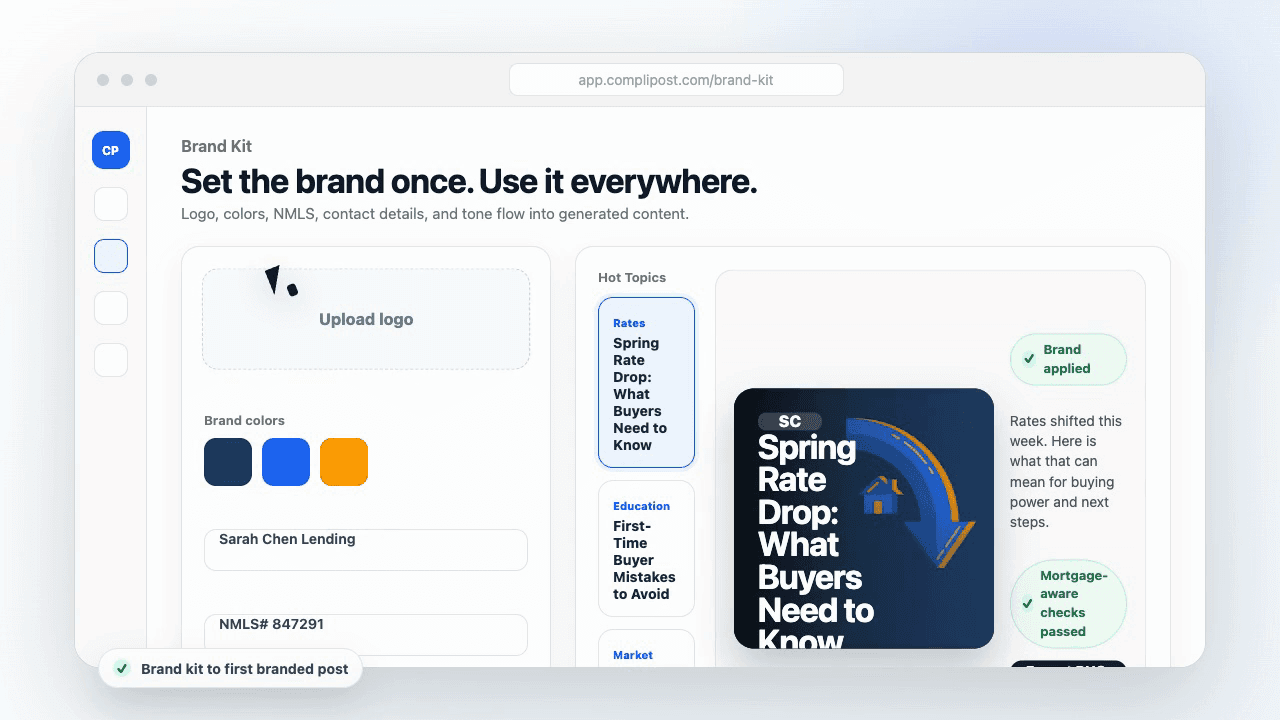
Product workflow
From blank page to export-ready mortgage content
- Start with a borrower topic
- Generate copy and a visual direction
- Review, save, and export the finished asset
These previews reflect the core CompliPost workflow: create, review, save, and export assets for use in your own channels.
Workflow comparison
| Content approach | What happens | Why it matters |
|---|---|---|
| Random posting | One-off ideas created when there is spare time | Inconsistent visibility and weak reuse |
| Template-only posting | Faster design but still requires rewriting and review | Helpful starting point, but not a full system |
| CompliPost workflow | Plan, generate, review, save, and export from one place | Better consistency with mortgage-aware review context |
| Done-for-you service | Someone else creates much of the content | Useful for some teams, but less control and less immediate reuse |
Who this guide helps
This guide is for loan officers working on solo loan officers who need a repeatable mortgage content workflow. The goal is to turn a broad mortgage topic into one borrower question, one useful takeaway, and one asset that can be reviewed before it is shared.
- You need content that sounds like a loan officer, not a generic brand account
- You want examples that can become captions, graphics, GIFs, or PDFs
- You need a clear place to review claims before export
- You want finished work saved for reuse, not lost in a chat thread
A practical workflow for this use case
Start with a narrow scenario, then move through planning, drafting, visual creation, review, and export. For ARM fixed-rate portfolio strategy multiple properties, that means the topic should be specific enough that a borrower or referral partner can immediately understand what decision the content helps with.
- Choose the borrower type, loan topic, or platform before generating copy
- Draft the caption and visual together so the asset feels cohesive
- Use the federal baseline review aid to flag claims and disclosure gaps
- Export the finished asset and save the post as a reusable starting point
What makes the content stronger
Strong mortgage content is usually specific, plain-spoken, and calm. It explains tradeoffs without pretending one answer fits every borrower. That is especially important on public social channels, where a short post can be interpreted without the full context of a loan conversation.
- Name the borrower question in the first line
- Explain one decision or tradeoff instead of covering everything
- Use examples without implying approval, savings, or rate outcomes
- End with a soft next step, checklist, or guide rather than pressure
Compliance-aware review notes
CompliPost should be treated as a review aid, not a compliance approval system. The public page, generated draft, graphic, and exported asset should all stay honest about that boundary.
- Review specific payment, APR, rate, savings, and qualification language
- Avoid “best,” “lowest,” “guaranteed,” “free,” and urgency claims unless approved
- Check NMLS, Equal Housing, company, and state-specific requirements
- Use company or legal review for anything outside the federal baseline
How this connects to the rest of CompliPost
A focused guide should leave you with a usable next step. After you understand the topic, you can turn it into a calendar slot, a reviewed social post, a downloadable guide, or a platform-specific version for the channel where your audience already spends time.
- Use the content calendar to turn the idea into a weekly plan
- Use the compliance page when claims or disclosures need a slower pass
- Use lead magnets when the topic deserves a deeper PDF guide
- Use platform pages to adapt the same idea for LinkedIn, Facebook, or Instagram
Recommended next steps
Refinance content hub
Create refinance education without overpromising outcomes.
ARM vs Fixed-Rate Mortgages: A Simple Explanation
Foundational understanding required before exploring blended strategies.
ARMs for Short-Term Homeowners: When the Numbers Make Sense
Understand when ARMs shine before combining them with fixed-rates.
ARM vs Fixed: When to Recommend Each Option
Master the single-product choice first; blending comes later.
Examples
FAQ
Is a blended ARM/fixed-rate approach better than choosing one?+
For certain borrower profiles, yes—it aligns products with different goals and timelines. For others, it adds unnecessary complexity. The 'better' approach depends entirely on the borrower's situation, comfort managing multiple mortgages, and overall financial strategy. There's no universal answer.
What if rates spike on the ARM property?+
That's the risk. An ARM on an investment property means you absorb rate increases, which could affect cash flow. Your fixed-rate primary residence is protected, but the ARM property is exposed. Model worst-case scenarios for the investment property before committing to this strategy.
Do I save taxes with an ARM/fixed-rate blend?+
Tax treatment depends on whether properties are primary residences, rentals, or investments—and tax law is complex. This is a question for a CPA or tax advisor, not a loan officer. Your role is to educate on mortgage mechanics, not tax strategy.
How do I talk about blended strategies without overstepping?+
Stay in your lane: explain ARM and fixed-rate mechanics. When a borrower asks about combining them across properties, acknowledge the concept exists, then refer them to their accountant or financial advisor: 'That's a great question for your CPA because tax and cash-flow implications vary.' You've educated without overstepping.
Should I ever recommend a blended approach unprompted?+
Rarely. Unless a borrower brings up multiple properties or asks about using both product types, stick to educating on one at a time. If they ask about combining products later, that's your opening to introduce the concept carefully.
Create mortgage content with a calmer workflow
CompliPost helps you plan, generate, review, save, and export useful mortgage content without pretending compliance or social distribution is automatic.
Start free