Mortgage Education
Understanding ARM vs Fixed-Rate: A Guide for Loan Officers
Adjustable-rate mortgages (ARMs) and fixed-rate mortgages are two fundamentally different loan structures, and your borrowers need clear, honest education before choosing. An ARM starts at one interest rate and adjusts after an initial period; a fixed-rate stays the same for the entire loan term. Both have genuine trade-offs—neither is "better" universally—and your social media voice can help borrowers understand their own situation.
What Is the Core Difference Between an ARM and a Fixed-Rate?
The simplest distinction: a fixed-rate mortgage keeps the same interest rate and monthly payment for 15, 20, or 30 years, while an ARM has an initial rate (often lower) that adjusts after a set period—typically 3, 5, 7, or 10 years. After adjustment, the rate moves based on market conditions and the loan's index and margin. This fundamental difference shapes everything about affordability, predictability, and long-term cost.
- Fixed-rate: identical payment every month for the entire loan life
- ARM: lower initial payment, then adjustments tied to market indices
- Adjustment periods vary (3/1, 5/1, 7/1, 10/1 are common)
- ARM caps limit how much the rate can rise per adjustment and over the loan
- Borrowers should understand their specific ARM structure before signing
Why Do Borrowers Choose ARMs Over Fixed Rates?
ARMs typically offer a lower starting rate, which means a lower initial monthly payment. This appeals to borrowers who plan to sell or refinance within the fixed-period window, or who expect their income to increase. Some borrowers simply want to lower their early housing costs. Understanding these motivations helps you create relevant social content that doesn't push one option but educates on the genuine trade-offs.
- Lower initial interest rate and monthly payment
- Useful for borrowers planning to move within 5–7 years
- May make sense if income is expected to rise
- Allows borrowers to qualify for a larger loan initially
- Requires clear understanding of caps and adjustment mechanics
Why Do Borrowers Choose Fixed-Rate Mortgages?
Fixed-rate mortgages offer certainty: borrowers know their payment will never change, making long-term budgeting straightforward. This stability appeals to borrowers planning to stay in the home for many years, those on fixed incomes, and anyone who values predictability over initial savings. Your social content can highlight this peace-of-mind angle without dismissing ARMs.
- Predictable payment for the entire 15, 20, or 30-year term
- No risk of payment shock if rates rise sharply
- Ideal for borrowers staying in the home long-term
- Simpler to explain and budget around
- Appeals to risk-averse borrowers and retirees
What Should You Cover in Your Social Content?
Loan officers can educate on the mechanics, timeline, and borrower profiles without steering. Explain what an ARM cap is, when adjustments happen, how to read loan documents, and what questions borrowers should ask their lender. Share realistic scenarios—not rates or predictions, but decision-making frameworks. This positions you as a trustworthy educator and builds borrower confidence.
- Explain ARM caps and adjustment frequencies clearly
- Show how to read a Loan Estimate side-by-side
- Share questions borrowers should ask their lender
- Avoid rate predictions or guarantees of any kind
- Use CompliPost's federal baseline review aid before export
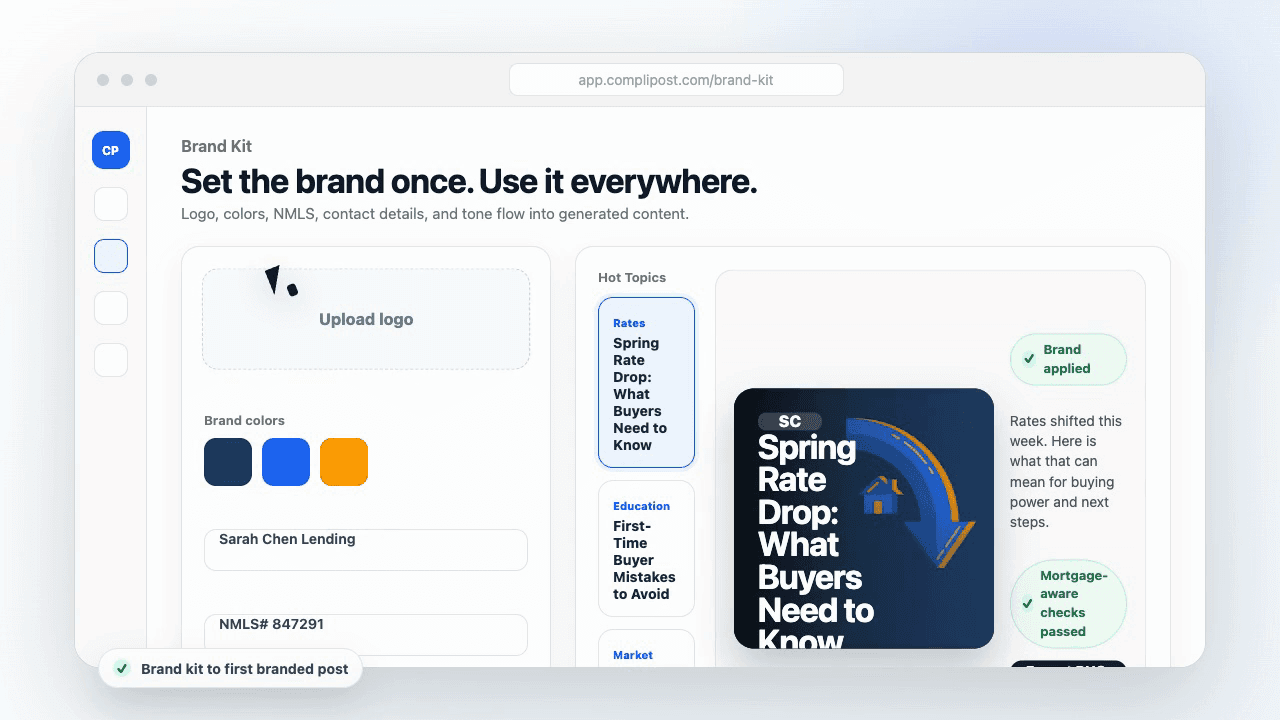
Product workflow
From blank page to export-ready mortgage content
- Start with a borrower topic
- Generate copy and a visual direction
- Review, save, and export the finished asset
These previews reflect the core CompliPost workflow: create, review, save, and export assets for use in your own channels.
Workflow comparison
| Content approach | What happens | Why it matters |
|---|---|---|
| Random posting | One-off ideas created when there is spare time | Inconsistent visibility and weak reuse |
| Template-only posting | Faster design but still requires rewriting and review | Helpful starting point, but not a full system |
| CompliPost workflow | Plan, generate, review, save, and export from one place | Better consistency with mortgage-aware review context |
| Done-for-you service | Someone else creates much of the content | Useful for some teams, but less control and less immediate reuse |
Who this guide helps
This guide is for loan officers working on solo loan officers who need a repeatable mortgage content workflow. The goal is to turn a broad mortgage topic into one borrower question, one useful takeaway, and one asset that can be reviewed before it is shared.
- You need content that sounds like a loan officer, not a generic brand account
- You want examples that can become captions, graphics, GIFs, or PDFs
- You need a clear place to review claims before export
- You want finished work saved for reuse, not lost in a chat thread
A practical workflow for this use case
Start with a narrow scenario, then move through planning, drafting, visual creation, review, and export. For ARM vs fixed-rate mortgage, that means the topic should be specific enough that a borrower or referral partner can immediately understand what decision the content helps with.
- Choose the borrower type, loan topic, or platform before generating copy
- Draft the caption and visual together so the asset feels cohesive
- Use the federal baseline review aid to flag claims and disclosure gaps
- Export the finished asset and save the post as a reusable starting point
What makes the content stronger
Strong mortgage content is usually specific, plain-spoken, and calm. It explains tradeoffs without pretending one answer fits every borrower. That is especially important on public social channels, where a short post can be interpreted without the full context of a loan conversation.
- Name the borrower question in the first line
- Explain one decision or tradeoff instead of covering everything
- Use examples without implying approval, savings, or rate outcomes
- End with a soft next step, checklist, or guide rather than pressure
Compliance-aware review notes
CompliPost should be treated as a review aid, not a compliance approval system. The public page, generated draft, graphic, and exported asset should all stay honest about that boundary.
- Review specific payment, APR, rate, savings, and qualification language
- Avoid “best,” “lowest,” “guaranteed,” “free,” and urgency claims unless approved
- Check NMLS, Equal Housing, company, and state-specific requirements
- Use company or legal review for anything outside the federal baseline
How this connects to the rest of CompliPost
A focused guide should leave you with a usable next step. After you understand the topic, you can turn it into a calendar slot, a reviewed social post, a downloadable guide, or a platform-specific version for the channel where your audience already spends time.
- Use the content calendar to turn the idea into a weekly plan
- Use the compliance page when claims or disclosures need a slower pass
- Use lead magnets when the topic deserves a deeper PDF guide
- Use platform pages to adapt the same idea for LinkedIn, Facebook, or Instagram
Recommended next steps
Refinance content hub
Create refinance education without overpromising outcomes.
How ARMs Work: Adjustment Periods Explained
A deeper dive into ARM mechanics: indices, margins, adjustment periods, and how to read an ARM disclosure.
Fixed-Rate Mortgages: Stability and Peace of Mind
Why borrowers choose fixed rates, how to educate on long-term predictability, and when to recommend fixed over ARM.
ARM vs Fixed: 5 Common Myths Loan Officers Bust
Debunk misconceptions about ARMs and fixed rates with facts and examples your borrowers will understand.
Examples
FAQ
Can an ARM ever convert to a fixed rate?+
No, an ARM stays an ARM for its life. However, borrowers can refinance into a fixed-rate loan at any time if rates and their financial situation make sense. Refinancing is a new loan application, so borrowers should understand the costs, timeline, and credit check involved. This is a great educational hook for your social content.
What happens to my monthly payment when an ARM adjusts?+
The lender recalculates your payment based on the new interest rate, outstanding balance, and remaining term. Your payment will increase if rates rise, decrease if rates fall. The loan documents specify caps on how much the rate can change per adjustment and over the life of the loan—understanding these caps is essential for borrowers to avoid surprises.
Is an ARM risky?+
Risk depends on the borrower's situation. An ARM is less risky for someone planning to sell in three years; it's riskier for someone intending to stay 30 years on a tight budget. The real risk comes from not understanding the terms, caps, and timeline—this is where your compliance-aware education on social media adds value. Encourage borrowers to read their Loan Estimate, ask questions, and run scenarios with their lender.
Why would anyone choose an ARM if fixed rates exist?+
The trade-off is real: a lower initial rate and payment in exchange for future uncertainty. For someone relocating in five years, an ARM saves money upfront. For someone prioritizing predictability, a fixed rate is worth the higher initial rate. Your job is to help borrowers understand their own priorities, timelines, and risk tolerance—not to push them toward one option.
How do I explain ARM caps in a social media post?+
Use a simple example: "This ARM has a 2% per-adjustment cap and a 6% lifetime cap. That means the rate can't jump more than 2% at each adjustment, and can't rise more than 6% over the entire loan." Avoid specific numbers from real mortgages; instead, explain the concept so borrowers know what to look for in their own documents. CompliPost's review aid helps flag risky language before you post.
Create mortgage content with a calmer workflow
CompliPost helps you plan, generate, review, save, and export useful mortgage content without pretending compliance or social distribution is automatic.
Start free