Fixed-Rate Benefits
Fixed-Rate Mortgages: Locked-In Stability for 15, 20, or 30 Years
A fixed-rate mortgage is simple and powerful: the same interest rate and payment for the entire loan term, whether that's 15, 20, or 30 years. Borrowers never worry about rate increases, payment shock, or market risk. It's the mortgage of certainty—and for borrowers planning to stay long-term or valuing predictability, that stability is worth paying for. Your social content can highlight this honest benefit.
What Makes Fixed-Rate Mortgages Predictable?
With a fixed-rate mortgage, the interest rate is locked at closing and never changes. Your monthly principal-and-interest payment stays identical for 15, 20, or 30 years. Property taxes and insurance may change, but the mortgage payment itself is unchanging. This predictability is powerful: borrowers can budget with certainty, plan for the future, and know exactly when the loan will be paid off.
- Interest rate is locked at closing for the entire loan term
- Monthly P&I payment never changes, regardless of market conditions
- Provides certainty for long-term financial planning
- Eliminates surprise payment increases if rates rise in the market
- Appeal to borrowers who value stability over short-term savings
Why Do Borrowers Choose Fixed-Rate Over ARM?
Fixed-rate mortgages cost more upfront (higher starting rate than an ARM), but borrowers gain years of peace of mind. Someone planning to stay 20 years in a home, retiring in the next decade, or simply uncomfortable with the idea of future uncertainty chooses a fixed rate for emotional and financial reasons. This is not irrationality—it's aligning the mortgage to lifestyle and values.
- Higher starting rate than ARM, but no future adjustments
- Appeals to long-term homeowners (10+ years)
- Ideal for retirees on fixed income
- Right choice for borrowers who value certainty over short-term savings
- Eliminates need to track indices, margins, or monitor rate markets
Fixed-Rate Mortgages and Long-Term Budgeting
The most underrated benefit of a fixed-rate mortgage is long-term budgeting simplicity. A borrower in year 1, year 10, and year 28 of a 30-year mortgage knows their payment will be identical. They can plan for home improvements, college savings, retirement, or unexpected expenses without worrying that their mortgage payment will spike. This stability enables other financial goals.
- Same payment in year 1 as in year 30 (except tax/insurance changes)
- Enables confident multi-decade financial planning
- Borrowers can allocate savings toward other goals without mortgage payment fear
- Appeals to families planning for children's education, retirement
- Simplifies household budgeting over decades
How to Educate on Fixed-Rate Value on Social Media
Avoid saying fixed-rate is always better—it's better for specific borrowers. Instead, frame it honestly: "If you're staying 20+ years or comfort matters more than rate savings, fixed-rate means no surprises, no adjustments, no rate tracking. You set it and forget it." This helps borrowers self-identify and see fixed-rate stability as a genuine feature, not a penalty.
- Highlight the peace-of-mind value of unchanging payments
- Explain that certainty has legitimate financial and emotional worth
- Help borrowers see fixed-rate as matching their long-term homeowner timeline
- Avoid rate comparisons; focus on stability benefits
- Use CompliPost's review tool to ensure balanced tone
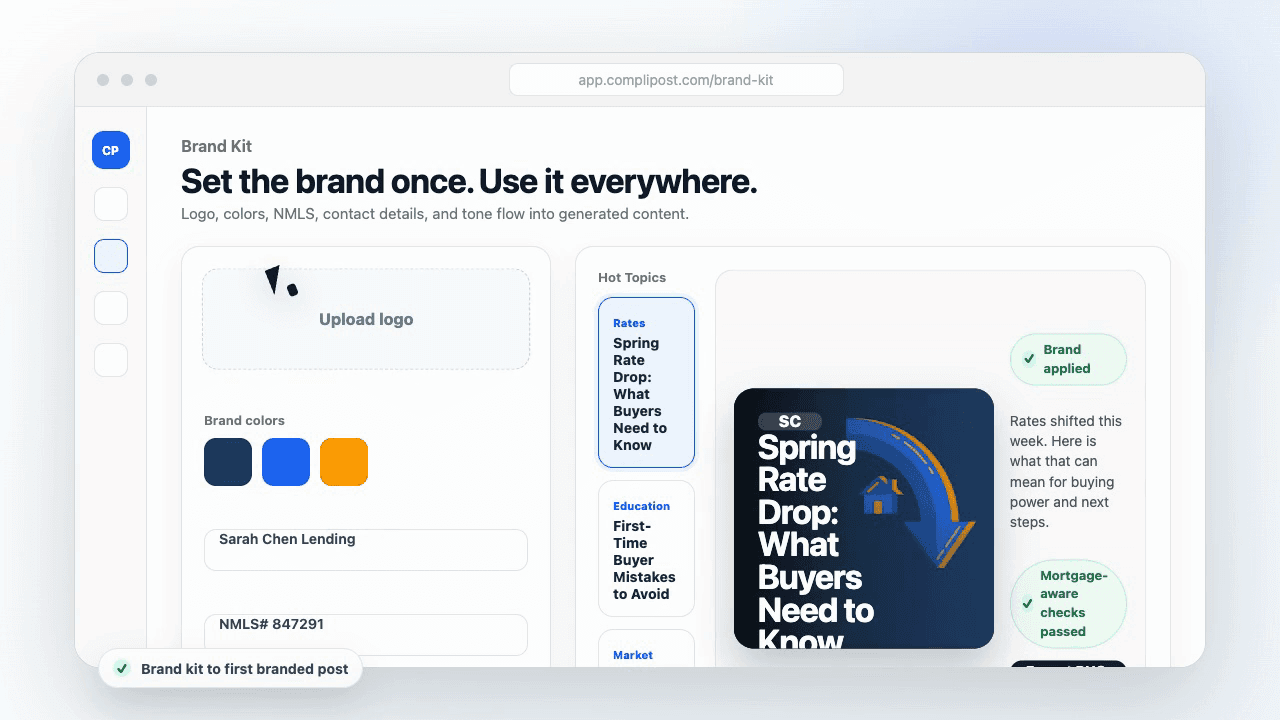
Product workflow
From blank page to export-ready mortgage content
- Start with a borrower topic
- Generate copy and a visual direction
- Review, save, and export the finished asset
These previews reflect the core CompliPost workflow: create, review, save, and export assets for use in your own channels.
Workflow comparison
| Content approach | What happens | Why it matters |
|---|---|---|
| Random posting | One-off ideas created when there is spare time | Inconsistent visibility and weak reuse |
| Template-only posting | Faster design but still requires rewriting and review | Helpful starting point, but not a full system |
| CompliPost workflow | Plan, generate, review, save, and export from one place | Better consistency with mortgage-aware review context |
| Done-for-you service | Someone else creates much of the content | Useful for some teams, but less control and less immediate reuse |
Who this guide helps
This guide is for loan officers working on solo loan officers who need a repeatable mortgage content workflow. The goal is to turn a broad mortgage topic into one borrower question, one useful takeaway, and one asset that can be reviewed before it is shared.
- You need content that sounds like a loan officer, not a generic brand account
- You want examples that can become captions, graphics, GIFs, or PDFs
- You need a clear place to review claims before export
- You want finished work saved for reuse, not lost in a chat thread
A practical workflow for this use case
Start with a narrow scenario, then move through planning, drafting, visual creation, review, and export. For fixed-rate mortgage stability predictability, that means the topic should be specific enough that a borrower or referral partner can immediately understand what decision the content helps with.
- Choose the borrower type, loan topic, or platform before generating copy
- Draft the caption and visual together so the asset feels cohesive
- Use the federal baseline review aid to flag claims and disclosure gaps
- Export the finished asset and save the post as a reusable starting point
What makes the content stronger
Strong mortgage content is usually specific, plain-spoken, and calm. It explains tradeoffs without pretending one answer fits every borrower. That is especially important on public social channels, where a short post can be interpreted without the full context of a loan conversation.
- Name the borrower question in the first line
- Explain one decision or tradeoff instead of covering everything
- Use examples without implying approval, savings, or rate outcomes
- End with a soft next step, checklist, or guide rather than pressure
Compliance-aware review notes
CompliPost should be treated as a review aid, not a compliance approval system. The public page, generated draft, graphic, and exported asset should all stay honest about that boundary.
- Review specific payment, APR, rate, savings, and qualification language
- Avoid “best,” “lowest,” “guaranteed,” “free,” and urgency claims unless approved
- Check NMLS, Equal Housing, company, and state-specific requirements
- Use company or legal review for anything outside the federal baseline
How this connects to the rest of CompliPost
A focused guide should leave you with a usable next step. After you understand the topic, you can turn it into a calendar slot, a reviewed social post, a downloadable guide, or a platform-specific version for the channel where your audience already spends time.
- Use the content calendar to turn the idea into a weekly plan
- Use the compliance page when claims or disclosures need a slower pass
- Use lead magnets when the topic deserves a deeper PDF guide
- Use platform pages to adapt the same idea for LinkedIn, Facebook, or Instagram
Recommended next steps
Refinance content hub
Create refinance education without overpromising outcomes.
ARM vs Fixed-Rate Mortgages: A Simple Explanation
Start with the fundamental difference before diving into fixed-rate-specific benefits.
Who Is an ARM Right For? Borrower Profiles and Timelines
Understand ARM profiles to better position fixed-rate stability in contrast.
ARM vs Fixed: When to Recommend Each Option
A framework for helping borrowers choose the mortgage type that fits their life.
Examples
FAQ
Can I refinance a fixed-rate mortgage to lower my rate?+
Yes—at any time, you can refinance a fixed-rate mortgage into a new fixed-rate or ARM if rates drop enough to justify closing costs. Refinancing is a new loan application with fees, appraisals, and credit checks. It makes sense only if the rate savings outweigh the costs and you plan to stay long enough to recoup the costs. Calculate break-even carefully.
Why is a fixed-rate mortgage's starting rate higher than an ARM?+
Lenders charge more upfront to lock a rate for 15–30 years because they're bearing the long-term interest-rate risk. If rates fall after you close, the lender missed out on higher future payments. If rates rise, they're stuck with a below-market rate. That long-term certainty you get as a borrower costs the lender, and they price it in.
What happens if I want to sell a fixed-rate home before the loan ends?+
You sell the home and use the sale proceeds to pay off the remaining mortgage balance. The fixed-rate loan ends, and you have no further obligation. If you haven't paid off the full balance, the difference comes from the sale price. There's no penalty for paying off a fixed-rate loan early (though confirm this in your loan documents).
Is a 15-year fixed rate or 30-year fixed rate better?+
It depends on budget and goals. A 15-year mortgage has a higher monthly payment but you own the home sooner and pay less interest overall. A 30-year mortgage has a lower monthly payment but takes longer to pay off and costs more in total interest. Compare what fits your budget now and your financial goals long-term. No universally "better" option.
How do I explain fixed-rate benefits without knocking ARMs?+
Frame it factually: 'Fixed-rate means stable, unchanging payments for the life of the loan. ARMs offer lower early payments but adjustments later. Which fits your situation better?' This respects both options and helps borrowers see their own fit rather than thinking one is objectively better.
Create mortgage content with a calmer workflow
CompliPost helps you plan, generate, review, save, and export useful mortgage content without pretending compliance or social distribution is automatic.
Start free