ARM Advantage
ARMs for Short-Term Owners: Real Money Saved in Years 1–5
If a borrower plans to sell, refinance, or relocate within 3–5 years, an ARM often makes straightforward financial sense. The lower starting rate saves real money during the years they own the home, and they exit before adjustments become a concern. This is the clearest ARM case—no complexity, genuine savings, and your social content can highlight this honestly.
The Math: What Does an ARM Actually Save Over 5 Years?
An ARM with a 0.5–1% lower starting rate than a fixed-rate mortgage saves borrowers real money over the first 5 years. If the difference is 0.5% on a $300,000 loan, the monthly payment savings are roughly $145. Over 5 years, that's $8,700 in genuine savings before even considering that they'll sell and avoid adjustments entirely. This is a concrete benefit, not speculation.
- 0.5–1% rate difference translates to $100–200/month savings for typical loans
- Over 5 years, those savings compound to $6,000–12,000
- Short-term owners don't experience adjustments, so all savings are locked in
- Use real numbers from loan estimates to show borrower-specific savings
- Acknowledge that savings aren't guaranteed, but the mechanism is clear
Why ARMs Work for Corporate Relocations
Corporate relocates are the ideal ARM case: borrower gets a relocation package, moves in 3–5 years with certainty, and takes advantage of ARM savings without adjustment risk. Your social content can highlight this scenario without fear language. It's a straightforward win for relocating borrowers.
- Relocating borrowers know their exit timeline with certainty
- ARM savings are captured before the relocation
- Refinance or sale happens before adjustments kick in
- Relocation packages often cover selling costs, making ARM savings pure benefit
- This is a clear educational angle for your social content
What Happens to the ARM When a Short-Term Owner Sells?
When a short-term owner sells, the mortgage is paid off from the sale proceeds—the ARM ends, and the buyer (or refinanced borrower) takes a fresh mortgage. The original ARM borrower never experiences an adjustment. The ARM served its purpose: lower costs for the years of ownership, then exit. Clean and simple.
- ARM ends when borrower sells; outstanding balance paid from sale proceeds
- No need to worry about what happens after year 5 if you've sold by then
- New buyer gets a fresh underwriting and can choose their own loan type
- Original ARM borrower's story ends at the sale
- This clarity eliminates uncertainty from the equation
How to Create Social Content Around ARM Advantages for Short-Term Owners
Focus on scenarios, not rates. 'Relocating in 3 years? An ARM could save you $8,000–12,000 before you move. Here's why.' This is specific, concrete, and honest—no fearmongering, no predictions, just math. Borrowers in this situation will self-identify and appreciate the education.
- Target borrowers with clear exit timelines: relocations, job changes, planned moves
- Use generic savings ranges, not specific rate projections
- Explain why early exit matters: no adjustments, pure savings
- Add the caveat: 'This assumes you're out before year 6/7/10—whatever your ARM timeline is'
- Save and reuse for repeatability
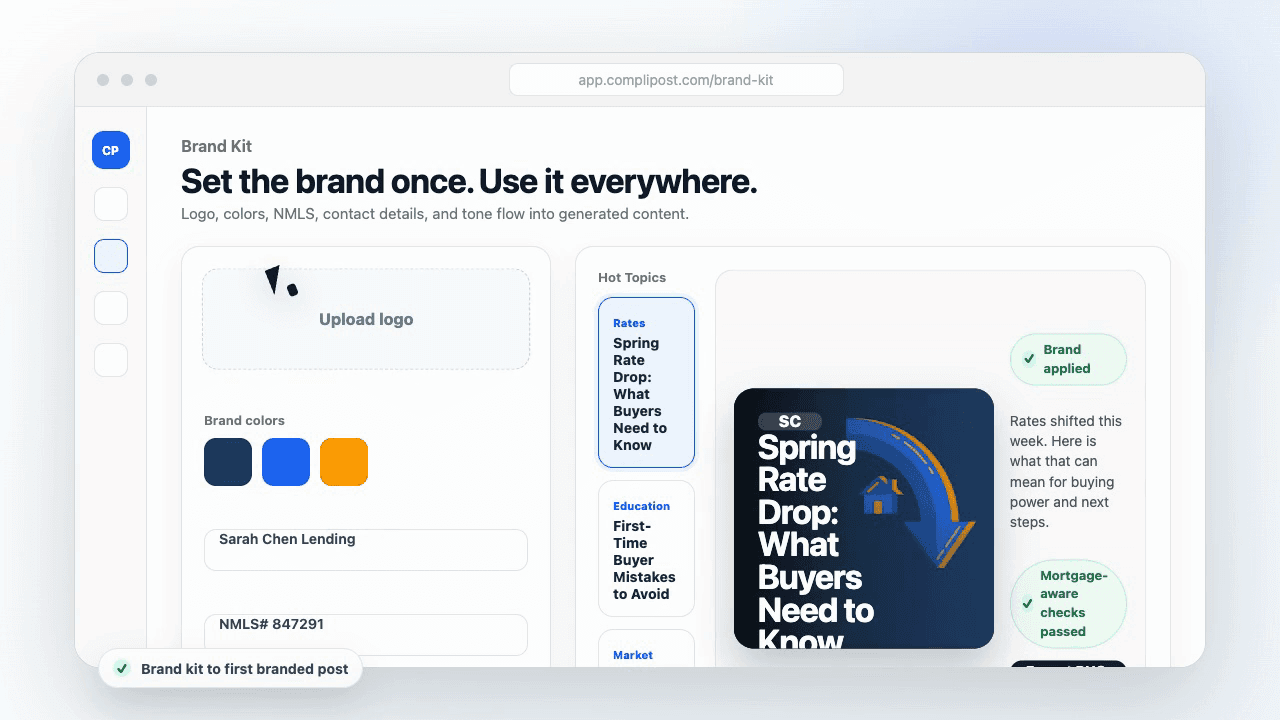
Product workflow
From blank page to export-ready mortgage content
- Start with a borrower topic
- Generate copy and a visual direction
- Review, save, and export the finished asset
These previews reflect the core CompliPost workflow: create, review, save, and export assets for use in your own channels.
Workflow comparison
| Content approach | What happens | Why it matters |
|---|---|---|
| Random posting | One-off ideas created when there is spare time | Inconsistent visibility and weak reuse |
| Template-only posting | Faster design but still requires rewriting and review | Helpful starting point, but not a full system |
| CompliPost workflow | Plan, generate, review, save, and export from one place | Better consistency with mortgage-aware review context |
| Done-for-you service | Someone else creates much of the content | Useful for some teams, but less control and less immediate reuse |
Who this guide helps
This guide is for loan officers working on solo loan officers who need a repeatable mortgage content workflow. The goal is to turn a broad mortgage topic into one borrower question, one useful takeaway, and one asset that can be reviewed before it is shared.
- You need content that sounds like a loan officer, not a generic brand account
- You want examples that can become captions, graphics, GIFs, or PDFs
- You need a clear place to review claims before export
- You want finished work saved for reuse, not lost in a chat thread
A practical workflow for this use case
Start with a narrow scenario, then move through planning, drafting, visual creation, review, and export. For ARM short-term homeowner relocation, that means the topic should be specific enough that a borrower or referral partner can immediately understand what decision the content helps with.
- Choose the borrower type, loan topic, or platform before generating copy
- Draft the caption and visual together so the asset feels cohesive
- Use the federal baseline review aid to flag claims and disclosure gaps
- Export the finished asset and save the post as a reusable starting point
What makes the content stronger
Strong mortgage content is usually specific, plain-spoken, and calm. It explains tradeoffs without pretending one answer fits every borrower. That is especially important on public social channels, where a short post can be interpreted without the full context of a loan conversation.
- Name the borrower question in the first line
- Explain one decision or tradeoff instead of covering everything
- Use examples without implying approval, savings, or rate outcomes
- End with a soft next step, checklist, or guide rather than pressure
Compliance-aware review notes
CompliPost should be treated as a review aid, not a compliance approval system. The public page, generated draft, graphic, and exported asset should all stay honest about that boundary.
- Review specific payment, APR, rate, savings, and qualification language
- Avoid “best,” “lowest,” “guaranteed,” “free,” and urgency claims unless approved
- Check NMLS, Equal Housing, company, and state-specific requirements
- Use company or legal review for anything outside the federal baseline
How this connects to the rest of CompliPost
A focused guide should leave you with a usable next step. After you understand the topic, you can turn it into a calendar slot, a reviewed social post, a downloadable guide, or a platform-specific version for the channel where your audience already spends time.
- Use the content calendar to turn the idea into a weekly plan
- Use the compliance page when claims or disclosures need a slower pass
- Use lead magnets when the topic deserves a deeper PDF guide
- Use platform pages to adapt the same idea for LinkedIn, Facebook, or Instagram
Recommended next steps
Refinance content hub
Create refinance education without overpromising outcomes.
Who Is an ARM Right For? Borrower Profiles and Timelines
Short-term owners are the clearest ARM fit—explore other profiles too.
ARM vs Fixed-Rate Mortgages: A Simple Explanation
Provide foundational education before diving into the short-term-owner angle.
ARM vs Fixed: When to Recommend Each Option
Use timeline as the primary decision driver for ARM recommendations.
Examples
FAQ
What if a short-term owner's plans change and they don't move?+
Then they'll experience adjustments starting in year 6 or 7 (depending on their ARM). They have options: refinance into a fixed-rate (costs to refinance, but possible), continue with adjustments, or sell for other reasons. This is why borrowers should enter an ARM with clear understanding: 'If circumstances change and you stay, here's what happens.' Then they can plan.
Should I recommend an ARM to all short-term owners?+
Not automatically. Some short-term owners are uncomfortable with the concept of adjustments, even if they won't experience them. Some value the psychological simplicity of a fixed rate. The ARM advantage is strong for short-term owners, but the recommendation should still flow from the borrower's comfort and situation, not just their timeline.
How much do ARM savings usually amount to for someone exiting in 5 years?+
Typical ARM/fixed-rate differences are 0.5–1%, translating to $100–200/month on a $300,000 loan. Over 5 years, that's $6,000–12,000. These are rough estimates; actual savings depend on specific loan amounts, rates, and terms. Use Loan Estimates to show borrower-specific numbers.
What if rates drop after the short-term owner closes?+
The ARM borrower still wins because they benefited from the lower starting ARM rate. If they refinance into a lower fixed-rate loan, that's a separate decision with its own costs/benefits. The ARM's advantage was captured upfront; rate drops afterward don't change that.
How do I handle short-term owners who still want a fixed-rate?+
That's their choice. Some borrowers value simplicity and peace of mind over potential savings. Respect that. If they're insistent, honor it; forcing an ARM onto a borrower who doesn't want it creates resentment and risk. Educate on the numbers, then let them choose.
Create mortgage content with a calmer workflow
CompliPost helps you plan, generate, review, save, and export useful mortgage content without pretending compliance or social distribution is automatic.
Start free