International Context
ARM vs Fixed-Rate for International Borrowers and Immigrant Communities
International borrowers, visa holders, and recent immigrants sometimes have unique circumstances: planned returns to home countries, visa expiration timelines, income documentation challenges, or unfamiliarity with U.S. mortgage norms. These factors should inform ARM vs. fixed-rate choices. Your education can be culturally aware and respectful.
Visa Expiration and Return Plans
A borrower on an H-1B visa expiring in 5 years has a clear timeline: either renew the visa or return home. This timeline might make an ARM attractive (low initial rate, exit before adjustments). Or it might argue for fixed-rate (simplicity, no surprises during visa uncertainty). The key is honest conversation about visa status and plans—neither is taboo; both are relevant financial questions.
- H-1B, L-1, EB-visa timelines create clear mortgage decision windows
- ARM can work if borrower knows they'll exit before adjustments
- Fixed-rate might simplify finances during visa uncertainty
- Permanent residents or citizenship holders have different considerations
- Honest conversation about status and plans is professional, not invasive
Currency, Income Documentation, and Risk
Borrowers with income in foreign currencies or complex income documentation might face challenges refinancing or proving ability to absorb ARM adjustments. For this population, fixed-rate reduces refinancing necessity and provides budgeting simplicity. If income documentation is difficult now, it might be harder if they need to refinance later.
- Foreign income and documentation can complicate future refinancing
- Fixed-rate eliminates need to refinance for rate reasons later
- Budgeting simplicity helps borrowers manage finances in new country
- Currency risk is real for international borrowers; fixed-rate hedges this
- Consider documentation challenges in ARM vs. fixed-rate calculus
Educating Without Stereotyping
International borrowers are individuals with diverse financial situations. Don't assume all international borrowers want short-term loans or are uncertain about U.S. markets. Instead, ask the same questions you ask all borrowers: timeline, income stability, risk tolerance. Listen to their answers and educate based on their specific situation, not assumptions.
- Ask the same questions as you ask all borrowers—don't assume
- Listen to their timeline, income plans, and risk tolerance
- Acknowledge their immigrant experience respectfully if relevant
- Educate based on their situation, not national origin or visa status
- Use translators or cultural advisors if language or understanding is a barrier
Special Considerations and Resources
Some lenders and non-profits specialize in international and immigrant borrowers. Know what's available in your market: lenders experienced with visa-based borrowers, non-profit housing counselors fluent in relevant languages, down-payment assistance for immigrants. These resources help borrowers navigate U.S. mortgages with cultural awareness and personalized support.
- Some lenders specialize in H-1B, L-1, visa-based borrowers
- Non-profit housing counselors often serve immigrant communities
- Down-payment assistance programs in some areas target immigrants
- Bilingual or multilingual advisors help bridge communication gaps
- Know what's available and refer proactively
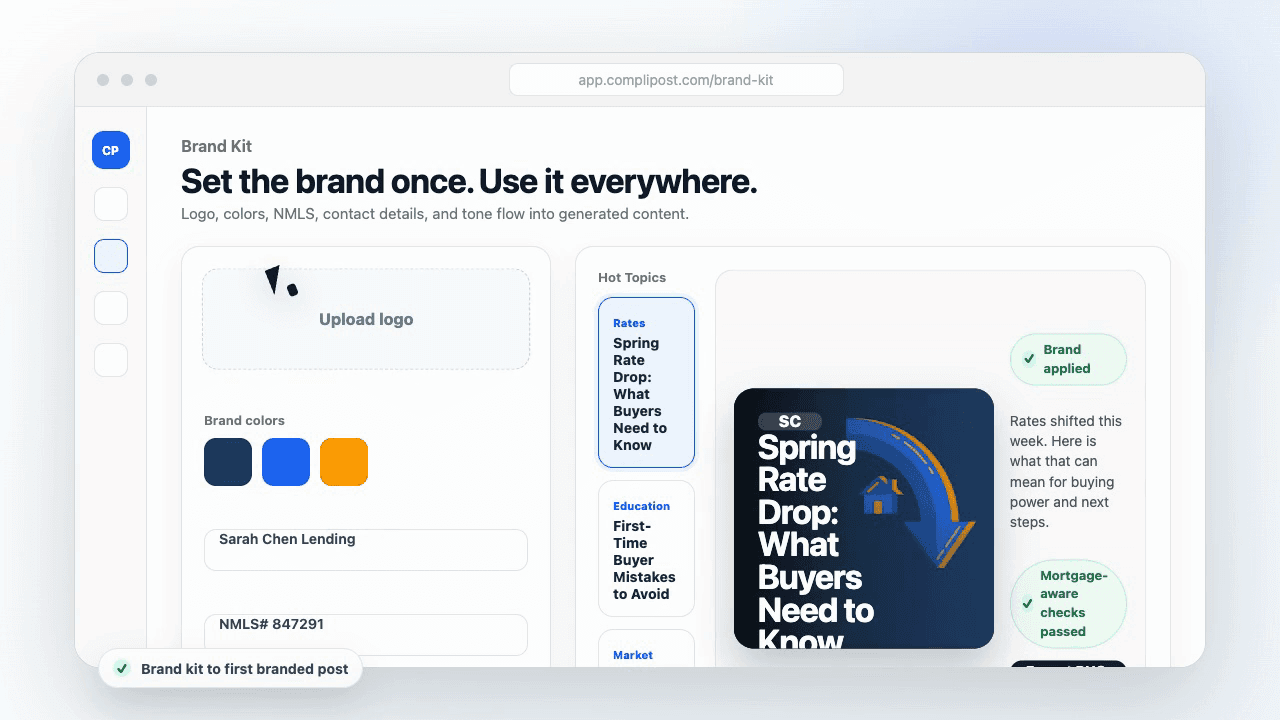
Product workflow
From blank page to export-ready mortgage content
- Start with a borrower topic
- Generate copy and a visual direction
- Review, save, and export the finished asset
These previews reflect the core CompliPost workflow: create, review, save, and export assets for use in your own channels.
Workflow comparison
| Content approach | What happens | Why it matters |
|---|---|---|
| Random posting | One-off ideas created when there is spare time | Inconsistent visibility and weak reuse |
| Template-only posting | Faster design but still requires rewriting and review | Helpful starting point, but not a full system |
| CompliPost workflow | Plan, generate, review, save, and export from one place | Better consistency with mortgage-aware review context |
| Done-for-you service | Someone else creates much of the content | Useful for some teams, but less control and less immediate reuse |
Who this guide helps
This guide is for loan officers working on solo loan officers who need a repeatable mortgage content workflow. The goal is to turn a broad mortgage topic into one borrower question, one useful takeaway, and one asset that can be reviewed before it is shared.
- You need content that sounds like a loan officer, not a generic brand account
- You want examples that can become captions, graphics, GIFs, or PDFs
- You need a clear place to review claims before export
- You want finished work saved for reuse, not lost in a chat thread
A practical workflow for this use case
Start with a narrow scenario, then move through planning, drafting, visual creation, review, and export. For ARM fixed-rate international borrower visa immigrant, that means the topic should be specific enough that a borrower or referral partner can immediately understand what decision the content helps with.
- Choose the borrower type, loan topic, or platform before generating copy
- Draft the caption and visual together so the asset feels cohesive
- Use the federal baseline review aid to flag claims and disclosure gaps
- Export the finished asset and save the post as a reusable starting point
What makes the content stronger
Strong mortgage content is usually specific, plain-spoken, and calm. It explains tradeoffs without pretending one answer fits every borrower. That is especially important on public social channels, where a short post can be interpreted without the full context of a loan conversation.
- Name the borrower question in the first line
- Explain one decision or tradeoff instead of covering everything
- Use examples without implying approval, savings, or rate outcomes
- End with a soft next step, checklist, or guide rather than pressure
Compliance-aware review notes
CompliPost should be treated as a review aid, not a compliance approval system. The public page, generated draft, graphic, and exported asset should all stay honest about that boundary.
- Review specific payment, APR, rate, savings, and qualification language
- Avoid “best,” “lowest,” “guaranteed,” “free,” and urgency claims unless approved
- Check NMLS, Equal Housing, company, and state-specific requirements
- Use company or legal review for anything outside the federal baseline
How this connects to the rest of CompliPost
A focused guide should leave you with a usable next step. After you understand the topic, you can turn it into a calendar slot, a reviewed social post, a downloadable guide, or a platform-specific version for the channel where your audience already spends time.
- Use the content calendar to turn the idea into a weekly plan
- Use the compliance page when claims or disclosures need a slower pass
- Use lead magnets when the topic deserves a deeper PDF guide
- Use platform pages to adapt the same idea for LinkedIn, Facebook, or Instagram
Recommended next steps
Refinance content hub
Create refinance education without overpromising outcomes.
ARM vs Fixed-Rate Mortgages: A Simple Explanation
Foundational education translated or explained clearly for international borrowers.
ARM vs Fixed: When to Recommend Each Option
The decision framework applies; ask the same questions regardless of borrower origin.
ARMs for Short-Term Homeowners: When the Numbers Make Sense
Visa timeline might make an ARM's short-term appeal relevant.
Examples
FAQ
Should I ask about visa status and immigration plans?+
Yes, respectfully and professionally. 'What's your visa status, and how long are you planning to stay in the U.S.?' is a legitimate question for mortgage planning. It determines timeline, refinancing likelihood, and overall financial stability. Ask the same way you'd ask a domestic borrower about relocation plans.
What if an international borrower is uncertain about long-term plans?+
That's information in itself. Uncertainty argues for fixed-rate—simpler finances, no need to refinance, no ARM adjustment risk. Say: 'If you're uncertain about long-term plans, fixed-rate takes the uncertainty out of your monthly payment. That might be valuable.' This frames fixed-rate as practical, not patronizing.
Can I recommend different products to international vs. domestic borrowers with similar situations?+
Not based on national origin or immigration status alone—that would be discrimination. However, if visa timeline, currency risk, or income documentation differences are real factors, they're valid considerations. Educate based on documented factors, not assumptions.
Should I connect international borrowers with specialized resources?+
Yes, proactively. If you know lenders, counselors, or non-profits that specialize in international or immigrant borrowers, refer them. This shows you respect their situation and want them to have expert support. It's not a slight to your expertise; it's providing the right match.
What if language is a barrier to understanding ARM vs. fixed-rate?+
Use a professional translator or bilingual loan officer. Don't rely on family members to interpret financial conversations—there's too much at stake. Invest in professional interpretation so the borrower understands the choice fully.
Create mortgage content with a calmer workflow
CompliPost helps you plan, generate, review, save, and export useful mortgage content without pretending compliance or social distribution is automatic.
Start free