Pre-approval
Create a Getting-Started Checklist for Pre-Approval
Loan officers can streamline the pre-approval process for borrowers by offering a clear, actionable checklist. This guide helps you design a borrower-friendly getting-started checklist, detailing the initial steps needed for pre-approval. By using this framework, loan officers can efficiently communicate the necessary actions to prospective buyers, making the process less daunting. This approach not only aids in borrower education but also positions you as a reliable resource in their homebuying journey. Use CompliPost to craft engaging captions, graphics, and follow-up posts that align with your checklist.
Essential Elements of a Getting-Started Checklist
A well-crafted checklist simplifies the pre-approval process for borrowers by breaking down the initial steps. Focus on necessary actions like gathering financial documents, considering a realistic budget, and contacting a loan officer. This targeted list should feel manageable, encouraging prospective buyers to proceed confidently. As a loan officer, your role is to ensure the checklist remains straightforward and actionable, providing guidance without overwhelming the borrower. Keeping it concise helps maintain their momentum as they embark on the homebuying process. pre-approval getting started checklist content caption angle: name one borrower decision, add one document cue, close with one calm question. pre-approval getting started checklist content planner note: keep the wording educational and leave room for individual review.
- Collect essential financial documents
- Assess a comfortable budget range
- Initiate contact with a loan officer
- Prepare key questions to discuss
- Ensure list remains concise and achievable
Balancing Detail and Simplicity
When creating your checklist, focus on the genuine first steps without delving into the entire pre-approval process. The goal is to present an achievable path that encourages action rather than stalling the buyer with complexity. By limiting the checklist to only the most immediate tasks, you help borrowers feel empowered to take the next step. Each item should be clear and simple, directing more detailed discussions to your in-person or virtual meetings. pre-approval getting started checklist content borrower concern: explain what a lender may verify, why the step matters, and how a reader can prepare. pre-approval getting started checklist content content should clarify without becoming personal advice.
- Highlight only immediate initial steps
- Avoid detailing the comprehensive process
- Simplify each task for clarity
- Encourage a sense of achievement
- Direct further details to personal interaction
Effective Formats for Your Checklist
Presenting your checklist in various formats can enhance its accessibility and appeal. Consider creating a clean and visually appealing graphic or a short introductory video. These formats can make the information more digestible and engaging, especially for visual learners. Additionally, an FAQ post addressing common pre-approval questions can serve as a valuable resource. Each format should maintain an encouraging tone, motivating buyers to begin their journey with confidence. pre-approval getting started checklist content compliance note: avoid exact terms, certainty language, and rushed decisions. pre-approval getting started checklist content works better as education when it explains a tradeoff and invites a specific question.
- Design a visually clean checklist graphic
- Produce a concise 'start here' video
- Craft an informative FAQ post
- Write a motivational caption for social media
- Prepare a reusable buyer-education template
Compliance and Review Considerations
Ensuring your checklist content complies with industry regulations is crucial. Each element should adhere to guidelines such as TILA or UDAAP, particularly when discussing financial advice or potential outcomes. It's vital to review your checklist for any suggestions or missing disclosures that could mislead borrowers. Use CompliPost's compliance check tools to validate your content before distribution, keeping your communications clear and compliant. pre-approval getting started checklist content reuse plan: make one caption, one carousel point, one email follow-up, and one saved template. pre-approval getting started checklist content then supports social, partner, and nurture workflows.
- Ensure alignment with TILA and UDAAP guidelines
- Avoid suggestions about results or approvals
- Incorporate necessary disclosures
- Utilize compliance tools for content validation
- Maintain transparency in all communications
Product workflow
From blank page to export-ready mortgage content
- Start with a borrower topic
- Generate copy and a visual direction
- Review, save, and export the finished asset
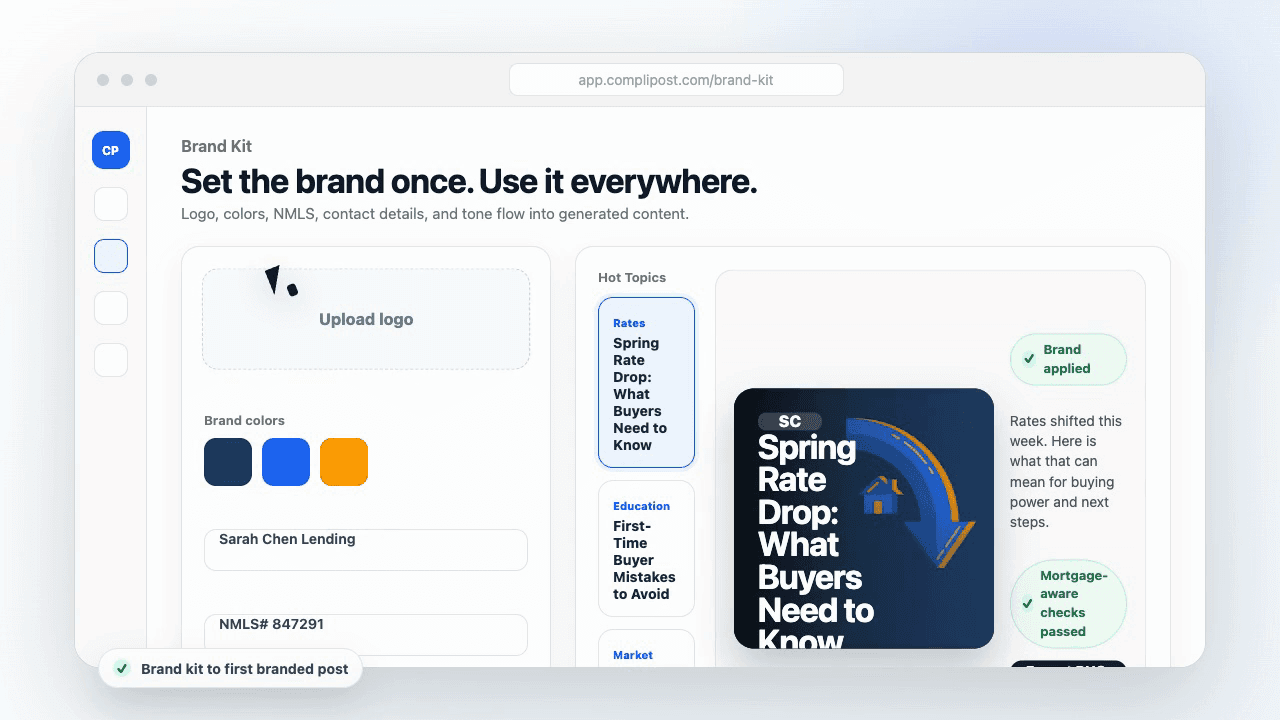
These previews reflect the core CompliPost workflow: create, review, save, and export assets for use in your own channels.
Workflow comparison
| Content approach | What happens | Why it matters |
|---|---|---|
| Random posting | One-off ideas created when there is spare time | Inconsistent visibility and weak reuse |
| Template-only posting | Faster design but still requires rewriting and review | Helpful starting point, but not a full system |
| CompliPost workflow | Plan, generate, review, save, and export from one place | Better consistency with mortgage-aware review context |
| Done-for-you service | Someone else creates much of the content | Useful for some teams, but less control and less immediate reuse |
Who this guide helps
This guide is for loan officers working on solo loan officers who need a repeatable mortgage content workflow. The goal is to turn a broad mortgage topic into one borrower question, one useful takeaway, and one asset that can be reviewed before it is shared.
- You need content that sounds like a loan officer, not a generic brand account
- You want examples that can become captions, graphics, GIFs, or PDFs
- You need a clear place to review claims before export
- You want finished work saved for reuse, not lost in a chat thread
A practical workflow for this use case
Start with a narrow scenario, then move through planning, drafting, visual creation, review, and export. For pre-approval getting started checklist content, that means the topic should be specific enough that a borrower or referral partner can immediately understand what decision the content helps with.
- Choose the borrower type, loan topic, or platform before generating copy
- Draft the caption and visual together so the asset feels cohesive
- Use the federal baseline review aid to flag claims and disclosure gaps
- Export the finished asset and save the post as a reusable starting point
What makes the content stronger
Strong mortgage content is usually specific, plain-spoken, and calm. It explains tradeoffs without pretending one answer fits every borrower. That is especially important on public social channels, where a short post can be interpreted without the full context of a loan conversation.
- Name the borrower question in the first line
- Explain one decision or tradeoff instead of covering everything
- Use examples without implying approval, savings, or rate outcomes
- End with a soft next step, checklist, or guide rather than pressure
Compliance-aware review notes
CompliPost should be treated as a review aid, not a compliance approval system. The public page, generated draft, graphic, and exported asset should all stay honest about that boundary.
- Review specific payment, APR, rate, savings, and qualification language
- Avoid “best,” “lowest,” “guaranteed,” “free,” and urgency claims unless approved
- Check NMLS, Equal Housing, company, and state-specific requirements
- Use company or legal review for anything outside the federal baseline
How this connects to the rest of CompliPost
A focused guide should leave you with a usable next step. After you understand the topic, you can turn it into a calendar slot, a reviewed social post, a downloadable guide, or a platform-specific version for the channel where your audience already spends time.
- Use the content calendar to turn the idea into a weekly plan
- Use the compliance page when claims or disclosures need a slower pass
- Use lead magnets when the topic deserves a deeper PDF guide
- Use platform pages to adapt the same idea for LinkedIn, Facebook, or Instagram
Recommended next steps
First-time buyer content hub
Build clear education for first-time buyers.
Mortgage content calendar
Plan a weekly rhythm of useful borrower and referral-partner posts.
Pre-approval first step
Reframe pre-approval as step one.
Compliance checklist tool
Check common mortgage marketing risk signals before export.
Examples
FAQ
What should a getting-started checklist include?+
A getting-started checklist should include initial steps like gathering essential financial documents, assessing a realistic budget, and contacting a loan officer. Keeping it concise helps borrowers take action without feeling overwhelmed. Details and complex questions should be reserved for discussions, ensuring clarity and simplicity in the initial stages.
Why is it important to keep the checklist short?+
A short checklist prevents overwhelming borrowers, encouraging them to take action. By focusing on the immediate first steps, you help maintain their momentum and confidence. An achievable list leads to progress, while a lengthy one may deter them from starting the process altogether. Simplicity is key to effective borrower guidance.
Can the checklist assure an approval outcome?+
No, a checklist should not suggest any specific outcomes or approvals. Its purpose is to guide borrowers through the initial steps of the pre-approval process. Encouraging them to start and engage in a conversation with you can lead to a better understanding of their unique situation and potential pathways.
Is this checklist format reusable for different borrowers?+
Yes, the getting-started checklist is a versatile tool that can be reused for various borrowers. By saving it as a template, you can quickly adapt it to different client scenarios. The foundational steps remain consistent, ensuring that you provide reliable and consistent guidance throughout the pre-approval process.
Create mortgage content with a calmer workflow
CompliPost helps you plan, generate, review, save, and export useful mortgage content without pretending compliance or social distribution is automatic.
Start free