Pre-approval
Position pre-approval as the essential first step
Loan officers can significantly benefit from guiding borrowers on why pre-approval should be their initial focus. By using CompliPost, you can create engaging content that reshapes the conversation around pre-approval, emphasizing its importance in the home buying journey. This article provides you with actionable ideas to craft compelling captions, checklists, and follow-up posts tailored for your borrower audience. By directing buyers to start with pre-approval, you help them navigate the complex real estate market with clarity and confidence, setting the stage for a more streamlined home buying process.
Why is pre-approval a strong first step?
Pre-approval serves as a critical starting point for buyers, helping them understand their financial standing before they begin house hunting. When buyers are pre-approved, they have a clearer picture of what they can afford, which narrows down their search to homes within their budget. This not only makes the process more efficient but also reduces the emotional stress of potentially falling for a home that is out of reach. By positioning pre-approval as the first step, loan officers can provide valuable guidance that helps buyers make informed decisions, ultimately leading to a more streamlined and satisfying home buying experience.
- Clarifies financial standing early
- Focuses search on affordable homes
- Reduces emotional stress
- Improves decision-making
- Avoids unrealistic expectations
How do you encourage this step honestly?
Encouraging buyers to start with pre-approval involves honest communication without creating false expectations. Emphasize the importance of understanding one’s financial situation as a wise move, rather than a mandatory step. Frame the conversation as an opportunity for buyers to gain insights into their buying power, which can aid in making informed decisions. It is essential to maintain a supportive tone, inviting buyers to discuss their options without implying any assurances or urgency. This approach fosters trust and positions you as a helpful guide in their home buying journey.
- Promote understanding of financial situation
- Frame as a wise, informative step
- Maintain supportive and open communication
- Avoid assurances or urgency
- Foster trust and transparency
What formats fit this topic?
To effectively communicate the importance of pre-approval, consider diverse content formats that engage borrowers visually and informatively. A short explainer video can succinctly outline the benefits of starting with pre-approval. Complement this with a straightforward graphic that visually represents the step-by-step process of obtaining pre-approval. Additionally, an FAQ post addressing common queries about pre-approval can provide clarity and dispel myths. Captions that reframe pre-approval as the beginning of the journey will resonate well on social media, while a saved buyer-education template ensures consistency across your communications.
- Short explainer video
- Clear, informative graphic
- FAQ post on common queries
- Captions for social media engagement
- Consistent buyer-education templates
How to ensure compliance in your content?
Creating content around pre-approval requires careful attention to compliance, particularly under regulations such as the Truth in Lending Act (TILA) and Unfair, Deceptive, or Abusive Acts or Practices (UDAAP). It’s crucial to avoid language that suggestions possible outcomes or creates undue pressure. Regularly review your content for compliance flags such as urgency or approval assurances. Incorporate necessary disclaimers in your graphics and videos to maintain transparency and protect both your practice and the borrower. Compliance checks not only safeguard your operations but also build credibility with your audience.
- Follow TILA and UDAAP guidelines
- Avoid suggesting possible outcomes
- Review content for compliance flags
- Include necessary disclaimers
- Build trust through transparent practices
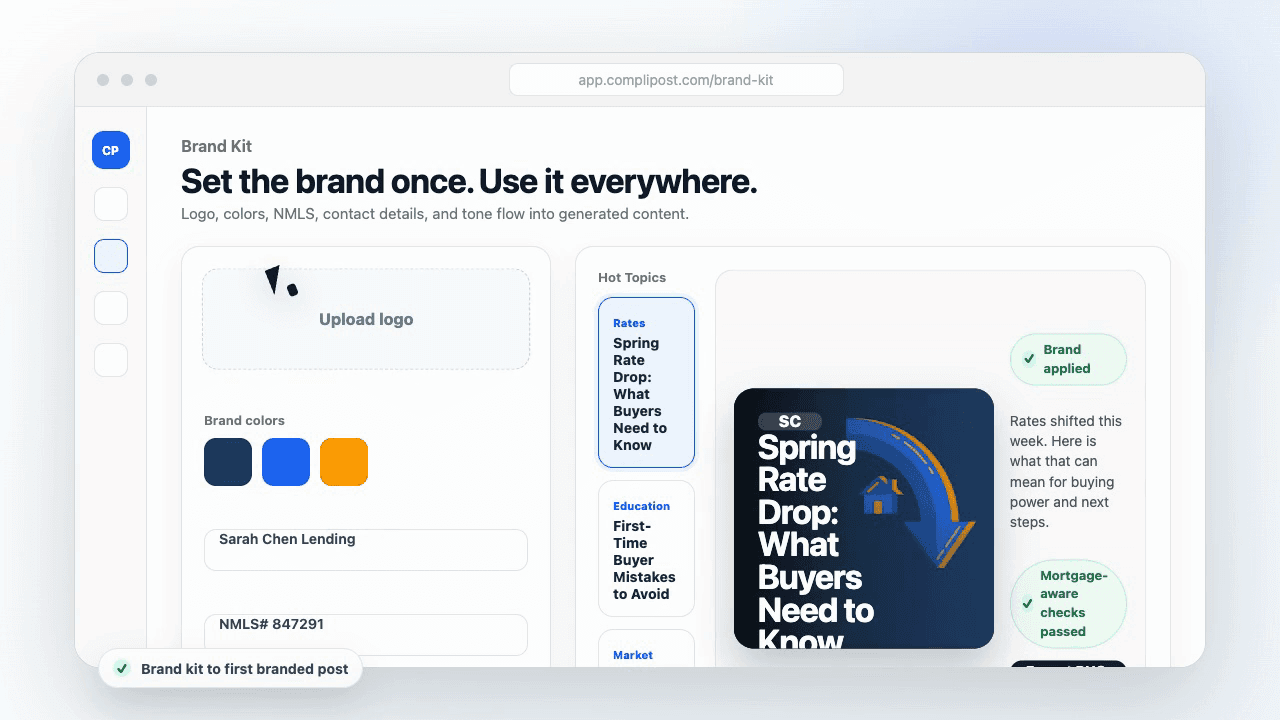
Product workflow
From blank page to export-ready mortgage content
- Start with a borrower topic
- Generate copy and a visual direction
- Review, save, and export the finished asset
These previews reflect the core CompliPost workflow: create, review, save, and export assets for use in your own channels.
Workflow comparison
| Content approach | What happens | Why it matters |
|---|---|---|
| Random posting | One-off ideas created when there is spare time | Inconsistent visibility and weak reuse |
| Template-only posting | Faster design but still requires rewriting and review | Helpful starting point, but not a full system |
| CompliPost workflow | Plan, generate, review, save, and export from one place | Better consistency with mortgage-aware review context |
| Done-for-you service | Someone else creates much of the content | Useful for some teams, but less control and less immediate reuse |
Who this guide helps
This guide is for loan officers working on solo loan officers who need a repeatable mortgage content workflow. The goal is to turn a broad mortgage topic into one borrower question, one useful takeaway, and one asset that can be reviewed before it is shared.
- You need content that sounds like a loan officer, not a generic brand account
- You want examples that can become captions, graphics, GIFs, or PDFs
- You need a clear place to review claims before export
- You want finished work saved for reuse, not lost in a chat thread
A practical workflow for this use case
Start with a narrow scenario, then move through planning, drafting, visual creation, review, and export. For pre-approval first step content for loan officers, that means the topic should be specific enough that a borrower or referral partner can immediately understand what decision the content helps with.
- Choose the borrower type, loan topic, or platform before generating copy
- Draft the caption and visual together so the asset feels cohesive
- Use the federal baseline review aid to flag claims and disclosure gaps
- Export the finished asset and save the post as a reusable starting point
What makes the content stronger
Strong mortgage content is usually specific, plain-spoken, and calm. It explains tradeoffs without pretending one answer fits every borrower. That is especially important on public social channels, where a short post can be interpreted without the full context of a loan conversation.
- Name the borrower question in the first line
- Explain one decision or tradeoff instead of covering everything
- Use examples without implying approval, savings, or rate outcomes
- End with a soft next step, checklist, or guide rather than pressure
Compliance-aware review notes
CompliPost should be treated as a review aid, not a compliance approval system. The public page, generated draft, graphic, and exported asset should all stay honest about that boundary.
- Review specific payment, APR, rate, savings, and qualification language
- Avoid “best,” “lowest,” “guaranteed,” “free,” and urgency claims unless approved
- Check NMLS, Equal Housing, company, and state-specific requirements
- Use company or legal review for anything outside the federal baseline
How this connects to the rest of CompliPost
A focused guide should leave you with a usable next step. After you understand the topic, you can turn it into a calendar slot, a reviewed social post, a downloadable guide, or a platform-specific version for the channel where your audience already spends time.
- Use the content calendar to turn the idea into a weekly plan
- Use the compliance page when claims or disclosures need a slower pass
- Use lead magnets when the topic deserves a deeper PDF guide
- Use platform pages to adapt the same idea for LinkedIn, Facebook, or Instagram
Recommended next steps
First-time buyer content hub
Build clear education for first-time buyers.
Mortgage content calendar
Plan a weekly rhythm of useful borrower and referral-partner posts.
Pre-approval getting started checklist
Give buyers a starting checklist.
Compliance checklist tool
Check common mortgage marketing risk signals before export.
Examples
FAQ
Why should pre-approval come first?+
Starting with pre-approval helps buyers understand their financial capabilities, which makes the home search more efficient and less stressful. It’s a strategic move that can lead to more informed decisions and a smoother buying process. The practical move is to keep the answer educational, mention that details vary by borrower profile and lender guidelines, and invite the reader to ask for a personal review instead of implying a certain result.
Can I suggest buyers approval?+
No, pre-approval is a review of financial status, not a suggest of final approval. It’s important to guide buyers with honesty, encouraging them to understand their financial options without suggesting specific outcomes. The practical move is to keep the answer educational, mention that details vary by borrower profile and lender guidelines, and invite the reader to ask for a personal review instead of implying a certain result.
Should this content use urgency?+
No, framing pre-approval with urgency can be misleading and is a compliance risk. Instead, present it as a beneficial step in the buying process that offers clarity and direction, without pressure. The practical move is to keep the answer educational, mention that details vary by borrower profile and lender guidelines, and invite the reader to ask for a personal review instead of implying a certain result.
Is this content evergreen?+
Yes, the importance of pre-approval remains constant in the home buying process. Save strong content as templates for future use, ensuring your messaging stays consistent and effective. The practical move is to keep the answer educational, mention that details vary by borrower profile and lender guidelines, and invite the reader to ask for a personal review instead of implying a certain result.
Create mortgage content with a calmer workflow
CompliPost helps you plan, generate, review, save, and export useful mortgage content without pretending compliance or social distribution is automatic.
Start free