Timing & Strategy
When Preapproval Expires and How to Renew It
Preapproval is valid for a limited time—usually 60 to 90 days—because lenders want current financial information and credit data. If you're house hunting slowly or taking time to save, your preapproval may expire before you're ready to make an offer. Create content that helps borrowers understand the expiration timeline and plan accordingly.
Standard preapproval validity periods
Most lenders issue preapproval letters valid for 60 to 90 days from the date of issuance. Some programs extend to 120 days if the borrower is with a preferred lender or applies for specific loan products. The validity period is printed on your preapproval letter. Use this in content to encourage borrowers to act within their window.
- Standard validity: 60-90 days from letter issue date
- Extended validity: some portfolio lenders offer 120+ days for specific programs
- Expiration date: always printed on the preapproval letter—mark it on your calendar
- After expiration: preapproval is no longer valid; renewal is needed to make offers
Why preapproval expires
Lenders set expiration dates because your financial situation can change—credit scores fluctuate, new debts appear, employment changes, and interest rates shift. Stale preapprovals don't reflect current risk. In your content, reframe expiration as a protective mechanism that keeps lending decisions sound.
- Credit pulls age: credit data is 30-90 days old; older data may not reflect current status
- Employment changes: borrower may have changed jobs, affecting income stability
- Market rates: interest rates fluctuate daily; older preapprovals may not reflect current markets
- Financial changes: new debts, account closures, or large withdrawals can affect qualification
The preapproval renewal process
Renewing a preapproval is faster than the initial application because the lender knows you. You'll re-verify employment, re-pull credit, and update bank statements. The process typically takes 1-2 business days. Create content showing this is routine and not a barrier to closing.
- Contact your lender when preapproval is nearing expiration (within 10-15 days)
- Provide updated pay stubs, bank statements, and authorization for credit pull
- Lender verifies employment and re-pulls credit (fast, usually 1 day)
- New preapproval letter issued within 2 business days in most cases
Staying preapproved between application and closing
Once you've made an offer and are in contract, your lender will guide you toward final approval. Stay in touch with your loan officer, disclose any financial changes immediately, and provide updates promptly. The closer you stay to closing, the less likely you'll need renewal.
- In-contract period: keep in regular contact with your loan officer
- Financial changes: disclose job changes, new debts, or large purchases immediately
- Document updates: provide updated pay stubs or employment letters if requested
- Final verification: within 7-10 days of closing, employment and credit will be re-verified
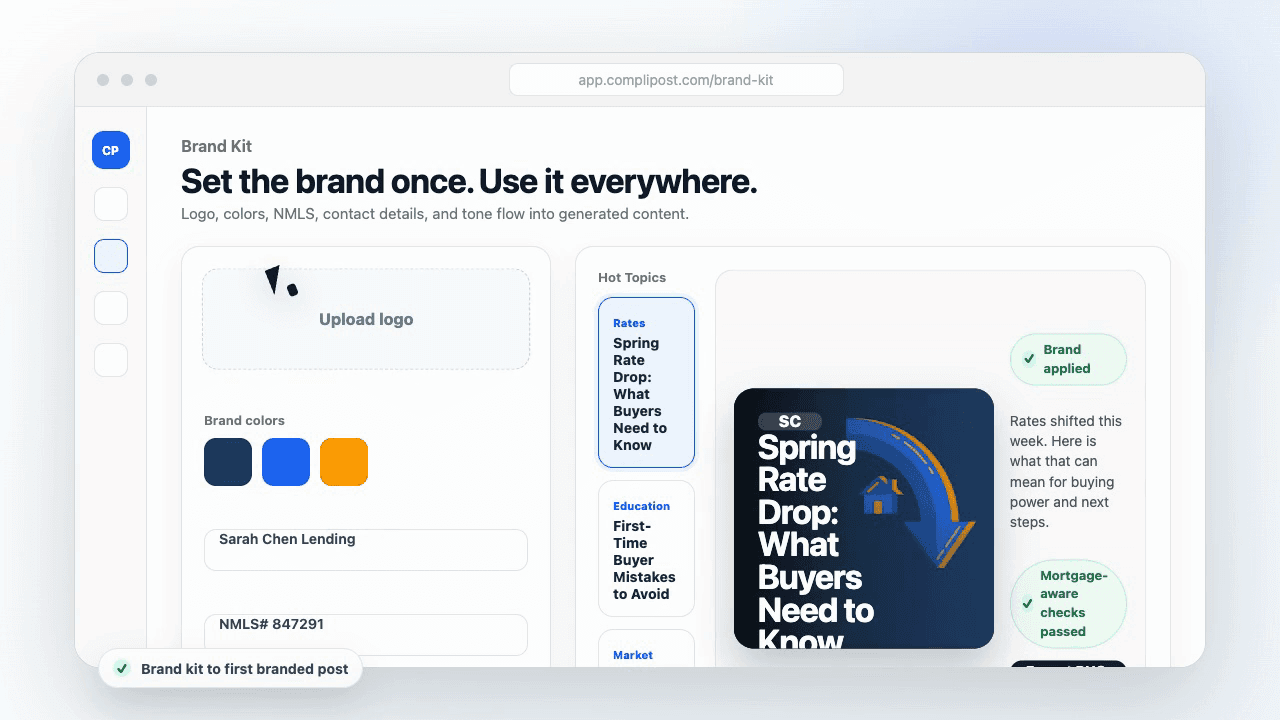
Product workflow
From blank page to export-ready mortgage content
- Start with a borrower topic
- Generate copy and a visual direction
- Review, save, and export the finished asset
These previews reflect the core CompliPost workflow: create, review, save, and export assets for use in your own channels.
Workflow comparison
| Content approach | What happens | Why it matters |
|---|---|---|
| Random posting | One-off ideas created when there is spare time | Inconsistent visibility and weak reuse |
| Template-only posting | Faster design but still requires rewriting and review | Helpful starting point, but not a full system |
| CompliPost workflow | Plan, generate, review, save, and export from one place | Better consistency with mortgage-aware review context |
| Done-for-you service | Someone else creates much of the content | Useful for some teams, but less control and less immediate reuse |
Who this guide helps
This guide is for loan officers working on solo loan officers who need a repeatable mortgage content workflow. The goal is to turn a broad mortgage topic into one borrower question, one useful takeaway, and one asset that can be reviewed before it is shared.
- You need content that sounds like a loan officer, not a generic brand account
- You want examples that can become captions, graphics, GIFs, or PDFs
- You need a clear place to review claims before export
- You want finished work saved for reuse, not lost in a chat thread
A practical workflow for this use case
Start with a narrow scenario, then move through planning, drafting, visual creation, review, and export. For preapproval expiration renewal, that means the topic should be specific enough that a borrower or referral partner can immediately understand what decision the content helps with.
- Choose the borrower type, loan topic, or platform before generating copy
- Draft the caption and visual together so the asset feels cohesive
- Use the federal baseline review aid to flag claims and disclosure gaps
- Export the finished asset and save the post as a reusable starting point
What makes the content stronger
Strong mortgage content is usually specific, plain-spoken, and calm. It explains tradeoffs without pretending one answer fits every borrower. That is especially important on public social channels, where a short post can be interpreted without the full context of a loan conversation.
- Name the borrower question in the first line
- Explain one decision or tradeoff instead of covering everything
- Use examples without implying approval, savings, or rate outcomes
- End with a soft next step, checklist, or guide rather than pressure
Compliance-aware review notes
CompliPost should be treated as a review aid, not a compliance approval system. The public page, generated draft, graphic, and exported asset should all stay honest about that boundary.
- Review specific payment, APR, rate, savings, and qualification language
- Avoid “best,” “lowest,” “guaranteed,” “free,” and urgency claims unless approved
- Check NMLS, Equal Housing, company, and state-specific requirements
- Use company or legal review for anything outside the federal baseline
How this connects to the rest of CompliPost
A focused guide should leave you with a usable next step. After you understand the topic, you can turn it into a calendar slot, a reviewed social post, a downloadable guide, or a platform-specific version for the channel where your audience already spends time.
- Use the content calendar to turn the idea into a weekly plan
- Use the compliance page when claims or disclosures need a slower pass
- Use lead magnets when the topic deserves a deeper PDF guide
- Use platform pages to adapt the same idea for LinkedIn, Facebook, or Instagram
Recommended next steps
First-time buyer content hub
Build clear education for first-time buyers.
What Mortgage Preapproval Actually Means
Understand the full preapproval timeline and validity.
Mortgage Approval Timeline: Application to Closing
Walk through the complete mortgage process from preapproval through closing.
Preapproval Letter Explained
Decode the preapproval letter and what to look for before expiration.
Examples
FAQ
What happens if I make an offer after my preapproval expires?+
You cannot make a binding offer with an expired preapproval letter. Sellers and real estate agents will reject offers without current preapproval. Contact your lender immediately if your preapproval is about to expire and you're making an offer. Renewal is fast—usually 1-2 days—so there's no excuse to wait.
If I renew my preapproval, do I get a new interest rate?+
The interest rate on your renewed preapproval may differ from your original rate because market rates change daily. If rates have fallen, your new preapproval may reflect a lower rate. If rates have risen, expect a higher rate. Once you're in contract, you'll lock your final rate as part of your Loan Estimate.
Can I renew my preapproval multiple times?+
Yes. If house hunting takes longer than expected, you can renew multiple times without penalty. Each renewal requires updated documentation and a re-pull of credit, but the process is routine and fast. Stay in touch with your lender and renew as needed to keep your preapproval current.
Does renewal hurt my credit score?+
Renewing your preapproval requires a credit pull, which is a hard inquiry and lowers your score slightly (typically 5-10 points). The impact is temporary and your score recovers in 3-6 months. Multiple credit inquiries within 14-45 days may count as one inquiry, so renewing doesn't significantly damage your score.
What if my financial situation changes before renewal?+
Disclose changes immediately to your lender—new debt, job loss, or large purchases can affect your preapproval. Your lender will re-evaluate your qualification based on current information. Transparency prevents surprises at closing and helps your lender find solutions if your situation has changed.
Create mortgage content with a calmer workflow
CompliPost helps you plan, generate, review, save, and export useful mortgage content without pretending compliance or social distribution is automatic.
Start free