Buyer Education
Understanding the Credit Pull for Preapproval
A credit pull during preapproval is a hard inquiry that temporarily lowers your credit score by a few points. It's necessary for lenders to assess risk and set your interest rate. Understanding how the credit pull works and why it matters helps borrowers feel confident moving forward with preapproval.
What happens during a credit pull
When you apply for preapproval, your lender pulls your credit report from one or more credit bureaus (Equifax, Experian, TransUnion). The lender reviews your credit history, existing debts, payment patterns, and credit utilization. This information helps the underwriter assess your risk profile and determine your interest rate. It's a standard, necessary step.
- Credit report pull: lender requests your credit history from one or more bureaus
- Review details: underwriter examines payment history, existing debts, credit age
- Risk assessment: credit score and history determine interest rate and approval odds
- Documentation: borrower authorizes the pull by signing the application
Impact on your credit score
A hard credit inquiry lowers your score by 5-10 points—minor and temporary. The impact fades as older inquiries age and new positive payment history builds. However, multiple hard inquiries within 14-45 days (depending on the scoring model) often count as one inquiry for mortgage shopping purposes. Assure borrowers in your content that the impact is short-term and worth it.
- Hard inquiry impact: typically 5-10 point reduction
- Temporary damage: score recovers in 3-6 months as inquiry ages
- Multiple inquiries: hard inquiries within 14-45 days often count as one for FICO scoring
- Neutral impact long-term: one preapproval won't harm your credit timeline
What lenders look for in the credit report
Lenders examine payment history (35% of score), amounts owed (30%), length of credit history (15%), credit mix (10%), and new credit (10%). Late payments, collections, or high debt levels raise red flags. However, past issues can be overcome with recent positive history or explanation letters.
- Payment history: on-time payments show reliability; late payments raise concerns
- Credit utilization: using less than 30% of available credit is ideal
- Debt levels: total debts affect your debt-to-income ratio and borrowing capacity
- Credit age: longer credit history is viewed favorably; new credit can indicate risk
Credit issues and preapproval options
Late payments, collections, or previous foreclosures don't automatically disqualify borrowers. Many lenders have programs for credit recovery, and FHA loans allow borrowers with credit scores as low as 580. If credit is a concern, discuss it upfront with your lender so they can recommend the right program.
- Recent late payments: 2+ years of on-time payments may offset recent issues
- Collections: paid collections are viewed more favorably than unpaid ones
- Foreclosure: seasoning period (typically 2-3 years) required before new mortgage
- Low score options: FHA and credit builder programs available for scores below 620
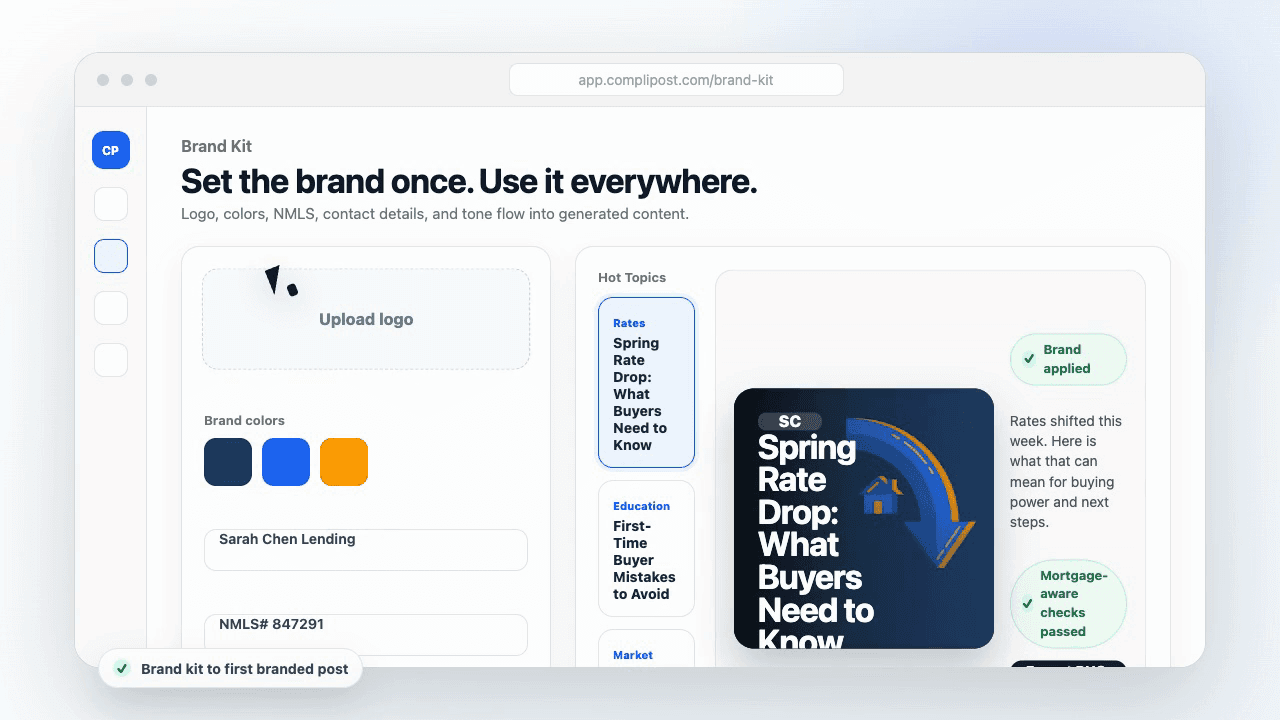
Product workflow
From blank page to export-ready mortgage content
- Start with a borrower topic
- Generate copy and a visual direction
- Review, save, and export the finished asset
These previews reflect the core CompliPost workflow: create, review, save, and export assets for use in your own channels.
Workflow comparison
| Content approach | What happens | Why it matters |
|---|---|---|
| Random posting | One-off ideas created when there is spare time | Inconsistent visibility and weak reuse |
| Template-only posting | Faster design but still requires rewriting and review | Helpful starting point, but not a full system |
| CompliPost workflow | Plan, generate, review, save, and export from one place | Better consistency with mortgage-aware review context |
| Done-for-you service | Someone else creates much of the content | Useful for some teams, but less control and less immediate reuse |
Who this guide helps
This guide is for loan officers working on solo loan officers who need a repeatable mortgage content workflow. The goal is to turn a broad mortgage topic into one borrower question, one useful takeaway, and one asset that can be reviewed before it is shared.
- You need content that sounds like a loan officer, not a generic brand account
- You want examples that can become captions, graphics, GIFs, or PDFs
- You need a clear place to review claims before export
- You want finished work saved for reuse, not lost in a chat thread
A practical workflow for this use case
Start with a narrow scenario, then move through planning, drafting, visual creation, review, and export. For preapproval credit pull impact, that means the topic should be specific enough that a borrower or referral partner can immediately understand what decision the content helps with.
- Choose the borrower type, loan topic, or platform before generating copy
- Draft the caption and visual together so the asset feels cohesive
- Use the federal baseline review aid to flag claims and disclosure gaps
- Export the finished asset and save the post as a reusable starting point
What makes the content stronger
Strong mortgage content is usually specific, plain-spoken, and calm. It explains tradeoffs without pretending one answer fits every borrower. That is especially important on public social channels, where a short post can be interpreted without the full context of a loan conversation.
- Name the borrower question in the first line
- Explain one decision or tradeoff instead of covering everything
- Use examples without implying approval, savings, or rate outcomes
- End with a soft next step, checklist, or guide rather than pressure
Compliance-aware review notes
CompliPost should be treated as a review aid, not a compliance approval system. The public page, generated draft, graphic, and exported asset should all stay honest about that boundary.
- Review specific payment, APR, rate, savings, and qualification language
- Avoid “best,” “lowest,” “guaranteed,” “free,” and urgency claims unless approved
- Check NMLS, Equal Housing, company, and state-specific requirements
- Use company or legal review for anything outside the federal baseline
How this connects to the rest of CompliPost
A focused guide should leave you with a usable next step. After you understand the topic, you can turn it into a calendar slot, a reviewed social post, a downloadable guide, or a platform-specific version for the channel where your audience already spends time.
- Use the content calendar to turn the idea into a weekly plan
- Use the compliance page when claims or disclosures need a slower pass
- Use lead magnets when the topic deserves a deeper PDF guide
- Use platform pages to adapt the same idea for LinkedIn, Facebook, or Instagram
Recommended next steps
First-time buyer content hub
Build clear education for first-time buyers.
How Credit Score Affects Mortgage Approval
Learn how credit scores impact approval odds, interest rates, and loan programs available to you.
What Mortgage Preapproval Actually Means
Understand the full preapproval process and what lenders verify.
First-Time Buyer Credit Score Improvement Strategy
Tips for improving credit before applying for preapproval.
Examples
FAQ
How much does the credit pull lower my score?+
A hard inquiry typically lowers your credit score by 5-10 points. The impact is temporary; as the inquiry ages, the effect diminishes. Within 3-6 months, most of the impact will fade. Multiple inquiries within 14-45 days usually count as one for mortgage-shopping purposes, so shopping around won't cause compounded damage.
Can I avoid the credit pull?+
No. Lenders are required by law to pull credit to assess risk and comply with underwriting standards. The credit pull is non-negotiable and necessary. However, the impact is small and temporary, so the trade-off is worth it to move forward with preapproval.
Will preapproval disqualify me if my credit has issues?+
Not necessarily. Late payments, collections, or previous credit issues don't automatically disqualify borrowers. Many lenders have programs for credit recovery—FHA loans, portfolio programs, and non-QM options. If credit is a concern, discuss it upfront with your lender so they can identify suitable programs.
What should I do before the credit pull?+
Avoid opening new credit, making large purchases, or applying for other loans before preapproval. Pay bills on time, don't close old credit accounts, and keep credit card balances low. These steps help you qualify with better terms. Inform your lender if you've had recent late payments or negative credit events.
Can the credit pull hurt my chances of approval?+
The credit pull itself doesn't hurt approval chances; it's what the pull reveals that matters. Late payments or high debt levels can affect approval odds or interest rates. However, one hard inquiry won't disqualify you. Multiple hard inquiries within a short window (from shopping around) might raise flags, but mortgage-shopping inquiries are treated favorably.
Create mortgage content with a calmer workflow
CompliPost helps you plan, generate, review, save, and export useful mortgage content without pretending compliance or social distribution is automatic.
Start free