Loan Structure
Co-Borrowers vs. Co-Signers: Which Should You Choose?
Some borrowers need help qualifying, and co-borrowers or co-signers can provide it. But these terms mean different things and have different implications. Understanding the difference helps borrowers make informed choices about loan structure.
Co-borrower: shared ownership and liability
A co-borrower is on the mortgage and the title. They're equally liable for the loan, can access the proceeds, and are a legal owner of the home. Co-borrowers' income counts toward qualification; their debts count toward DTI. A spouse is typically a co-borrower.
- Title: co-borrower's name is on the deed; they're a legal owner
- Liability: co-borrower is equally liable for the mortgage debt
- Income: co-borrower's income counts toward qualification
- Debts: co-borrower's debts count toward DTI
Co-signer: liability without ownership
A co-signer is on the mortgage note but NOT on the title. They're liable for the loan if the primary borrower defaults, but they don't own the home. Co-signers' income and debts both count toward the application. A parent helping a child qualify is typically a co-signer.
- Title: co-signer's name is NOT on the deed; they don't own the property
- Liability: co-signer is liable for the mortgage if primary borrower defaults
- Income: co-signer's income counts toward qualification
- Debts: co-signer's debts count toward DTI (red flag for lenders)
Why co-borrowers vs. co-signers matter
Co-borrowers share ownership and responsibility; co-signers take risk without ownership. From a lender's perspective, co-signers are riskier because they have liability but no incentive to pay. Co-borrowers are cleaner because ownership aligns incentives. Tax, estate, and divorce implications differ too.
- Ownership: co-borrowers own; co-signers don't (major difference)
- Risk alignment: co-borrowers have skin in the game; co-signers don't
- Tax deductions: co-borrowers can deduct interest; co-signers may not
- Divorce: co-borrower is subject to divorce division; co-signer status is unclear
When to use each structure
Use co-borrower when both people are committing to the home (spouses, partners). Use co-signer when one person is helping qualify but won't live in the home (parent helping adult child). Understand the implications before choosing.
- Co-borrower: spouses, partners, family members living in the home
- Co-signer: parents, relatives helping qualify but not living there
- Qualification risk: co-signers don't improve qualification odds as much as co-borrowers
- Future implications: consider divorce, death, and refinancing before choosing structure
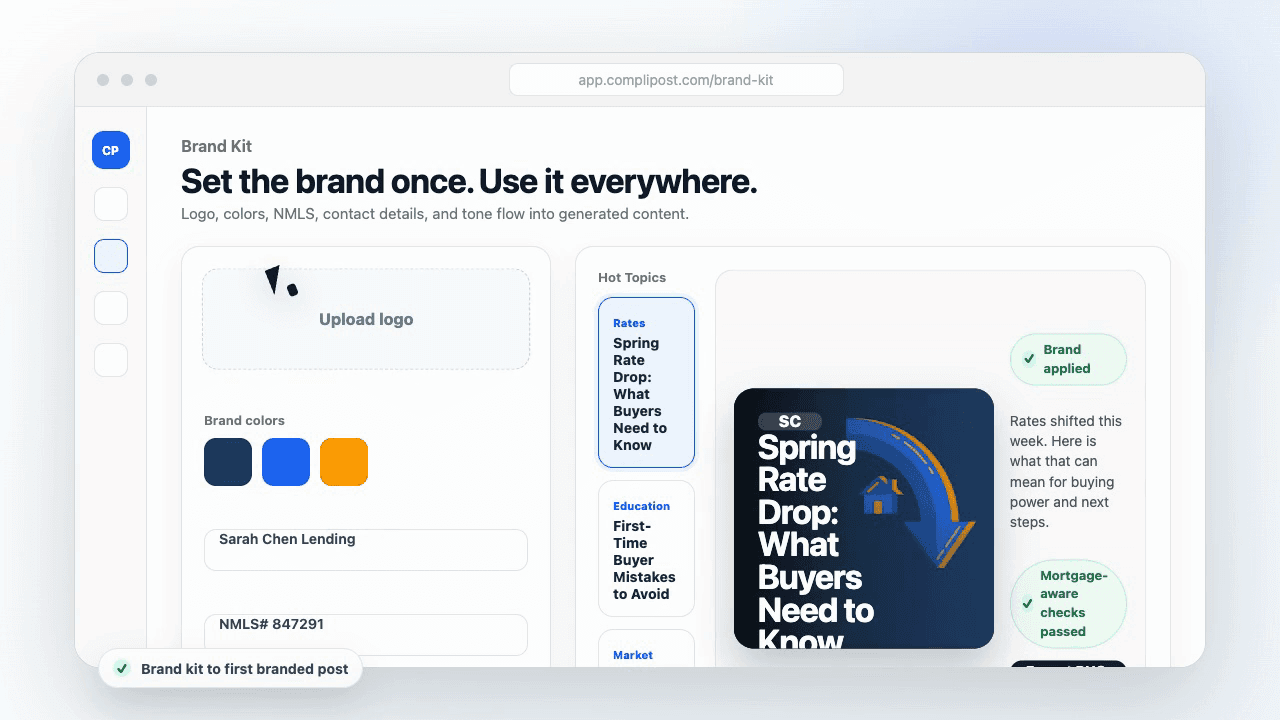
Product workflow
From blank page to export-ready mortgage content
- Start with a borrower topic
- Generate copy and a visual direction
- Review, save, and export the finished asset
These previews reflect the core CompliPost workflow: create, review, save, and export assets for use in your own channels.
Workflow comparison
| Content approach | What happens | Why it matters |
|---|---|---|
| Random posting | One-off ideas created when there is spare time | Inconsistent visibility and weak reuse |
| Template-only posting | Faster design but still requires rewriting and review | Helpful starting point, but not a full system |
| CompliPost workflow | Plan, generate, review, save, and export from one place | Better consistency with mortgage-aware review context |
| Done-for-you service | Someone else creates much of the content | Useful for some teams, but less control and less immediate reuse |
Who this guide helps
This guide is for loan officers working on solo loan officers who need a repeatable mortgage content workflow. The goal is to turn a broad mortgage topic into one borrower question, one useful takeaway, and one asset that can be reviewed before it is shared.
- You need content that sounds like a loan officer, not a generic brand account
- You want examples that can become captions, graphics, GIFs, or PDFs
- You need a clear place to review claims before export
- You want finished work saved for reuse, not lost in a chat thread
A practical workflow for this use case
Start with a narrow scenario, then move through planning, drafting, visual creation, review, and export. For co-borrower vs co-signer preapproval, that means the topic should be specific enough that a borrower or referral partner can immediately understand what decision the content helps with.
- Choose the borrower type, loan topic, or platform before generating copy
- Draft the caption and visual together so the asset feels cohesive
- Use the federal baseline review aid to flag claims and disclosure gaps
- Export the finished asset and save the post as a reusable starting point
What makes the content stronger
Strong mortgage content is usually specific, plain-spoken, and calm. It explains tradeoffs without pretending one answer fits every borrower. That is especially important on public social channels, where a short post can be interpreted without the full context of a loan conversation.
- Name the borrower question in the first line
- Explain one decision or tradeoff instead of covering everything
- Use examples without implying approval, savings, or rate outcomes
- End with a soft next step, checklist, or guide rather than pressure
Compliance-aware review notes
CompliPost should be treated as a review aid, not a compliance approval system. The public page, generated draft, graphic, and exported asset should all stay honest about that boundary.
- Review specific payment, APR, rate, savings, and qualification language
- Avoid “best,” “lowest,” “guaranteed,” “free,” and urgency claims unless approved
- Check NMLS, Equal Housing, company, and state-specific requirements
- Use company or legal review for anything outside the federal baseline
How this connects to the rest of CompliPost
A focused guide should leave you with a usable next step. After you understand the topic, you can turn it into a calendar slot, a reviewed social post, a downloadable guide, or a platform-specific version for the channel where your audience already spends time.
- Use the content calendar to turn the idea into a weekly plan
- Use the compliance page when claims or disclosures need a slower pass
- Use lead magnets when the topic deserves a deeper PDF guide
- Use platform pages to adapt the same idea for LinkedIn, Facebook, or Instagram
Recommended next steps
First-time buyer content hub
Build clear education for first-time buyers.
Co-Borrower and Co-Signer Mortgage Guide
Comprehensive guide to co-borrower and co-signer structures and implications.
Debt-to-Income Ratio and Qualification Math
Understand how co-signer debts affect your DTI and qualification.
How Credit Score Affects Mortgage Approval
See how both borrowers' credit profiles affect approval odds and terms.
Examples
FAQ
Can a co-signer remove themselves after closing?+
Not easily. A co-signer can only be removed through refinancing (primary borrower refinances alone) or loan assumption (if allowed). As long as the co-signer is on the note, they remain liable. Discuss this before becoming a co-signer.
Does a co-signer's income count toward qualification?+
Yes, both income and debts count. If a parent co-signs, their income helps you qualify (good), but their debts count toward your DTI (bad). The lender assumes both borrowers could default, so both financial profiles matter.
If I'm a co-signer, does the mortgage show on my credit?+
Yes. The co-signer's credit report will show the mortgage as a new account and the monthly payment as a debt obligation. This can affect the co-signer's DTI if they apply for credit. Co-signing is a credit commitment.
Can my parent be a co-borrower instead of a co-signer?+
Technically yes, but it means your parent's name is on the deed and they're a legal owner. If they don't intend to live in or own the home, co-signer is more appropriate. Co-borrower status has tax and estate implications.
What happens to a co-signer if the borrower dies?+
The co-signer remains liable for the mortgage unless the primary borrower's estate can pay it off. Life insurance on the primary borrower is smart if a co-signer is involved. Discuss these scenarios before becoming a co-signer.
Create mortgage content with a calmer workflow
CompliPost helps you plan, generate, review, save, and export useful mortgage content without pretending compliance or social distribution is automatic.
Start free