Cadence Basics
Build a Weekly Posting Rhythm That Works for Busy Loan Officers
A sustainable weekly posting rhythm is the foundation of a consistent online presence. Instead of sporadic bursts followed by silence, a regular weekly schedule trains your audience to expect and look for your content on certain days. This guide helps you design a repeatable weekly structure that builds momentum without demanding more hours than you actually have.
Why Weekly Structure Beats Random Posting
Your audience learns when to expect you—consistency builds habit and visibility. A predictable weekly schedule is also easier to execute because you're running the same process every week instead of making ad-hoc decisions. Loan officers who follow a weekly rhythm report higher engagement and feel less pressured to constantly create because they know exactly what days require content.
- Audiences expect new content on the same day each week
- Weekly structure is easier to batch-produce content for
- Algorithms reward consistent posting frequency
- You control your schedule instead of reacting constantly
- Lower stress: one rhythm beats a chaotic content calendar
A Sample Loan Officer Weekly Schedule
Monday might be an education post (e.g., preapproval explained), Wednesday a quick win or client story, Friday a personality post or week recap. This mix keeps content fresh and matches how people engage across the week. The specifics depend on your platforms—LinkedIn favors longer posts Tuesday–Thursday, TikTok thrives on daily or near-daily uploads, Instagram does well with 3–4 posts per week. Pick the rhythm that fits your bandwidth and audience.
- Monday: Education or compliance-safe explainer post
- Wednesday: Quick win, client milestone, or case study
- Friday: Personality, weekend market outlook, or reflection
- Adjust day and type based on your platform and audience
- Batch-produce all weekly content on one admin day
How to Batch Weekly Content in One Session
Dedicate one focused session—90 minutes to 2 hours—to brainstorm, write, and schedule all weekly posts. This batching approach eliminates daily context switching and makes you more creative because you're in one mindset instead of jumping between platforms. Write headlines, drafts, and copy for all posts at once, then generate social graphics or video hooks if needed.
- Block 2 hours on Monday morning to plan the entire week
- Brainstorm all post angles and headlines first
- Write copy for each post in sequence, not one at a time
- Use scheduling tools to queue posts in advance
- Allocate time for engagement replies during the week
Adapting Your Rhythm to Seasonal Cycles
Spring and summer usually see higher inquiry volume and more competitive posting. Winter and fall may allow for longer-form content or deeper education because your audience has more time. If you experience seasonal lending surges, you might increase frequency during high-season months and ease back during quieter periods, keeping your rhythm stable enough that your audience still knows what to expect.
- Increase posting frequency during your busy season
- Slow down frequency slightly in off-season without dropping it entirely
- Use quiet periods to produce longer, more substantive content
- Announce rhythm changes to your audience so they adjust expectations
- Keep a repeating baseline even if you add occasional bonus posts
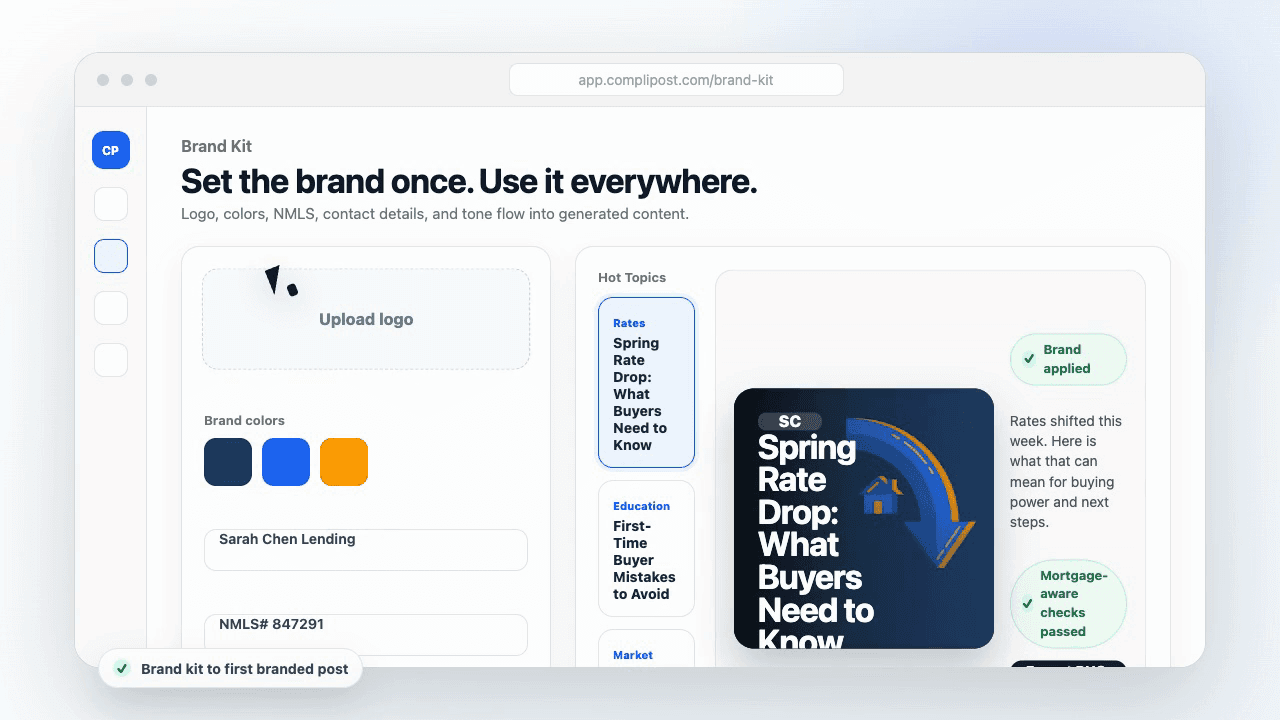
Product workflow
From blank page to export-ready mortgage content
- Start with a borrower topic
- Generate copy and a visual direction
- Review, save, and export the finished asset
These previews reflect the core CompliPost workflow: create, review, save, and export assets for use in your own channels.
Workflow comparison
| Content approach | What happens | Why it matters |
|---|---|---|
| Random posting | One-off ideas created when there is spare time | Inconsistent visibility and weak reuse |
| Template-only posting | Faster design but still requires rewriting and review | Helpful starting point, but not a full system |
| CompliPost workflow | Plan, generate, review, save, and export from one place | Better consistency with mortgage-aware review context |
| Done-for-you service | Someone else creates much of the content | Useful for some teams, but less control and less immediate reuse |
Who this guide helps
This guide is for loan officers working on solo loan officers who need a repeatable mortgage content workflow. The goal is to turn a broad mortgage topic into one borrower question, one useful takeaway, and one asset that can be reviewed before it is shared.
- You need content that sounds like a loan officer, not a generic brand account
- You want examples that can become captions, graphics, GIFs, or PDFs
- You need a clear place to review claims before export
- You want finished work saved for reuse, not lost in a chat thread
A practical workflow for this use case
Start with a narrow scenario, then move through planning, drafting, visual creation, review, and export. For posting cadence, that means the topic should be specific enough that a borrower or referral partner can immediately understand what decision the content helps with.
- Choose the borrower type, loan topic, or platform before generating copy
- Draft the caption and visual together so the asset feels cohesive
- Use the federal baseline review aid to flag claims and disclosure gaps
- Export the finished asset and save the post as a reusable starting point
What makes the content stronger
Strong mortgage content is usually specific, plain-spoken, and calm. It explains tradeoffs without pretending one answer fits every borrower. That is especially important on public social channels, where a short post can be interpreted without the full context of a loan conversation.
- Name the borrower question in the first line
- Explain one decision or tradeoff instead of covering everything
- Use examples without implying approval, savings, or rate outcomes
- End with a soft next step, checklist, or guide rather than pressure
Compliance-aware review notes
CompliPost should be treated as a review aid, not a compliance approval system. The public page, generated draft, graphic, and exported asset should all stay honest about that boundary.
- Review specific payment, APR, rate, savings, and qualification language
- Avoid “best,” “lowest,” “guaranteed,” “free,” and urgency claims unless approved
- Check NMLS, Equal Housing, company, and state-specific requirements
- Use company or legal review for anything outside the federal baseline
How this connects to the rest of CompliPost
A focused guide should leave you with a usable next step. After you understand the topic, you can turn it into a calendar slot, a reviewed social post, a downloadable guide, or a platform-specific version for the channel where your audience already spends time.
- Use the content calendar to turn the idea into a weekly plan
- Use the compliance page when claims or disclosures need a slower pass
- Use lead magnets when the topic deserves a deeper PDF guide
- Use platform pages to adapt the same idea for LinkedIn, Facebook, or Instagram
Recommended next steps
Mortgage content calendar
Plan a steady mortgage social content rhythm.
Posting Cadence: Monthly Themes for Deeper Engagement
Layer monthly content themes over your weekly rhythm to create a larger narrative that ties your posts together.
Mortgage Content Batching: One-Day Production for a Week of Posts
Master the batching workflow that lets you produce a full week of content in one focused session.
Loan Officer Engagement Strategy: Replying to Comments and Building Community
Maintain your rhythm by allocating dedicated time to reply to audience comments and build real relationships.
Examples
FAQ
What if I miss a scheduled post day?+
Reschedule it for the next available slot rather than skipping—your audience expects you, and posting late is better than not posting. If life gets hectic, post just once that week on your highest-impact day instead of abandoning the rhythm. Missing occasionally won't hurt; stopping entirely does.
How many posts per week is sustainable for a solo loan officer?+
Most solo loan officers thrive with 3–4 posts per week across all platforms combined. If you're on one platform, 3–4 per week is solid. If you're on three platforms, you might do 1–2 per platform. Sustainable means you can keep it up for months without burnout, not that you max out every day.
Should I post the same content on every platform?+
Adapt, don't copy-paste. The core message stays the same, but format it for each platform: LinkedIn posts are longer and professional, Instagram captions are conversational, TikTok scripts are punchy. Reusing your core idea across platforms is efficient; treating each platform identically wastes potential reach.
What time of day should I post?+
Post when your audience is most active and most likely to engage. LinkedIn engagement peaks Tuesday–Thursday at 8–10am and 5–6pm. Instagram peaks mid-morning and evening. TikTok rewards frequent posting any time. Test and track which of your posts get the most early engagement, then schedule new posts for similar times.
Can I change my rhythm after I've started?+
Yes, but communicate the change clearly so your audience knows what to expect. If you've been posting Monday, Wednesday, Friday and want to shift to Tuesday and Thursday, announce it in a post or story. Your audience will adjust if they understand the new pattern.
Create mortgage content with a calmer workflow
CompliPost helps you plan, generate, review, save, and export useful mortgage content without pretending compliance or social distribution is automatic.
Start free