Social Media Strategy
Mortgage Social Media Engagement: How Loan Officers Build an Audience That Trusts Them
Mortgage social media engagement means more than collecting likes. A 30-day scan of loan-officer social content found the dominant driver of audience trust is consistent, useful posting — not follower counts or viral moments. Loan officers who treat engagement as a reputation-building system, rather than a lead funnel, attract borrowers who already trust them before the first call.
Why engagement metrics mislead most loan officers
Likes and reach are the most visible numbers in any platform dashboard, and they're also the least predictive of whether someone will call you about a loan. A 30-day scan of mortgage loan-officer social content found the posts that generated actual borrower conversations were almost never the ones that went wide — they were the consistent, specific, useful posts that landed with the right 50 people. A post explaining what a debt-to-income ratio actually means to a first-time buyer will earn three DMs from qualified borrowers; a trending audio reel might earn 4,000 views from people who will never need a mortgage. Engagement worth chasing is the kind that deepens a relationship, not the kind that inflates a vanity number.
- Track DMs and profile visits over pure reach — those signal intent
- Comments with questions are more valuable than 'love this!' reactions
- Saves and shares indicate your content is useful enough to keep — the strongest organic signal
- Declining reach on a consistent account is normal; declining relevance is the real risk
The post formats that consistently generate loan-officer engagement
Certain content structures reliably open conversations because they invite a response rather than broadcasting at an audience. Educational carousels that end with a question routinely outperform static announcements. Market-update posts that provide context — not a rate quote — give followers something to respond to without crossing into unauthorized-advice territory. A reframe post corrects a common misconception and creates enough surprise to prompt a share or a question. Personal posts — your why, a moment from a closing, a lesson from a deal that didn't close — perform especially well because they remind followers there's a person behind the content. The 80/20 rule holds here: roughly 80 percent genuinely useful content, 20 percent soft invitation to connect.
- Carousels ending in a question: pair education with a clear prompt
- Market-context posts: provide framing, never a rate prediction
- Reframe posts: correct a common misconception relevant to your audience
- Personal moments: humanize the professional relationship before it starts
- Comment-trigger posts: "comment 'guide' and I'll send you the free download"
How to respond to comments and DMs without crossing compliance lines
The most common compliance mistake in loan-officer social engagement is not in a published post — it's in a casual reply. "It's a great time to buy" typed into a comment thread is the same unauthorized financial advice whether it's in a post or a reply. The safest engagement framework is to acknowledge, invite, and redirect: acknowledge the question, invite the conversation, and redirect to a private channel. This keeps the public thread warm while moving the substantive conversation to a compliant channel. CompliPost's federal-baseline review aid flags this class of casual phrase in generated content before export — but your replies are written live, so the pattern needs to be internalized.
Building a comment-section culture that compounds over time
Loan officers who consistently generate engagement in comments share one habit: they respond to every comment in the first hour after posting. Platform algorithms treat early comment velocity as a signal that the post is worth distributing further. More importantly, a loan officer who responds thoughtfully to a comment about first-time-buyer anxiety builds a public, visible relationship with every follower who reads that exchange — not just the person who commented. Over time this creates a comment-section culture where followers expect to learn something and feel heard. The 5-day posting schedule that circulates widely among mortgage LOs gives you five chances per week to build this culture with a manageable creation load.
What CompliPost helps you create for consistent engagement
Consistent engagement requires consistent output — and consistent output requires a system. CompliPost generates branded social copy, graphics, and short-form content that a loan officer can review, export, and post from their own platforms. Every piece of generated content goes through a federal-baseline compliance review aid that surfaces language worth a closer look — TILA, RESPA, NMLS disclosure patterns, Fair Housing signals, UDAAP flags — before you export it. The system handles the blank-calendar problem most loan officers cite as their single biggest content barrier, so you can focus on the engagement layer — the responses, the relationships, the conversations — that no tool can automate.
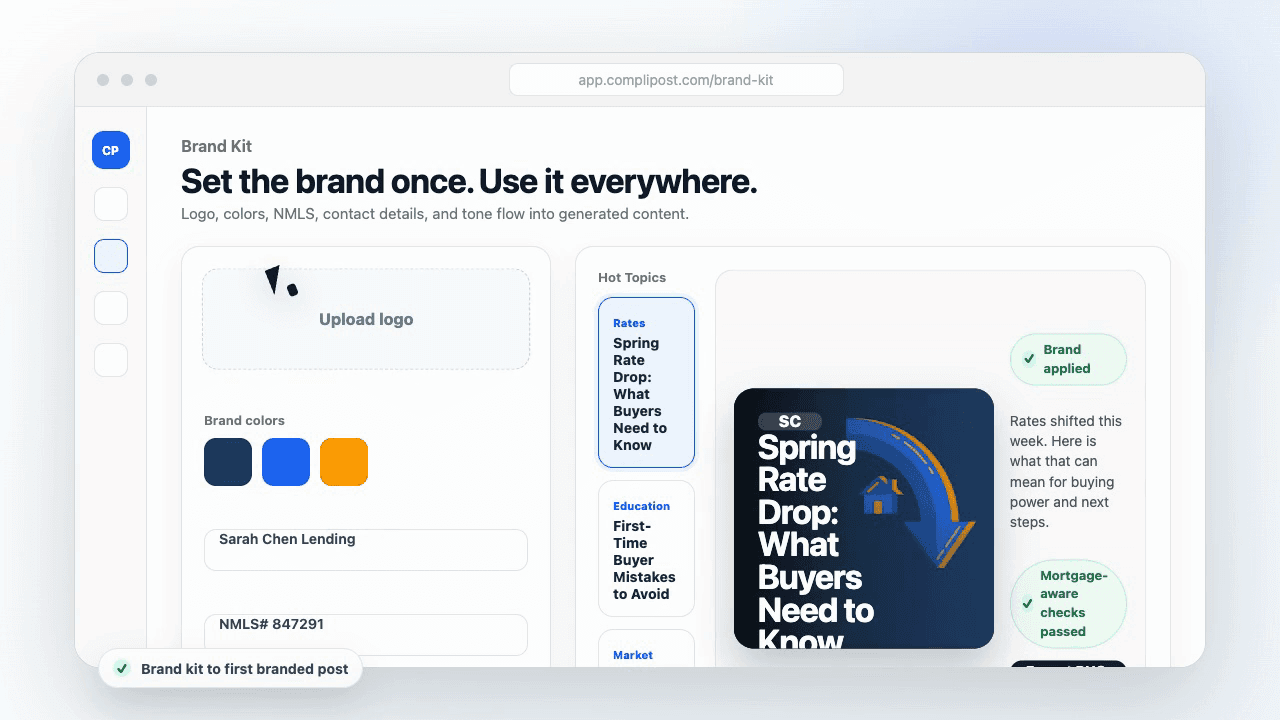
Product workflow
From blank page to export-ready mortgage content
- Start with a borrower topic
- Generate copy and a visual direction
- Review, save, and export the finished asset
These previews reflect the core CompliPost workflow: create, review, save, and export assets for use in your own channels.
Workflow comparison
| Content approach | What happens | Why it matters |
|---|---|---|
| Random posting | One-off ideas created when there is spare time | Inconsistent visibility and weak reuse |
| Template-only posting | Faster design but still requires rewriting and review | Helpful starting point, but not a full system |
| CompliPost workflow | Plan, generate, review, save, and export from one place | Better consistency with mortgage-aware review context |
| Done-for-you service | Someone else creates much of the content | Useful for some teams, but less control and less immediate reuse |
Who this guide helps
This guide is for loan officers working on solo loan officers who need a repeatable mortgage content workflow. The goal is to turn a broad mortgage topic into one borrower question, one useful takeaway, and one asset that can be reviewed before it is shared.
- You need content that sounds like a loan officer, not a generic brand account
- You want examples that can become captions, graphics, GIFs, or PDFs
- You need a clear place to review claims before export
- You want finished work saved for reuse, not lost in a chat thread
A practical workflow for this use case
Start with a narrow scenario, then move through planning, drafting, visual creation, review, and export. For mortgage social media engagement, that means the topic should be specific enough that a borrower or referral partner can immediately understand what decision the content helps with.
- Choose the borrower type, loan topic, or platform before generating copy
- Draft the caption and visual together so the asset feels cohesive
- Use the federal baseline review aid to flag claims and disclosure gaps
- Export the finished asset and save the post as a reusable starting point
What makes the content stronger
Strong mortgage content is usually specific, plain-spoken, and calm. It explains tradeoffs without pretending one answer fits every borrower. That is especially important on public social channels, where a short post can be interpreted without the full context of a loan conversation.
- Name the borrower question in the first line
- Explain one decision or tradeoff instead of covering everything
- Use examples without implying approval, savings, or rate outcomes
- End with a soft next step, checklist, or guide rather than pressure
Compliance-aware review notes
CompliPost should be treated as a review aid, not a compliance approval system. The public page, generated draft, graphic, and exported asset should all stay honest about that boundary.
- Review specific payment, APR, rate, savings, and qualification language
- Avoid “best,” “lowest,” “guaranteed,” “free,” and urgency claims unless approved
- Check NMLS, Equal Housing, company, and state-specific requirements
- Use company or legal review for anything outside the federal baseline
How this connects to the rest of CompliPost
A focused guide should leave you with a usable next step. After you understand the topic, you can turn it into a calendar slot, a reviewed social post, a downloadable guide, or a platform-specific version for the channel where your audience already spends time.
- Use the content calendar to turn the idea into a weekly plan
- Use the compliance page when claims or disclosures need a slower pass
- Use lead magnets when the topic deserves a deeper PDF guide
- Use platform pages to adapt the same idea for LinkedIn, Facebook, or Instagram
Recommended next steps
Mortgage social media content
See the cross-platform content workflow for loan officers.
Loan officer social proof content
Turn testimonials and closing moments into trust-building content that works on every platform.
Mortgage content calendar
Plan a week or month of posts so consistent engagement doesn't depend on daily inspiration.
Mortgage compliance disclaimer examples
Real examples of compliant and non-compliant mortgage language — including common comment-reply mistakes.
Examples
FAQ
What counts as good engagement for a loan officer's social media?+
Saves, shares, DMs, and comments with real questions are more valuable than raw likes or reach. A post that generates five DMs from prospective borrowers outperforms a post that reaches 10,000 people who don't need a mortgage. Track profile visits and link clicks as a proxy for intent.
How often should a loan officer post to build engagement?+
Consistency matters more than frequency. A widely-shared 5-day posting schedule — Monday local context, Tuesday authority post, Wednesday short video, Thursday lead-magnet trigger, Friday personal post — gives enough surface area to build a comment-section culture without requiring daily content creation.
Are there compliance risks in replying to comments on social media?+
Yes. Casual replies like "it's a great time to buy" or "rates are going up, act fast" carry the same unauthorized-advice exposure as published posts. The safest pattern is to acknowledge the question publicly, invite the conversation, and redirect substantive advice to a private channel like DM or a scheduled call.
Should a loan officer respond to every comment?+
Responding to every comment in the first hour after posting signals quality to platform algorithms and builds a visible culture of responsiveness for all followers who see the exchange. You don't need to answer a lending question publicly — a warm redirect to DM is both compliant and relationship-building.
What post types generate the most engagement for mortgage loan officers?+
Educational carousels with a closing question, market-context posts that explain rather than predict, reframe posts that correct common misconceptions, and personal posts about your story or a client moment consistently outperform promotional announcements. The 80/20 rule — 80% useful, 20% soft offer — applies to the engagement mix.
Create mortgage content with a calmer workflow
CompliPost helps you plan, generate, review, save, and export useful mortgage content without pretending compliance or social distribution is automatic.
Start free