PHYSICIAN AUDIENCE
Help Rural and Underserved-Area Physicians Find and Finance Homes
Physicians in rural practice often face unique home-buying challenges: limited inventory, lower property values, less competitive lending, and different lifestyle expectations. Your content should address rural-specific loan programs (USDA, Rural Development, small-town lenders), show how physician salaries support rural housing markets, and frame rural homeownership as both financially smart and lifestyle-enhancing for physicians committed to underserved areas.
Rural-Specific Loan Programs and Financing Options
Rural homebuyers access specialized programs—USDA Rural Development, state rural mortgage programs, community development lenders—that standard urban lenders may not offer. Your content should explain these programs and show they often provide better terms than conventional mortgages.
- USDA Rural Development: zero-down loans for eligible rural properties; physician income usually qualifies
- State loan programs: many states offer rural physician incentives, forgiveness programs, or favorable financing
- Community lenders: local banks in rural areas understand physician income and local practice stability
- Construction loans: rural builds (building a home from scratch) often easier to finance in rural areas
- Grant programs: some rural physician recruitment programs offer housing assistance or down payment grants
Lower Home Prices and Appreciation Potential in Rural Markets
Rural homes cost less than urban equivalents—a family home in a rural area may be $200K–$400K vs. $1M+ in cities. Your content should frame this as financial advantage, and address the long-term appreciation potential in growing rural markets.
- Price advantage: lower purchase prices mean lower mortgages and faster home equity buildup
- Affordability: physician income supports comfortable lifestyle in rural markets (more home for less money)
- Appreciation opportunity: rural markets growing due to remote work, population shifts; good investment timing
- Community anchor: new physicians often become pillars of small communities; home ownership strengthens this
- Quality of life: lower cost of living, more space, often better work-life balance trade-off
Shortage of Rural Physicians and Lender Recognition
Rural physician shortages mean lenders recognize their value and offer favorable terms. Your content should emphasize that rural physicians are in high demand, which improves mortgage lending terms and creates job security.
- Shortage recognition: lenders know rural physicians are scarce and stable employers; favorable terms reflect this
- Job security: rural physician positions are long-term, often with multi-year contracts or partnership track
- Hospital partnerships: rural hospitals often assist employee physicians with housing/relocation incentives
- Loan program incentives: some programs offer better rates/terms specifically for rural physicians
- Community stability: living and owning in rural communities shows commitment; improves lender confidence
Lifestyle and Community Positioning for Rural Physicians
Your content should speak to the lifestyle appeal of rural medicine—smaller communities, close relationships, slower pace—and position home ownership as cementing these lifestyle choices. This is emotional and practical.
- Community integration: home ownership deepens roots and relationships in small-town practice
- Work-life balance: rural practice often offers better schedule control, more family time
- Space and privacy: rural homes offer acreage, natural settings, outdoor lifestyle appeal
- School quality: many rural school districts are strong; important for family physicians
- Intergenerational wealth: family home in stable community can pass to children or become family anchor
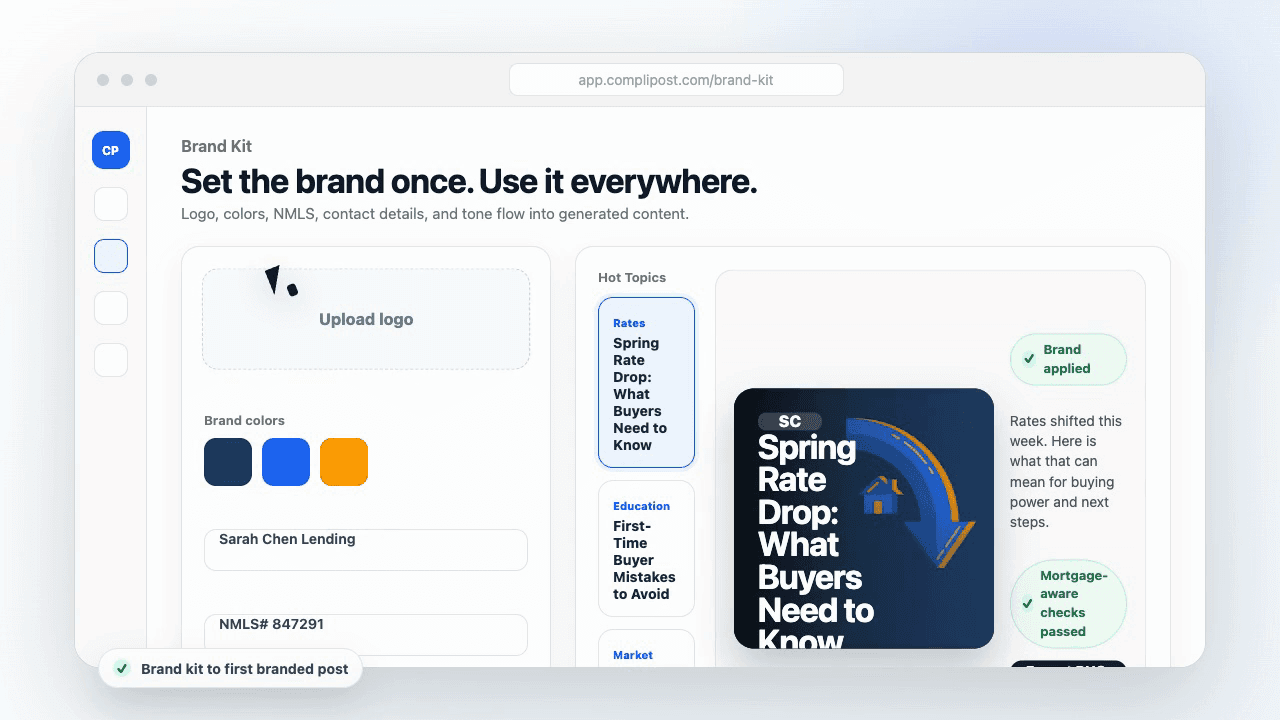
Product workflow
From blank page to export-ready mortgage content
- Start with a borrower topic
- Generate copy and a visual direction
- Review, save, and export the finished asset
These previews reflect the core CompliPost workflow: create, review, save, and export assets for use in your own channels.
Workflow comparison
| Content approach | What happens | Why it matters |
|---|---|---|
| Random posting | One-off ideas created when there is spare time | Inconsistent visibility and weak reuse |
| Template-only posting | Faster design but still requires rewriting and review | Helpful starting point, but not a full system |
| CompliPost workflow | Plan, generate, review, save, and export from one place | Better consistency with mortgage-aware review context |
| Done-for-you service | Someone else creates much of the content | Useful for some teams, but less control and less immediate reuse |
Who this guide helps
This guide is for loan officers working on solo loan officers who need a repeatable mortgage content workflow. The goal is to turn a broad mortgage topic into one borrower question, one useful takeaway, and one asset that can be reviewed before it is shared.
- You need content that sounds like a loan officer, not a generic brand account
- You want examples that can become captions, graphics, GIFs, or PDFs
- You need a clear place to review claims before export
- You want finished work saved for reuse, not lost in a chat thread
A practical workflow for this use case
Start with a narrow scenario, then move through planning, drafting, visual creation, review, and export. For physician homebuyer rural practice underserved, that means the topic should be specific enough that a borrower or referral partner can immediately understand what decision the content helps with.
- Choose the borrower type, loan topic, or platform before generating copy
- Draft the caption and visual together so the asset feels cohesive
- Use the federal baseline review aid to flag claims and disclosure gaps
- Export the finished asset and save the post as a reusable starting point
What makes the content stronger
Strong mortgage content is usually specific, plain-spoken, and calm. It explains tradeoffs without pretending one answer fits every borrower. That is especially important on public social channels, where a short post can be interpreted without the full context of a loan conversation.
- Name the borrower question in the first line
- Explain one decision or tradeoff instead of covering everything
- Use examples without implying approval, savings, or rate outcomes
- End with a soft next step, checklist, or guide rather than pressure
Compliance-aware review notes
CompliPost should be treated as a review aid, not a compliance approval system. The public page, generated draft, graphic, and exported asset should all stay honest about that boundary.
- Review specific payment, APR, rate, savings, and qualification language
- Avoid “best,” “lowest,” “guaranteed,” “free,” and urgency claims unless approved
- Check NMLS, Equal Housing, company, and state-specific requirements
- Use company or legal review for anything outside the federal baseline
How this connects to the rest of CompliPost
A focused guide should leave you with a usable next step. After you understand the topic, you can turn it into a calendar slot, a reviewed social post, a downloadable guide, or a platform-specific version for the channel where your audience already spends time.
- Use the content calendar to turn the idea into a weekly plan
- Use the compliance page when claims or disclosures need a slower pass
- Use lead magnets when the topic deserves a deeper PDF guide
- Use platform pages to adapt the same idea for LinkedIn, Facebook, or Instagram
Recommended next steps
Self-employed borrower hub
Create income-documentation education for self-employed borrowers.
USDA Loan Rural Buyer Content Strategy
Deep dive into USDA Rural Development programs applicable to rural physicians.
Relocation Loan Officer Content Strategy
Rural practice moves often involve relocation; use general relocation content alongside rural-specific content.
Physician Mortgage Specialist Content for Loan Officers
Positioning within rural medical lending communities as physician specialist.
Examples
FAQ
Can I get a USDA Rural Development loan as a physician?+
Yes. USDA Rural Development loans (Section 502) are available to physicians in eligible rural areas. Your physician income typically qualifies you for loan amounts. The main requirements: the property is in an eligible rural area, you meet income limits (which are generous for physicians), and you occupy it as primary residence. USDA loans offer zero-down financing and no private mortgage insurance, making them attractive for rural physicians. Confirm your property location is eligible using the USDA eligibility map.
What's the difference between a rural property and an urban property for mortgage purposes?+
Rural properties are defined by USDA guidelines (typically areas with fewer than 10,000 people), and some loan programs are limited to rural properties only. Property values are lower, inventory is limited, and appraisal processes may take longer. Lenders may require more documentation if the property is very remote or if comparable sales are limited. Otherwise, financing is straightforward. Always confirm property eligibility if applying for rural-specific programs.
Are there physician-specific incentives for rural practice homebuying?+
Some states and rural health organizations offer programs: loan forgiveness (if you practice rurally for X years), down payment assistance, favorable lending rates, or relocation assistance. Contact your state medical board, state loan programs office, or National Rural Health Association to research state-specific programs. Some hospitals recruiting rural physicians also offer housing assistance as part of employment packages. These programs vary by location; research your specific region.
Will a rural home appreciate in value, or should I expect flat/declining markets?+
This depends on the specific rural market. Some rural areas are declining (aging populations, job losses), while others are growing (population migration, young professionals settling). Research market trends before buying. Generally, rural medical communities tend to remain stable or grow slightly, as population needs ensure physician presence is stable. Consider long-term personal plans: if you plan 10+ years in rural practice, appreciation is secondary to lifestyle fit and equity-building.
Can I build a home from scratch in a rural area?+
Yes. Rural construction loans and USDA loans can finance new home construction. Land + construction often costs less than buying an existing home in urban markets. However, construction timelines are longer (6–12 months typical), and you'll need detailed plans and builder quotes. Some physicians in rural areas choose to build homes to exact specifications, as land is available and costs are lower. Discuss construction financing with a rural lender early in the process.
Create mortgage content with a calmer workflow
CompliPost helps you plan, generate, review, save, and export useful mortgage content without pretending compliance or social distribution is automatic.
Start free