Rural & USDA loans
Guide Clients on USDA Loans for Rural Areas
Loan officers can enhance their service to clients in rural and small-town areas by understanding the USDA loan program. This guide provides the necessary content to educate your buyers about USDA loans, focusing on limited upfront down-payment requirement when eligible options, property eligibility, and the benefits of rural homeownership. Highlighting USDA loans as a viable solution for rural buyers can help you tap into underserved markets and increase your reach. This content will equip you with the tools to articulate the unique advantages of USDA loans, ensuring that your clients are well-informed and confident in their purchasing decisions.
Understanding USDA Loan Basics for Rural Buyers
USDA loans offer a compelling option for rural home buyers by providing 100% financing with limited upfront down-payment requirement when eligible requirement. As a loan officer, it's crucial to communicate this benefit to potential clients who may find it challenging to gather funds for a down payment. Understanding the eligibility criteria is essential, as USDA loans are specifically designed for rural and small-town properties. This program is backed by the U.S. Department of Agriculture, aiming to increase homeownership in rural areas. By offering limited upfront down-payment requirement when eligible options, USDA loans can be a significant opportunity for those who may not qualify for conventional loans due to financial constraints.
Communicating Property Eligibility for USDA Loans
One of the most critical aspects of USDA loans is property eligibility. Not all rural properties qualify, which makes it essential for loan officers to guide clients through the eligibility verification process. This involves checking property locations against USDA eligibility maps. By explaining this process clearly, you can help clients understand whether their desired property qualifies for a USDA loan. Providing step-by-step content on how to use these maps can demystify the process for your clients and set realistic expectations from the outset. Proper understanding of property eligibility can prevent misunderstandings and streamline the loan process.
Managing Client Expectations on USDA Loan Processing
USDA loan processing can take longer compared to other loan types, due to the additional steps involved in verifying property eligibility and meeting specific program requirements. It's important to prepare your clients for this extended timeline and emphasize the benefits that make the wait worthwhile. USDA loans offer flexible credit requirements and no monthly mortgage insurance, which can be appealing to many buyers. By comparing USDA loans with other options like FHA loans, which require a down payment and mortgage insurance, you can highlight the unique advantages of USDA financing. This comparison helps clients make informed decisions based on their financial situation and homeownership goals.
Leveraging USDA Loan Content for Client Engagement
Creating engaging content around USDA loans can position you as a knowledgeable resource for rural buyers. Use your content to address common questions and clarify misconceptions about USDA loans. This not only educates your clients but also builds trust and credibility. Consider developing content that highlights success stories of past clients who have benefited from USDA loans. Sharing these narratives can inspire potential buyers to explore their options. Additionally, ensure that your content is compliant with relevant regulations, such as the Truth in Lending Act (TILA) and the Equal Housing Opportunity guidelines, to avoid misleading claims.
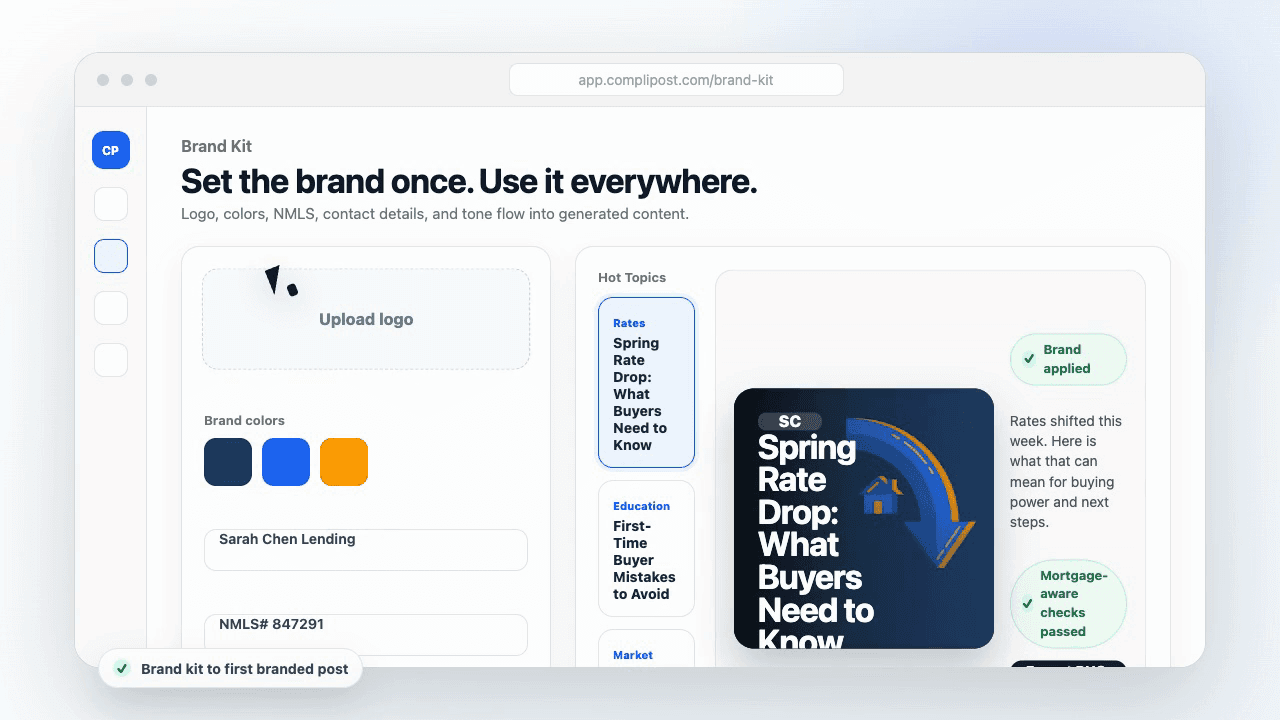
Product workflow
From blank page to export-ready mortgage content
- Start with a borrower topic
- Generate copy and a visual direction
- Review, save, and export the finished asset
These previews reflect the core CompliPost workflow: create, review, save, and export assets for use in your own channels.
Workflow comparison
| Content approach | What happens | Why it matters |
|---|---|---|
| Random posting | One-off ideas created when there is spare time | Inconsistent visibility and weak reuse |
| Template-only posting | Faster design but still requires rewriting and review | Helpful starting point, but not a full system |
| CompliPost workflow | Plan, generate, review, save, and export from one place | Better consistency with mortgage-aware review context |
| Done-for-you service | Someone else creates much of the content | Useful for some teams, but less control and less immediate reuse |
Who this guide helps
This guide is for loan officers working on solo loan officers who need a repeatable mortgage content workflow. The goal is to turn a broad mortgage topic into one borrower question, one useful takeaway, and one asset that can be reviewed before it is shared.
- You need content that sounds like a loan officer, not a generic brand account
- You want examples that can become captions, graphics, GIFs, or PDFs
- You need a clear place to review claims before export
- You want finished work saved for reuse, not lost in a chat thread
A practical workflow for this use case
Start with a narrow scenario, then move through planning, drafting, visual creation, review, and export. For USDA loan rural buyer content, that means the topic should be specific enough that a borrower or referral partner can immediately understand what decision the content helps with.
- Choose the borrower type, loan topic, or platform before generating copy
- Draft the caption and visual together so the asset feels cohesive
- Use the federal baseline review aid to flag claims and disclosure gaps
- Export the finished asset and save the post as a reusable starting point
What makes the content stronger
Strong mortgage content is usually specific, plain-spoken, and calm. It explains tradeoffs without pretending one answer fits every borrower. That is especially important on public social channels, where a short post can be interpreted without the full context of a loan conversation.
- Name the borrower question in the first line
- Explain one decision or tradeoff instead of covering everything
- Use examples without implying approval, savings, or rate outcomes
- End with a soft next step, checklist, or guide rather than pressure
Compliance-aware review notes
CompliPost should be treated as a review aid, not a compliance approval system. The public page, generated draft, graphic, and exported asset should all stay honest about that boundary.
- Review specific payment, APR, rate, savings, and qualification language
- Avoid “best,” “lowest,” “guaranteed,” “free,” and urgency claims unless approved
- Check NMLS, Equal Housing, company, and state-specific requirements
- Use company or legal review for anything outside the federal baseline
How this connects to the rest of CompliPost
A focused guide should leave you with a usable next step. After you understand the topic, you can turn it into a calendar slot, a reviewed social post, a downloadable guide, or a platform-specific version for the channel where your audience already spends time.
- Use the content calendar to turn the idea into a weekly plan
- Use the compliance page when claims or disclosures need a slower pass
- Use lead magnets when the topic deserves a deeper PDF guide
- Use platform pages to adapt the same idea for LinkedIn, Facebook, or Instagram
Recommended next steps
Mortgage social media content
See the cross-platform content workflow for loan officers.
Rural Homebuyer Guide
Comprehensive guide for rural buying strategies.
Positioning as a USDA Loan Specialist
Enhance your authority in USDA lending.
Mortgage Content Calendar
Plan a consistent schedule of educational posts.
Examples
FAQ
What is a USDA loan?+
A USDA loan is a agency-guideline mortgage designed to promote homeownership in rural areas. It offers 100% financing with limited upfront down-payment requirement when eligible, which can be advantageous for buyers in eligible areas. This program is administered by the U.S. Department of Agriculture and focuses on aiding low-to-moderate income borrowers in rural communities.
How can I determine if a property qualifies for a USDA loan?+
To determine property eligibility for a USDA loan, the location must be checked against USDA's eligibility maps. Generally, rural and small-town properties are eligible, while urban areas are not. Your lender can assist in verifying eligibility to ensure your property qualifies for USDA financing. The practical move is to keep the answer educational, mention that details vary by borrower profile and lender guidelines, and invite the reader to ask for a personal review instead of implying a certain result.
Do USDA loans require private mortgage insurance (PMI)?+
USDA loans do not require private mortgage insurance (PMI). Instead, they include a funding fee that can be rolled into the loan amount. This feature can reduce the monthly financial burden for borrowers compared to loans that require PMI. The practical move is to keep the answer educational, mention that details vary by borrower profile and lender guidelines, and invite the reader to ask for a personal review instead of implying a certain result.
How does a USDA loan differ from an FHA loan?+
USDA loans offer limited upfront down-payment requirement when eligible and are limited to rural properties, with no PMI required. FHA loans require a minimum a low-down-payment option payment and include mortgage insurance, but are available in more locations. The choice depends on your down payment capacity and property location.
Create mortgage content with a calmer workflow
CompliPost helps you plan, generate, review, save, and export useful mortgage content without pretending compliance or social distribution is automatic.
Start free