PHYSICIAN AUDIENCE
Help Physicians Manage Primary Home Purchase While Buying Into a Practice
Many attendings buy into their practice within the first few years of starting, taking on $100K–$500K+ in practice debt (loans or equity buyins). This creates a complex financial picture: practice debt impacts personal mortgage qualification, and managing both down payments (home + practice) requires strategic planning. Your content should address the sequencing (buy practice first, then home? home first, then practice?), explain how practice debt affects mortgage qualification, and show that both goals are achievable with planning.
Practice Buy-In Debt and Mortgage Qualification Impact
Practice debt—either as a personal loan or equity buyoin requirement—counts against personal debt-to-income ratio. Your content should explain how to calculate the impact, when practice debt becomes favorable (after payoff, if income grows), and strategies for managing both debts. Demystify the math so physicians understand they're not choosing between practice and home.
- Practice loan impact: monthly payment counts in DTI, reducing home mortgage qualification
- Buyoin vs. loan: buyoin (equity) vs. loan (debt service) have different accounting impacts
- DTI calculation: practice debt typically reduces home-mortgage qualification 10–30%, depending on debt size
- Growth offset: attending income often grows enough to offset practice debt impact on DTI
- Payoff timeline: many practice debts are 5–10 year, manageable alongside primary home mortgage
Sequencing: When to Buy Practice vs. Home
Should physicians buy practice first (reducing home buying power) or buy home first (locking in primary residence before taking on practice debt)? Your content should present both scenarios, show the math, and let physicians decide based on their priorities and timeline.
- Home first approach: buy residence before practice debt hits DTI, then take practice buyoin
- Practice first approach: buy into practice immediately, then buy home once income grows (2–3 years later)
- Simultaneous approach: buy both in same year if income is sufficient, practice loan + home mortgage
- Partner position timing: junior partners buy in after 1–3 years, earlier for established physicians
- Financial readiness: down payment savings, practice profitability, partner comfort with pace
Using Practice Equity and Cash Flow for Home Wealth Building
Practice ownership builds equity and generates cash flow that can accelerate home-related wealth strategies. Your content should show that practice debt isn't purely negative—it's an investment in income-generating assets. Once practice is profitable, physicians can use cash flow for home down payments or investment properties.
- Practice income growth: new partners often see income rise 50%+ after buyoin, improving home finances
- Cash flow use: practice profits can fund down payments, accelerate debt payoff, or fund investments
- Retained earnings: practice allows tax-deferred profit retention, useful for home down payments
- Refinancing advantage: once practice is established, refinancing home often improves terms
- Multi-property approach: practice equity + growing income supports investment property portfolios
Partnership Agreements and Personal Finance Implications
Partnership agreements define buy-in costs, payment schedules, and potential buyout clauses. Your content should highlight that these agreements impact personal finances—mortgage lenders need to understand the practice structure and payment obligations. Address worst-case scenarios (practice dissolves, forced buyout) and how they affect home ownership.
- Buy-in contract: defines practice debt obligation, term, and payment schedule
- Forced buyout clauses: if partnership ends, may owe additional amounts affecting home equity
- Profit-sharing vs. guaranteed income: affects personal income stability for mortgage purposes
- Non-compete clauses: may restrict ability to relocate, which affects primary home value long-term
- Practice valuation: affects personal net worth and future refinancing ability
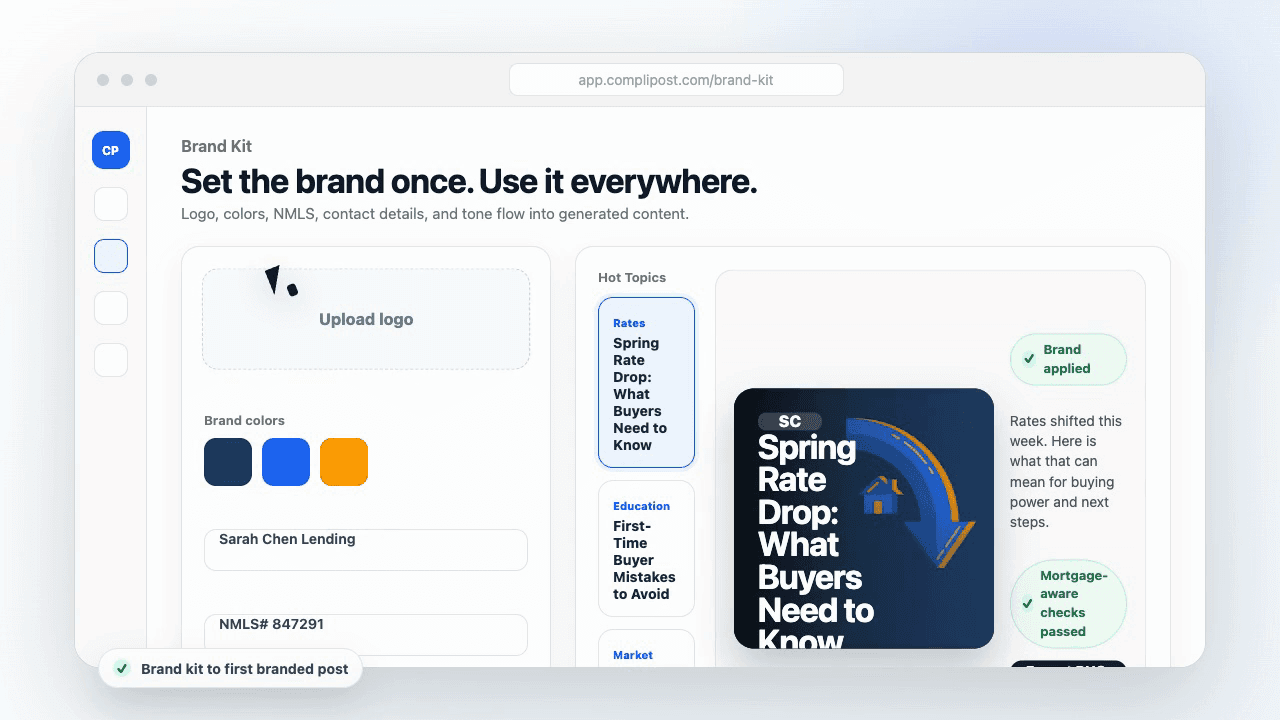
Product workflow
From blank page to export-ready mortgage content
- Start with a borrower topic
- Generate copy and a visual direction
- Review, save, and export the finished asset
These previews reflect the core CompliPost workflow: create, review, save, and export assets for use in your own channels.
Workflow comparison
| Content approach | What happens | Why it matters |
|---|---|---|
| Random posting | One-off ideas created when there is spare time | Inconsistent visibility and weak reuse |
| Template-only posting | Faster design but still requires rewriting and review | Helpful starting point, but not a full system |
| CompliPost workflow | Plan, generate, review, save, and export from one place | Better consistency with mortgage-aware review context |
| Done-for-you service | Someone else creates much of the content | Useful for some teams, but less control and less immediate reuse |
Who this guide helps
This guide is for loan officers working on solo loan officers who need a repeatable mortgage content workflow. The goal is to turn a broad mortgage topic into one borrower question, one useful takeaway, and one asset that can be reviewed before it is shared.
- You need content that sounds like a loan officer, not a generic brand account
- You want examples that can become captions, graphics, GIFs, or PDFs
- You need a clear place to review claims before export
- You want finished work saved for reuse, not lost in a chat thread
A practical workflow for this use case
Start with a narrow scenario, then move through planning, drafting, visual creation, review, and export. For physician homebuyer practice buy-in debt, that means the topic should be specific enough that a borrower or referral partner can immediately understand what decision the content helps with.
- Choose the borrower type, loan topic, or platform before generating copy
- Draft the caption and visual together so the asset feels cohesive
- Use the federal baseline review aid to flag claims and disclosure gaps
- Export the finished asset and save the post as a reusable starting point
What makes the content stronger
Strong mortgage content is usually specific, plain-spoken, and calm. It explains tradeoffs without pretending one answer fits every borrower. That is especially important on public social channels, where a short post can be interpreted without the full context of a loan conversation.
- Name the borrower question in the first line
- Explain one decision or tradeoff instead of covering everything
- Use examples without implying approval, savings, or rate outcomes
- End with a soft next step, checklist, or guide rather than pressure
Compliance-aware review notes
CompliPost should be treated as a review aid, not a compliance approval system. The public page, generated draft, graphic, and exported asset should all stay honest about that boundary.
- Review specific payment, APR, rate, savings, and qualification language
- Avoid “best,” “lowest,” “guaranteed,” “free,” and urgency claims unless approved
- Check NMLS, Equal Housing, company, and state-specific requirements
- Use company or legal review for anything outside the federal baseline
How this connects to the rest of CompliPost
A focused guide should leave you with a usable next step. After you understand the topic, you can turn it into a calendar slot, a reviewed social post, a downloadable guide, or a platform-specific version for the channel where your audience already spends time.
- Use the content calendar to turn the idea into a weekly plan
- Use the compliance page when claims or disclosures need a slower pass
- Use lead magnets when the topic deserves a deeper PDF guide
- Use platform pages to adapt the same idea for LinkedIn, Facebook, or Instagram
Recommended next steps
Self-employed borrower hub
Create income-documentation education for self-employed borrowers.
Physician Mortgage Specialist Content for Loan Officers
Understand the full financial picture of physicians, including practice ownership and professional business structures.
Business Owner Mortgage Guide
General business ownership financing strategies applicable to practice-owning physicians.
Debt-to-Income Ratio Calculation and Qualification
Master DTI calculation when practice debt is involved, to explain impacts accurately to physicians.
Examples
FAQ
How does practice buy-in debt affect my mortgage qualification?+
Practice debt counts as a monthly obligation in your debt-to-income ratio, reducing your mortgage qualification proportionally. For example, a $300K practice loan at 5% over 10 years is approximately $2,800/month, which reduces your available mortgage qualification. However, if your attending income is rising or will rise as a partner, this impact is temporary. Work with a lender who understands practice structures to calculate the exact impact—it's usually 10–25% reduction in home mortgage qualification depending on debt size.
Should I buy my home before or after buying into the practice?+
This depends on your priorities and timeline. Many physicians buy the home first (while qualification is cleaner), then take the practice buyoin 1–2 years later. Others buy into the practice first (to establish partnership) and buy a home 2–3 years later once income has grown and practice debt is partially paid. Model both scenarios with a lender and accountant—the answer depends on practice opportunity timing and your personal readiness.
Can I use practice cash flow to help with home mortgage payments?+
Yes, once you're established as a partner. For initial mortgage qualification, only your documented personal W-2 or guaranteed income counts. But once you're profitable in the practice, future refinances can incorporate documented partnership income (via K-1 forms, profit & loss statements). Many physicians find that improved practice cash flow within 2–3 years allows refinancing into better rates or larger mortgages.
What if the practice buy-in falls through—does that affect my home mortgage?+
Once your home mortgage is closed and funded, the practice deal falling through doesn't automatically change it. However, if you were relying on projected partnership income that doesn't materialize, and you need to refinance, lenders will evaluate your situation at that time. This is why buying your home before committing to a practice buyoin is sometimes strategically smart—locks in the primary residence regardless of practice plans.
How do partnership agreements and forced buyout clauses affect my home ownership?+
Partnership agreements can include provisions that require you to buy out a departing partner or force you out with a buyout amount owed. These contingencies affect your personal finances and home equity. Make sure your mortgage lender knows about major partnership contingencies, and discuss with an attorney how they might impact personal finances if triggered. Some physicians structure home equity or insurance to cover potential forced buyouts.
Create mortgage content with a calmer workflow
CompliPost helps you plan, generate, review, save, and export useful mortgage content without pretending compliance or social distribution is automatic.
Start free