PHYSICIAN AUDIENCE
Help Medical Residents Buy Their First Home During Residency
Medical residents face unique financing challenges: lower current income, student debt, and frequent relocations. As a loan officer, you can position yourself as understanding residency-specific hurdles by creating content about loan programs that weight future attending income, manage student debt in debt-to-income calculations, and address temporary relocation concerns. Your content should reassure residents that homeownership during residency is achievable and financially smart if structured correctly.
Why Medical Residents Wait—But Don't Have To
Many residents postpone homebuying, assuming their debt and income make it impossible. Your message: physician loan programs exist specifically to bridge this gap, factoring in future attending income and recognizing that resident debt is temporary. Create content showing real resident buyership timelines and the long-term wealth advantage of buying early over renting through years of relocations. This validates their concern while opening the door to a solution.
- Physician loan programs recognize future attending income, not just current resident salary
- Student loan debt is handled differently for physicians—not a disqualifier
- Building home equity during residency beats renting through multiple relocations
- Buying in a residency city can be a family anchor point, reducing moving stress
- Early purchase locks in mortgage before attending-level income, lowering long-term cost
Addressing Relocation Fear in Resident Content
Residents fear buying in a city they may leave after 3–5 years. Your content should normalize this: frame ownership as wealth-building even if they move, discuss rental-out options, and explain that physician-focused lenders understand resident mobility. Address how to evaluate neighborhoods for future resale appeal rather than permanent settling.
- Position home as investment, not permanent anchor—it can become a rental if you relocate
- Create content comparing rent vs. own in residency markets, showing breakeven timelines
- Explain how physician lenders approve relocation plans and future career moves
- Discuss market selection: buying in growing residency cities with strong rental demand
- Show examples of residents who profited from purchasing in 3-year residency windows
Physician Programs That Work for Residents
Residents qualify for standard mortgages plus specialized physician loan products that recognize their trajectory. Your content should clarify which programs make sense at their income stage, how future income documentation works, and what minimum down payment looks like. Demystify the approval process so prospects feel in control.
- Physician loans allow documented future attending income to be included in qualification
- Down payment assistance or low-down programs offset capital constraints of new physicians
- Some programs waive private mortgage insurance (PMI) for physicians despite lower down payments
- Interest rate pricing may improve as resident approaches fellowship or attending role
- Pre-approval timelines for physicians can be faster once future income is verified
Building Trust by Understanding Resident Life
Content that proves you understand the resident experience—grueling schedules, frequent calls, family separation, and the dream of stable home life—creates instant credibility. Reference real resident pain points (call schedules, student loan stress, partner income complications) to show you don't treat them as standard borrowers.
- Call schedules and shift work don't disqualify homeownership—lenders know this
- Spouse income and co-borrower advantages help couples where one is resident, one is not
- Managing 250K+ student debt while buying a home is common and manageable
- Mortgage approval before finishing residency is possible with the right lender
- Attending retirement planning can start during residency if home is structured right
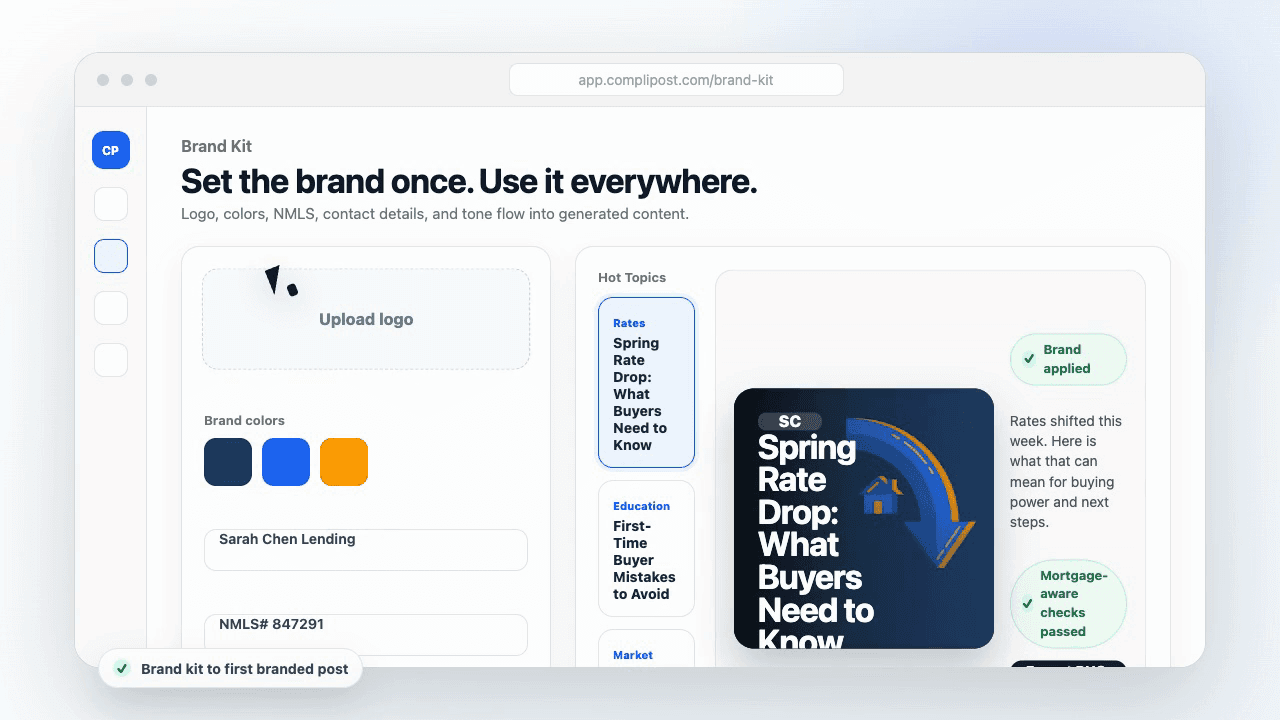
Product workflow
From blank page to export-ready mortgage content
- Start with a borrower topic
- Generate copy and a visual direction
- Review, save, and export the finished asset
These previews reflect the core CompliPost workflow: create, review, save, and export assets for use in your own channels.
Workflow comparison
| Content approach | What happens | Why it matters |
|---|---|---|
| Random posting | One-off ideas created when there is spare time | Inconsistent visibility and weak reuse |
| Template-only posting | Faster design but still requires rewriting and review | Helpful starting point, but not a full system |
| CompliPost workflow | Plan, generate, review, save, and export from one place | Better consistency with mortgage-aware review context |
| Done-for-you service | Someone else creates much of the content | Useful for some teams, but less control and less immediate reuse |
Who this guide helps
This guide is for loan officers working on solo loan officers who need a repeatable mortgage content workflow. The goal is to turn a broad mortgage topic into one borrower question, one useful takeaway, and one asset that can be reviewed before it is shared.
- You need content that sounds like a loan officer, not a generic brand account
- You want examples that can become captions, graphics, GIFs, or PDFs
- You need a clear place to review claims before export
- You want finished work saved for reuse, not lost in a chat thread
A practical workflow for this use case
Start with a narrow scenario, then move through planning, drafting, visual creation, review, and export. For physician homebuyer residents mortgage, that means the topic should be specific enough that a borrower or referral partner can immediately understand what decision the content helps with.
- Choose the borrower type, loan topic, or platform before generating copy
- Draft the caption and visual together so the asset feels cohesive
- Use the federal baseline review aid to flag claims and disclosure gaps
- Export the finished asset and save the post as a reusable starting point
What makes the content stronger
Strong mortgage content is usually specific, plain-spoken, and calm. It explains tradeoffs without pretending one answer fits every borrower. That is especially important on public social channels, where a short post can be interpreted without the full context of a loan conversation.
- Name the borrower question in the first line
- Explain one decision or tradeoff instead of covering everything
- Use examples without implying approval, savings, or rate outcomes
- End with a soft next step, checklist, or guide rather than pressure
Compliance-aware review notes
CompliPost should be treated as a review aid, not a compliance approval system. The public page, generated draft, graphic, and exported asset should all stay honest about that boundary.
- Review specific payment, APR, rate, savings, and qualification language
- Avoid “best,” “lowest,” “guaranteed,” “free,” and urgency claims unless approved
- Check NMLS, Equal Housing, company, and state-specific requirements
- Use company or legal review for anything outside the federal baseline
How this connects to the rest of CompliPost
A focused guide should leave you with a usable next step. After you understand the topic, you can turn it into a calendar slot, a reviewed social post, a downloadable guide, or a platform-specific version for the channel where your audience already spends time.
- Use the content calendar to turn the idea into a weekly plan
- Use the compliance page when claims or disclosures need a slower pass
- Use lead magnets when the topic deserves a deeper PDF guide
- Use platform pages to adapt the same idea for LinkedIn, Facebook, or Instagram
Recommended next steps
Self-employed borrower hub
Create income-documentation education for self-employed borrowers.
Physician Mortgage Specialist Positioning for Loan Officers
Build authority and trust with physician audiences by positioning yourself as a specialist in their unique financial challenges.
Medical Professionals and Student Debt Mortgage Qualification
Master the income documentation rules that make student debt manageable in physician mortgage qualification.
Physician Investment Property DSCR Loans
Teach residents and attendings how to leverage investment property financing to build wealth beyond their primary home.
Examples
FAQ
Can I qualify for a mortgage during residency with this much student debt?+
Yes. Physician loan programs treat student debt differently than standard lenders do. Instead of counting your full loan balance against your debt-to-income ratio, many programs use an estimated payment based on income-driven repayment plans, which is much lower. Additionally, some programs allow future attending income to be factored into your qualification, which can dramatically improve your purchasing power. Work with a lender experienced in physician loans to get an accurate pre-approval.
What if I'm planning to relocate after residency?+
Relocation is expected and normal for residents. As a loan officer, you should frame the home as a real estate investment that builds equity regardless of where the resident ends up. Discuss the option of converting it to a rental property if they move, and help them evaluate the specific market they're buying in for future resale or rental appeal. Some physician-focused lenders have specific guidance on managing this transition and can help structure the mortgage with future moves in mind.
How much down payment do I need as a resident?+
Down payment options for residents range from 3% to 20%, depending on the loan program. Conventional physician programs often allow down payments as low as 5%, and some specialized programs offer even lower down payments in exchange for slightly higher interest rates or mortgage insurance. Down payment assistance programs exist in many states specifically to help residents and early-career physicians, so research your state's programs in addition to lender options.
Will my interest rate be higher because I'm still in residency?+
Not necessarily. Some physician lenders price rates the same regardless of residency status, recognizing the stability of the medical profession. Others may offer rate improvements once you transition to fellowship or attending status. Shop multiple lenders to compare; the difference can be significant over a 30-year mortgage. Your future income trajectory actually makes you a lower-risk borrower than your current salary alone suggests.
Can my spouse's income help me qualify if they're not a physician?+
Absolutely. Co-borrower income is factored into qualification. If your spouse has stable employment, their income strengthens your application and increases your buying power. Physician lenders are accustomed to scenarios where one partner is a physician and the other is not, so there are no surprises in the underwriting process. Make sure all income is documented clearly to speed approval.
Create mortgage content with a calmer workflow
CompliPost helps you plan, generate, review, save, and export useful mortgage content without pretending compliance or social distribution is automatic.
Start free