PHYSICIAN AUDIENCE
Help Recently Matched Medical Students Plan Home Purchases
Match season (typically March) is when medical students learn their residency location and begin life transition planning. This is the perfect moment for loan officers to engage—newly matched physicians are thinking about relocation, starting residency in a new city, and often want to establish roots. Your content should congratulate them, normalize the idea of buying a home during residency (not waiting until attending), and offer a clear first step (pre-approval). Position yourself as understanding the match timeline and available to help immediately.
Match Season: The Perfect Timing for Mortgage Pre-Approval
Matched students have 2–3 months before residency starts, which is the ideal window for pre-approval and home searching. Your content should explain why pre-approval now (before resident income starts) is often easier, and highlight the psychological win: they can start exploring homes and neighborhoods immediately, not after their first 80-hour resident week. Create urgency without pressure.
- Pre-approval timing: use offer letter + student status for initial pre-approval
- Medical school debt is known and documented; easier to approve than waiting for early residency
- Head start on neighborhoods: explore the city before moving, identify communities
- Summer move planning: pre-approval done before July 1 start date reduces moving stress
- Competitive markets: pre-approval shows sellers you're a serious buyer, advantage in bidding
First-Time Homebuyer Frame for Residents
Many matched students are buying their first home. Your content should acknowledge first-time buyer nervousness, provide reassurance, and give basic education (down payment, closing costs, what to expect). Frame residency home purchase as achievable and smart, not overwhelming.
- First-time buyer programs: down payment assistance, lower down payments for new homeowners
- Closing cost explanations: demystify what residents will owe, when, and to whom
- Home inspection and appraisal process: explain what happens, reduce surprise
- Timeline clarity: offer letter to pre-approval to home offer to closing, realistic schedule
- Support system: connect residents with local real estate agents, lenders, and community
The Relocation Reality: Buying in an Unknown City
Matched residents are moving to a city they may have never visited or don't know well. Your content should address the emotion (excitement, anxiety) and practical strategy (virtual tours, local realtors, neighborhood research). Show that remote home buying is normal and achievable with the right support.
- Virtual tours and video calls: see homes without travel if budget doesn't allow visits
- Local realtor partnership: hire someone in the new city to guide you, show properties
- Neighborhood research: walkability, safety, demographics, schools, community feel
- Commute planning: drive times from residency hospital to candidate neighborhoods
- Social scouting: connect with co-residents, ask about neighborhoods and living situations
Building Loan Officer Authority in Match Season
Match season content positions you as part of the resident's life transition support system. Your tone should be congratulatory, understanding, and resource-rich. Show that you understand residency timelines, offer actionable next steps, and make yourself accessible during the chaotic weeks after match day.
- Acknowledge achievement: congratulate matched students, recognize the significance
- Resident-first positioning: show you understand resident culture, scheduling, challenges
- Clear next steps: pre-approval, home search, offer, closing—spell out the path
- Accessibility: available for questions during match season chaos, responsive communication
- Peer review: share testimonials from residents who bought during training
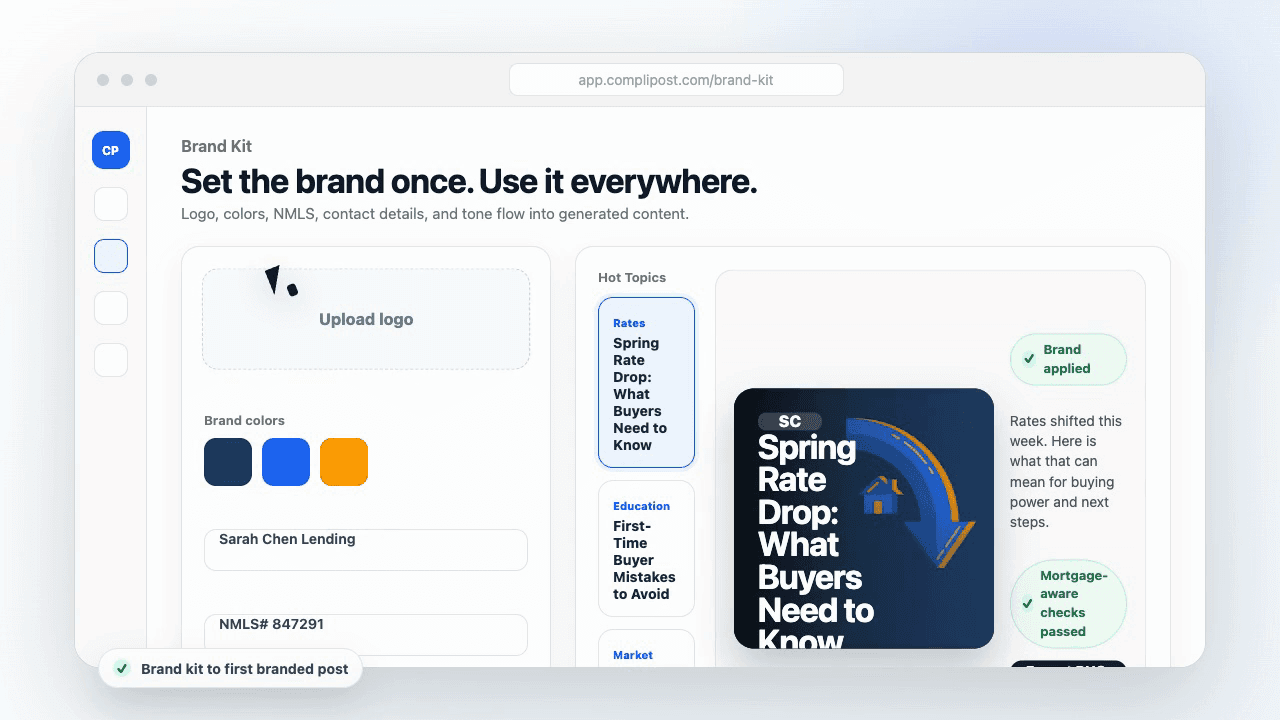
Product workflow
From blank page to export-ready mortgage content
- Start with a borrower topic
- Generate copy and a visual direction
- Review, save, and export the finished asset
These previews reflect the core CompliPost workflow: create, review, save, and export assets for use in your own channels.
Workflow comparison
| Content approach | What happens | Why it matters |
|---|---|---|
| Random posting | One-off ideas created when there is spare time | Inconsistent visibility and weak reuse |
| Template-only posting | Faster design but still requires rewriting and review | Helpful starting point, but not a full system |
| CompliPost workflow | Plan, generate, review, save, and export from one place | Better consistency with mortgage-aware review context |
| Done-for-you service | Someone else creates much of the content | Useful for some teams, but less control and less immediate reuse |
Who this guide helps
This guide is for loan officers working on solo loan officers who need a repeatable mortgage content workflow. The goal is to turn a broad mortgage topic into one borrower question, one useful takeaway, and one asset that can be reviewed before it is shared.
- You need content that sounds like a loan officer, not a generic brand account
- You want examples that can become captions, graphics, GIFs, or PDFs
- You need a clear place to review claims before export
- You want finished work saved for reuse, not lost in a chat thread
A practical workflow for this use case
Start with a narrow scenario, then move through planning, drafting, visual creation, review, and export. For match season physician homebuyer residency, that means the topic should be specific enough that a borrower or referral partner can immediately understand what decision the content helps with.
- Choose the borrower type, loan topic, or platform before generating copy
- Draft the caption and visual together so the asset feels cohesive
- Use the federal baseline review aid to flag claims and disclosure gaps
- Export the finished asset and save the post as a reusable starting point
What makes the content stronger
Strong mortgage content is usually specific, plain-spoken, and calm. It explains tradeoffs without pretending one answer fits every borrower. That is especially important on public social channels, where a short post can be interpreted without the full context of a loan conversation.
- Name the borrower question in the first line
- Explain one decision or tradeoff instead of covering everything
- Use examples without implying approval, savings, or rate outcomes
- End with a soft next step, checklist, or guide rather than pressure
Compliance-aware review notes
CompliPost should be treated as a review aid, not a compliance approval system. The public page, generated draft, graphic, and exported asset should all stay honest about that boundary.
- Review specific payment, APR, rate, savings, and qualification language
- Avoid “best,” “lowest,” “guaranteed,” “free,” and urgency claims unless approved
- Check NMLS, Equal Housing, company, and state-specific requirements
- Use company or legal review for anything outside the federal baseline
How this connects to the rest of CompliPost
A focused guide should leave you with a usable next step. After you understand the topic, you can turn it into a calendar slot, a reviewed social post, a downloadable guide, or a platform-specific version for the channel where your audience already spends time.
- Use the content calendar to turn the idea into a weekly plan
- Use the compliance page when claims or disclosures need a slower pass
- Use lead magnets when the topic deserves a deeper PDF guide
- Use platform pages to adapt the same idea for LinkedIn, Facebook, or Instagram
Recommended next steps
Self-employed borrower hub
Create income-documentation education for self-employed borrowers.
Physician Homebuyer for Medical Residents: First Home Strategy
Deep dive into resident-specific buying strategies, once they've matched and made the decision to buy.
First Time Homebuyer Specialist Content
Broader first-time buyer education applicable to matched residents buying their first home.
Relocation Loan Officer Content Strategy
General relocation strategies adapted for match-season residents entering new cities.
Examples
FAQ
When should I apply for a mortgage pre-approval after match day?+
As soon as you have your residency offer letter (or match letter), you can start the pre-approval process. Applying in March/April gives you 3+ months to search and potentially close before residency starts July 1. This timeline is comfortable and reduces stress. If you're planning to buy immediately upon arrival, apply within 2 weeks of match day. If you want to rent first and explore, you can apply in June. The timing is flexible, but earlier is easier because medical school income/debt status is clear.
Can I use my medical school offer letter to get pre-approved for a mortgage?+
Yes. Residency offer letters (sometimes called match contracts) are acceptable documentation for pre-approval. You'll also need to provide proof of your medical school graduation (diploma, graduation date) and a copy of your medical license or confirmation of licensure timeline. If you don't have your state medical license yet, most lenders accept an expected licensure date. Physician lenders are familiar with this process and have streamlined it.
Should I buy a home right away or rent first to explore the city?+
This is personal, but consider: if you buy immediately, you start building equity right away and avoid multiple moves. If you rent for 6–12 months, you explore the market, get to know neighborhoods, and understand the area before committing to a purchase. Many residents do both over time (rent first year, buy in year 2 after establishing roots). Discuss your personal goals and risk tolerance with a lender; there's no wrong answer.
What if my spouse is also a medical resident/student?+
Two medical students applying together is great—you have combined income and clear documentation. Both offer letters or match contracts can be used for pre-approval. Both medical school debts are factored into DTI. Work with a lender experienced in dual-physician households because your combined income likely supports a larger mortgage than either individual income alone.
How much should I expect to pay for a home during residency?+
This depends on your resident salary (varies by specialty and location) and down payment savings. Most resident income supports $250K–$400K home purchases in affordable markets, and $300K–$600K in moderate markets. In high-cost markets (CA, NYC, Boston), resident purchasing power is lower. Use an online mortgage calculator with your expected resident salary to estimate. A lender can give you a precise pre-approval amount once you apply.
Create mortgage content with a calmer workflow
CompliPost helps you plan, generate, review, save, and export useful mortgage content without pretending compliance or social distribution is automatic.
Start free