PHYSICIAN AUDIENCE
Help Non-Traditional-Career Physicians Buy Homes with Unconventional Income Paths
Not all physicians follow traditional residency-to-attending paths. Some are in telemedicine, hospital administration, pharma research, medical writing, or other non-clinical roles. Income patterns are different (W-2 but variable, contract-based, equity-dependent), and lenders need reassurance of stability. Your content should address these alternative paths, explain how non-traditional physician income is documented and verified, and show that diverse physician careers are fundable.
Non-Traditional Physician Income Documentation
Telemedicine, administration, research, and industry physician roles have different income structures—some W-2 (easier to document), some 1099 or contract-based (harder). Your content should explain how each is documented and what lenders need to verify stability.
- Telemedicine W-2: employment contract with company, paystubs, income stable and documentable
- Telemedicine 1099/contract: variable per-session pay, requires proof of ongoing contracts, historical earnings
- Hospital administration: W-2 salaried position, standard documentation, similar to attending employment
- Research/academia: grant funding, publication record, institution verification, variable but documentable
- Pharma/industry: W-2 salaried or bonus-based, depends on company structure and role
Proof of Career Stability in Non-Traditional Paths
Non-traditional careers can face skepticism about stability ('Is this sustainable? Will income continue?'). Your content should show how to document stability—multi-year contract history, employer stability, growth trajectory, peer comparisons.
- Contract duration: long-term contracts (2+ years) prove stability better than short-term gigs
- Employer stability: large telemedicine platforms or pharma companies are lower-risk than startups
- Income history: 2+ years of consistent earnings (even if variable) proves sustainability
- Industry trajectory: telemedicine and digital health growing rapidly; emphasize market demand
- Peer income: show that physician peers in same role earn similar amounts (proof of normalcy)
Variable and Bonus-Based Income Qualification
Some non-traditional physicians earn bonuses, commissions, or equity that fluctuates. Your content should explain how lenders handle variable income—averaging, requirements for 2+ years history, and when bonus/equity counts toward qualification.
- Bonus income: typically counted if documented 2+ years and showing consistency/growth
- Equity/stock options: some programs count vested equity as assets; unvested may not count as income
- Commission-based: rare for physicians but some telemedicine platforms use commission; needs documentation
- Part-time + side gig: some physicians combine part-time telemedicine with other income; lenders average
- Clinical work shifting to non-clinical: changing from attending to admin/telemedicine; document both roles
Building Authority with Non-Traditional Physician Audiences
Your content should demonstrate understanding of alternative physician careers—acknowledge that they're growing, valid, and offer different lifestyle advantages than traditional roles. Show respect for diverse career paths.
- Flexibility recognition: acknowledge that telemedicine, admin, research offer better work-life balance
- Market understanding: digital health, physician leadership, research all growing fields with strong demand
- Career validation: show that non-traditional physicians contribute significantly to healthcare
- Lender expertise: position yourself as understanding non-traditional income documentation
- Peer community: reference networks and associations for non-traditional physicians (not just clinical)
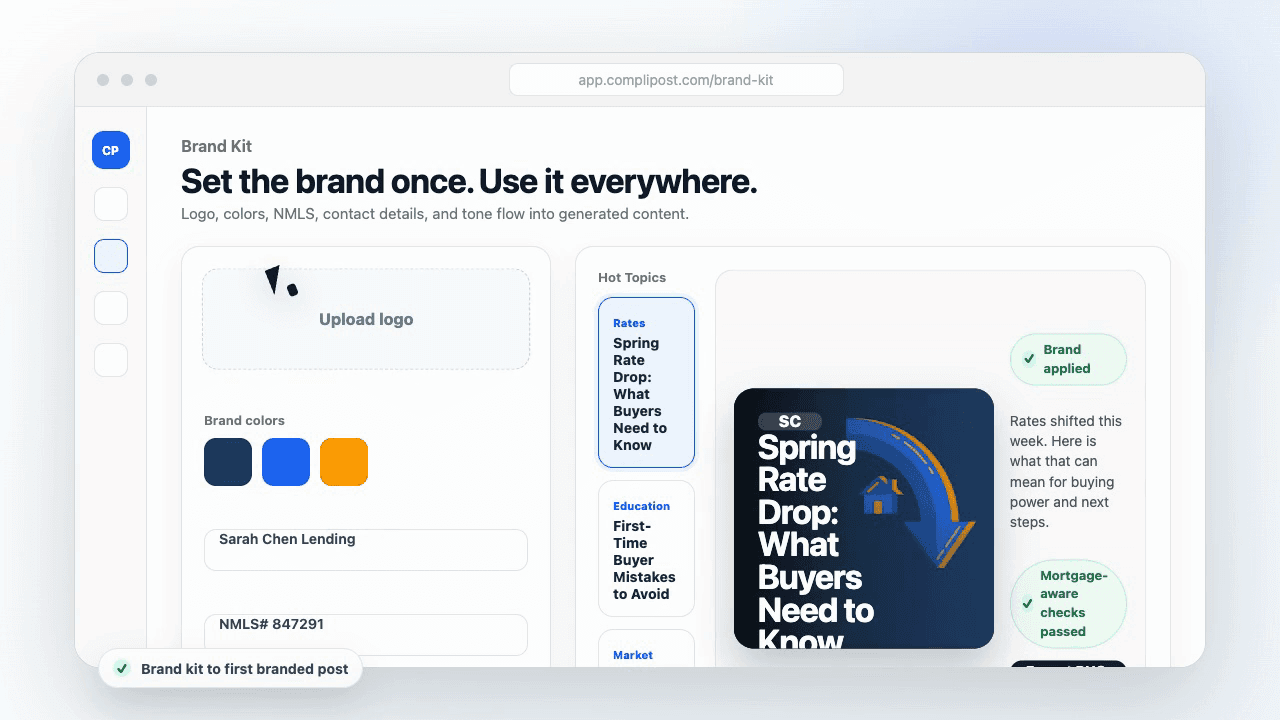
Product workflow
From blank page to export-ready mortgage content
- Start with a borrower topic
- Generate copy and a visual direction
- Review, save, and export the finished asset
These previews reflect the core CompliPost workflow: create, review, save, and export assets for use in your own channels.
Workflow comparison
| Content approach | What happens | Why it matters |
|---|---|---|
| Random posting | One-off ideas created when there is spare time | Inconsistent visibility and weak reuse |
| Template-only posting | Faster design but still requires rewriting and review | Helpful starting point, but not a full system |
| CompliPost workflow | Plan, generate, review, save, and export from one place | Better consistency with mortgage-aware review context |
| Done-for-you service | Someone else creates much of the content | Useful for some teams, but less control and less immediate reuse |
Who this guide helps
This guide is for loan officers working on solo loan officers who need a repeatable mortgage content workflow. The goal is to turn a broad mortgage topic into one borrower question, one useful takeaway, and one asset that can be reviewed before it is shared.
- You need content that sounds like a loan officer, not a generic brand account
- You want examples that can become captions, graphics, GIFs, or PDFs
- You need a clear place to review claims before export
- You want finished work saved for reuse, not lost in a chat thread
A practical workflow for this use case
Start with a narrow scenario, then move through planning, drafting, visual creation, review, and export. For physician homebuyer non-traditional career telemedicine, that means the topic should be specific enough that a borrower or referral partner can immediately understand what decision the content helps with.
- Choose the borrower type, loan topic, or platform before generating copy
- Draft the caption and visual together so the asset feels cohesive
- Use the federal baseline review aid to flag claims and disclosure gaps
- Export the finished asset and save the post as a reusable starting point
What makes the content stronger
Strong mortgage content is usually specific, plain-spoken, and calm. It explains tradeoffs without pretending one answer fits every borrower. That is especially important on public social channels, where a short post can be interpreted without the full context of a loan conversation.
- Name the borrower question in the first line
- Explain one decision or tradeoff instead of covering everything
- Use examples without implying approval, savings, or rate outcomes
- End with a soft next step, checklist, or guide rather than pressure
Compliance-aware review notes
CompliPost should be treated as a review aid, not a compliance approval system. The public page, generated draft, graphic, and exported asset should all stay honest about that boundary.
- Review specific payment, APR, rate, savings, and qualification language
- Avoid “best,” “lowest,” “guaranteed,” “free,” and urgency claims unless approved
- Check NMLS, Equal Housing, company, and state-specific requirements
- Use company or legal review for anything outside the federal baseline
How this connects to the rest of CompliPost
A focused guide should leave you with a usable next step. After you understand the topic, you can turn it into a calendar slot, a reviewed social post, a downloadable guide, or a platform-specific version for the channel where your audience already spends time.
- Use the content calendar to turn the idea into a weekly plan
- Use the compliance page when claims or disclosures need a slower pass
- Use lead magnets when the topic deserves a deeper PDF guide
- Use platform pages to adapt the same idea for LinkedIn, Facebook, or Instagram
Recommended next steps
Self-employed borrower hub
Create income-documentation education for self-employed borrowers.
Physician Mortgage Specialist Content for Loan Officers
Broad guide covering all physician career paths, including non-traditional roles.
Self-Employed Business Owner Mortgage Guide
For 1099-based or contract physicians, apply general self-employed financing strategies.
Income Documentation and Qualification Requirements
Deep dive into income documentation for all physician employment types.
Examples
FAQ
Can I qualify for a mortgage if I work in telemedicine instead of traditional clinical practice?+
Yes. Telemedicine W-2 employment is straightforward to document (employer contract, paystubs). Telemedicine 1099 or contract work requires proof of ongoing contracts and 2+ years of historical earnings. Lenders understand telemedicine is a growing field and stable for established companies. Make sure your telemedicine company is established and credible; startups may face extra scrutiny. Combine telemedicine income with traditional medical credentials (MD/DO, license) to build lender confidence.
Does non-traditional physician income count differently than traditional practice income?+
W-2 employment (telemedicine, hospital admin, pharma) is documented identically to standard W-2 income—paystubs, employment letter, recent returns. 1099 or contract-based work requires documentation of contracts and historical earnings (2+ years typical). Bonus or equity income requires 2+ years of documentation and proof it will continue. The key is stability and documentation; non-traditional work isn't inherently riskier, just potentially more variable.
What if I'm transitioning from traditional practice to non-traditional work—does that affect my mortgage?+
Transitioning can complicate qualification timing. If you're changing jobs mid-year, your income documentation is split between old and new roles. Lenders prefer: (1) Completing the mortgage before major job changes, or (2) Transitioning after closing. If you must transition during the mortgage process, provide offer letters and income documentation from both roles. Emphasize continuity (e.g., same field, similar income) to reduce lender concerns about stability.
Can equity or stock options in a pharma/tech company count toward my income?+
Vested equity can sometimes count as assets (increases net worth). Unvested equity generally doesn't count as current income unless documented as guaranteed future payment. Some lenders consider restricted stock units (RSUs) if they have a documented vesting schedule. Discuss equity documentation with your lender; it varies by program. Equity primarily helps by increasing overall net worth and down payment capacity, not by increasing qualifying income.
How do I prove stability in a relatively new non-traditional role?+
Document: (1) Your signed employment contract, (2) Offer letter from employer, (3) Paystubs (even if only recent), (4) Employer stability (size, funding, longevity), (5) Growth potential (your career/income trajectory). New roles are harder to qualify for (less history), but physician credentials and employer stability help. Consider waiting 6–12 months for a longer history before applying, or apply for pre-approval immediately after start date with clear documentation.
Create mortgage content with a calmer workflow
CompliPost helps you plan, generate, review, save, and export useful mortgage content without pretending compliance or social distribution is automatic.
Start free