PHYSICIAN AUDIENCE
Help Entrepreneur Physicians Buy Homes While Building Healthcare Ventures
Some physicians own or invest in healthcare businesses—telemedicine platforms, medical device companies, healthcare software, urgent care clinics, private practices. Income from these ventures is variable and requires proof of stability. Your content should address how business ownership is documented, when business income qualifies for mortgages, and strategies for building homes while growing ventures.
Business Ownership Income Documentation and Qualification
Physician business owners have multiple income streams—salary from practice/employment plus business profits. Your content should explain how both are documented and how lenders verify sustainability of business income.
- Practice W-2 + business K-1: physician salary counts as standard W-2; business profit counts on K-1 (partnership) or Schedule C (sole proprietor)
- Two-year history: business income typically requires 2 years of documented profitability to count toward qualification
- Business financials: lenders review profit & loss, balance sheet, bank statements to verify business viability
- Startup phase: new ventures (less than 2 years) may not count toward income; rely on W-2 income only
- Equity stake: business ownership improves net worth (asset position) even if income doesn't yet count
Timing Home Purchase Around Business Launch or Growth
Entrepreneur physicians often ask: should I buy before starting the business, after it's profitable, or while growing? Your content should present scenarios and help physicians think strategically about timing.
- Buy before startup: establish primary residence before business drain; business income adds later
- Wait for profitability: 2-year business track record needed for business income to count; lock in mortgage then
- Hybrid approach: buy modest home on W-2 income first, upgrade after business is established
- Business provides down payment: some entrepreneurs use business profits for down payment on home
- Refinance timing: once business is profitable and documented, refinance primary home for better terms
Managing Dual Income Streams in Mortgage Qualification
Physician entrepreneurs have complexity: full-time practice income + business profits. Your content should show how to optimize qualification by documenting both streams and positioning them as complementary (risk diversification).
- Income stability perception: physician W-2 (stable) + business income (variable) = diversified risk profile
- Lender preference: documented, growing business income is preferred over declining or flat trends
- Tax planning impact: some physicians minimize business income for tax reasons; discuss with accountant/lender
- SBA loan integration: if physician used SBA loan to fund business, disclosure and repayment plan required
- Personal guarantee: if business has debt you personally guaranteed, that counts in your DTI
Building Authority with Entrepreneur Physician Audiences
Your content should acknowledge the hustle and vision of physician entrepreneurs, and position mortgages as enabling their dreams, not competing with them.
- Vision recognition: acknowledge the drive and risk-taking of physician entrepreneurs
- Financing sophistication: show understanding of business revenue models, growth trajectories, profitability timelines
- Integrated planning: position home mortgage as part of broader financial strategy (personal + business wealth)
- Reinvestment strategy: show understanding that business profits may be reinvested, not maximizing income distribution
- Success celebration: frame home purchase as milestone in entrepreneurial journey, tangible proof of success
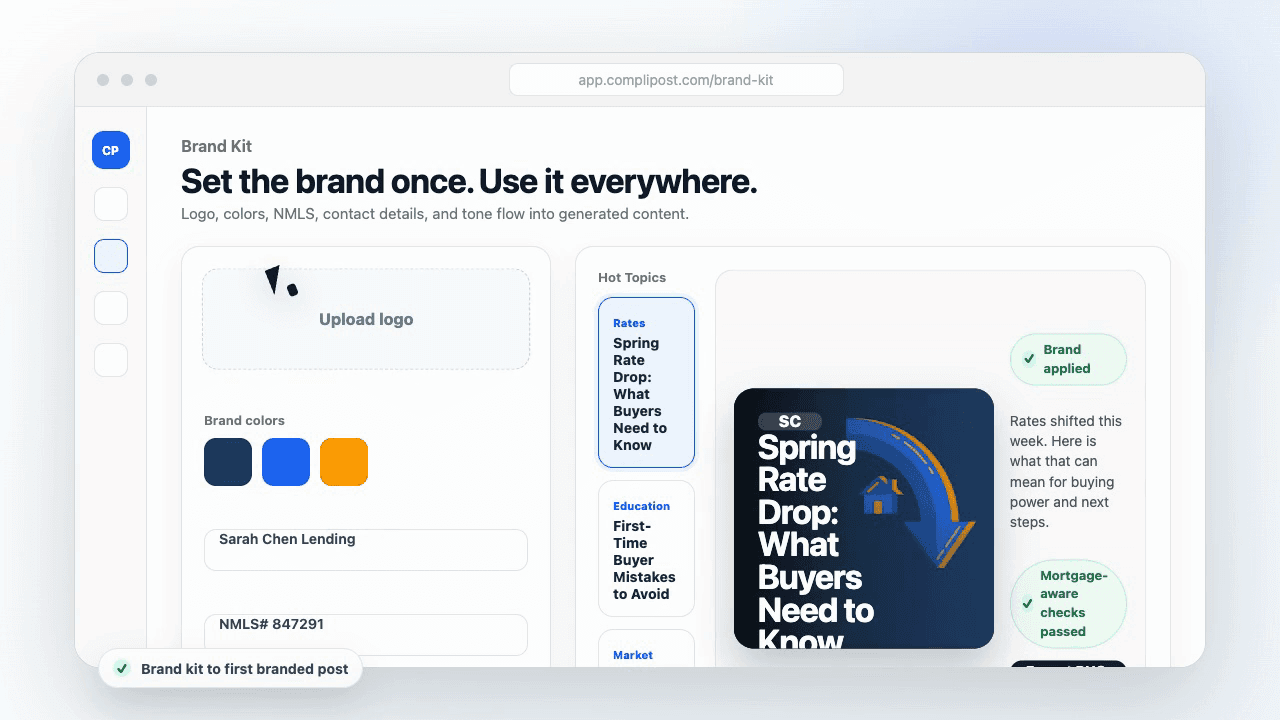
Product workflow
From blank page to export-ready mortgage content
- Start with a borrower topic
- Generate copy and a visual direction
- Review, save, and export the finished asset
These previews reflect the core CompliPost workflow: create, review, save, and export assets for use in your own channels.
Workflow comparison
| Content approach | What happens | Why it matters |
|---|---|---|
| Random posting | One-off ideas created when there is spare time | Inconsistent visibility and weak reuse |
| Template-only posting | Faster design but still requires rewriting and review | Helpful starting point, but not a full system |
| CompliPost workflow | Plan, generate, review, save, and export from one place | Better consistency with mortgage-aware review context |
| Done-for-you service | Someone else creates much of the content | Useful for some teams, but less control and less immediate reuse |
Who this guide helps
This guide is for loan officers working on solo loan officers who need a repeatable mortgage content workflow. The goal is to turn a broad mortgage topic into one borrower question, one useful takeaway, and one asset that can be reviewed before it is shared.
- You need content that sounds like a loan officer, not a generic brand account
- You want examples that can become captions, graphics, GIFs, or PDFs
- You need a clear place to review claims before export
- You want finished work saved for reuse, not lost in a chat thread
A practical workflow for this use case
Start with a narrow scenario, then move through planning, drafting, visual creation, review, and export. For physician homebuyer entrepreneur startup healthcare business, that means the topic should be specific enough that a borrower or referral partner can immediately understand what decision the content helps with.
- Choose the borrower type, loan topic, or platform before generating copy
- Draft the caption and visual together so the asset feels cohesive
- Use the federal baseline review aid to flag claims and disclosure gaps
- Export the finished asset and save the post as a reusable starting point
What makes the content stronger
Strong mortgage content is usually specific, plain-spoken, and calm. It explains tradeoffs without pretending one answer fits every borrower. That is especially important on public social channels, where a short post can be interpreted without the full context of a loan conversation.
- Name the borrower question in the first line
- Explain one decision or tradeoff instead of covering everything
- Use examples without implying approval, savings, or rate outcomes
- End with a soft next step, checklist, or guide rather than pressure
Compliance-aware review notes
CompliPost should be treated as a review aid, not a compliance approval system. The public page, generated draft, graphic, and exported asset should all stay honest about that boundary.
- Review specific payment, APR, rate, savings, and qualification language
- Avoid “best,” “lowest,” “guaranteed,” “free,” and urgency claims unless approved
- Check NMLS, Equal Housing, company, and state-specific requirements
- Use company or legal review for anything outside the federal baseline
How this connects to the rest of CompliPost
A focused guide should leave you with a usable next step. After you understand the topic, you can turn it into a calendar slot, a reviewed social post, a downloadable guide, or a platform-specific version for the channel where your audience already spends time.
- Use the content calendar to turn the idea into a weekly plan
- Use the compliance page when claims or disclosures need a slower pass
- Use lead magnets when the topic deserves a deeper PDF guide
- Use platform pages to adapt the same idea for LinkedIn, Facebook, or Instagram
Recommended next steps
Self-employed borrower hub
Create income-documentation education for self-employed borrowers.
Self-Employed Business Owner Mortgage Guide
Broader business owner financing strategies applicable to physician entrepreneurs.
Income Documentation and Qualification Requirements
Master income documentation for physicians with multiple income streams and business ownership.
Physician Investment Property DSCR Loans
Once primary home is financed, entrepreneur physicians can scale investments using business cash flow.
Examples
FAQ
Can I count my healthcare business income toward my mortgage if the business is new?+
New businesses (less than 2 years old) typically don't count as income toward qualification; lenders want to see 2 years of documented profitability and tax returns. However, your physician W-2 income (if you have one) still qualifies. Once the business is established and profitable, you can refinance and add business income to improve terms. Some lenders are more flexible with seasoned entrepreneurs; discuss your specific situation.
How do I document income from a healthcare startup or side venture?+
Document with 2 years of federal income tax returns (Schedule C for sole proprietor, K-1 for partnership/LLC), plus recent business bank statements and profit & loss statements. Lenders will verify the business exists, is operating, and is generating documented income. If the business is less than 2 years old, you can still apply for a mortgage on your W-2 physician income; business income will strengthen qualification once documented.
Should I buy a home before or after launching my business?+
Most entrepreneurs buy before or early in business launch, using stable physician W-2 income to qualify. This locks in a primary residence mortgage while income is clear. The business then grows, and within 2 years, if profitable, you can refinance to improve terms or tap equity for business reinvestment. Launching business while shopping for homes adds stress; complete home purchase first if possible.
Does my healthcare business debt count against my mortgage qualification?+
Yes. Business loans you personally guaranteed count fully against your personal debt-to-income ratio. Business debt not personally guaranteed (corporate debt) doesn't count. Minimize personal business debt before applying for a large primary residence mortgage. Alternatively, plan conservatively—your qualification will be lower if you're carrying significant business debt.
Can I use my business bank account funds for the down payment?+
Yes, but with documentation. You'll need to show the source of the funds (business profits, retained earnings) and that the withdrawal is properly authorized by the business (not a loan that must be repaid). Provide business tax returns and bank statements showing the funds have been in your account. Lenders want to confirm the down payment is your own capital, not borrowed funds.
Create mortgage content with a calmer workflow
CompliPost helps you plan, generate, review, save, and export useful mortgage content without pretending compliance or social distribution is automatic.
Start free