Content Strategy
Loan Officer Purchase Market Content: Build Visibility When Buyers Are Ready to Move
Purchase market content is the content strategy built for when buyers are actively searching — not refinancing, not waiting, but ready to make a move. Loan officers who build consistent, educational content during active purchase cycles show up exactly when a borrower is doing research, comparing options, and deciding who to trust. This guide covers the formats, compliance lines, and posting cadence that work in a purchase market.
What makes purchase market content different from refinance content
Purchase market and refinance market content serve different borrower psychology. A refinance borrower already has a home and a loan — they're evaluating whether to change something they know. A purchase borrower is often facing the most complex financial transaction of their life for the first time. Purchase market content earns the most engagement when it treats this complexity honestly: not simplifying it away, but making it legible. A 30-day scan of loan-officer social content found the posts that generated actual borrower conversations addressed specific process questions, not rate announcements.
The content formats that work in an active purchase market
In a purchase market, borrowers are in research mode — actively looking for people who can explain the process. Process explainers are the highest-value format: "What happens between offer accepted and closing day" as a carousel addresses the exact anxiety purchase borrowers carry. Pre-approval education serves borrowers in earlier research: what pre-approval does and doesn't commit them to, what lenders pull, and why getting pre-approved early changes negotiating position. Down-payment and closing-cost transparency is one of the most-saved content categories. Local market context — without predicting rates or outcomes — connects your purchase-market content to geography.
- Process explainers: what happens between offer and closing, step by step
- Pre-approval education: what it does and doesn't commit you to
- Closing-cost transparency: real fee breakdowns, labeled and explained
- Local market context: inventory and conditions, framed without rate predictions
- Down-payment assistance: who qualifies and how to find programs in your market
Posting cadence during a hot purchase market
Active purchase markets — typically spring and early fall — are when posting consistently matters most. This is when borrowers are actively researching and when consistent presence translates most directly into inbound conversations. The 5-day posting schedule maps well to a purchase market: Monday neighborhood or local-market context, Tuesday a process explainer, Wednesday a short video answering a purchase question, Thursday a lead magnet, Friday a personal post. Research on loan-officer contact timing suggests about 40% of mortgage inquiries happen outside business hours — consistent content presence means you're visible during those research sessions even when you're not online.
Compliance guardrails for purchase market content
Purchase market content carries compliance risks concentrated in two categories: rate and market statements, and outcome promises. Rate statements — "rates are still historically low," "now is a great time to lock" — are unauthorized advice regardless of how carefully they're qualified. Outcome promises — "you'll qualify for more house than you think," "I always get my clients to closing" — are deceptive practices under UDAAP when they can't be guaranteed. The safer pattern is to describe what you help borrowers understand rather than what you can predict: "I help buyers understand every fee on their closing disclosure before they sign." CompliPost's federal-baseline review aid flags rate statements, urgency-framing, and outcome-promise language before export. "It's a great time to buy" is the canonical documented violation — the review layer matters even for copy that feels clearly fine.
- Do not state or imply rate predictions in purchase market posts
- Do not promise approval, qualification, or a specific closing timeline
- "It's a great time to buy" is unauthorized financial advice — reframe as education
- Local market context is safe when framed as information, not recommendation
How CompliPost supports purchase market content creation
The blank-calendar problem is most acute in a hot purchase market — the same market cycle that makes consistent posting most valuable also makes loan officers busiest. CompliPost generates purchase market content — process explainers, pre-approval education, closing-cost breakdowns, and local-market context posts — that a loan officer can review, adjust, and export during the narrow windows between closings. Every piece goes through a federal-baseline compliance review aid that flags rate statements, urgency-framing, and outcome-promise language. The output is yours to post from your own platforms, on your own schedule, with your own branding.
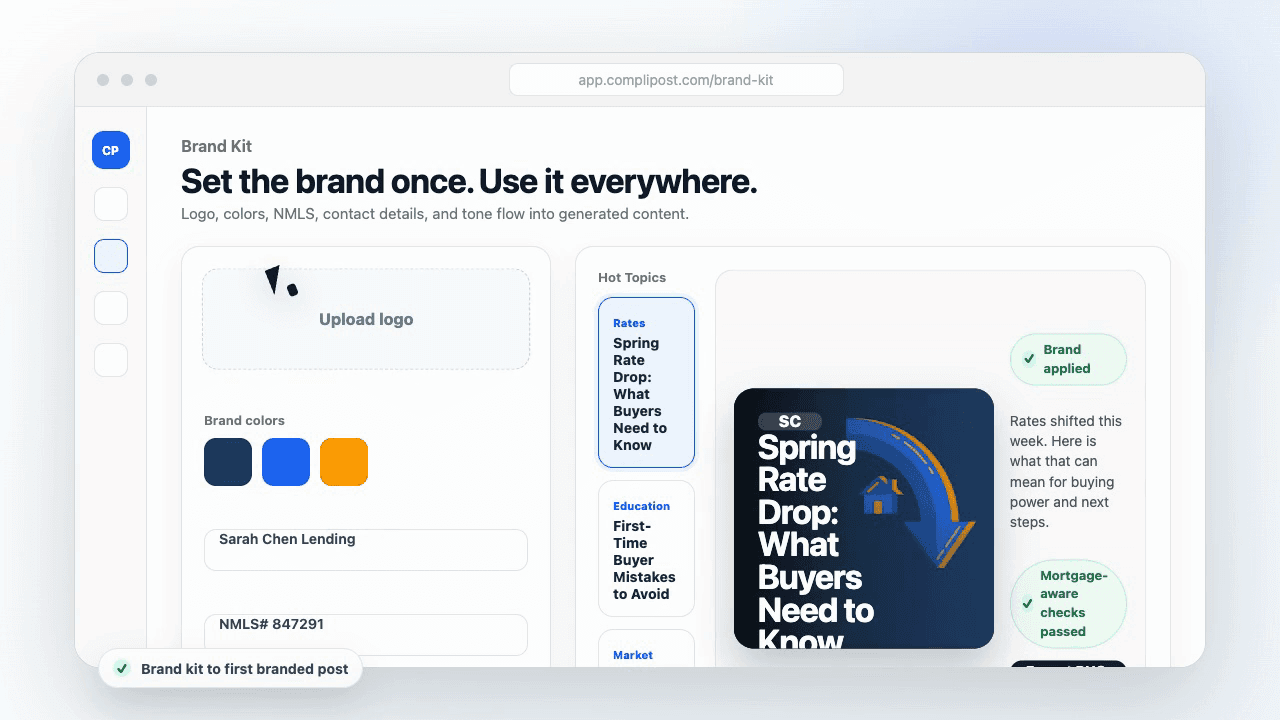
Product workflow
From blank page to export-ready mortgage content
- Start with a borrower topic
- Generate copy and a visual direction
- Review, save, and export the finished asset
These previews reflect the core CompliPost workflow: create, review, save, and export assets for use in your own channels.
Workflow comparison
| Content approach | What happens | Why it matters |
|---|---|---|
| Random posting | One-off ideas created when there is spare time | Inconsistent visibility and weak reuse |
| Template-only posting | Faster design but still requires rewriting and review | Helpful starting point, but not a full system |
| CompliPost workflow | Plan, generate, review, save, and export from one place | Better consistency with mortgage-aware review context |
| Done-for-you service | Someone else creates much of the content | Useful for some teams, but less control and less immediate reuse |
Who this guide helps
This guide is for loan officers working on solo loan officers who need a repeatable mortgage content workflow. The goal is to turn a broad mortgage topic into one borrower question, one useful takeaway, and one asset that can be reviewed before it is shared.
- You need content that sounds like a loan officer, not a generic brand account
- You want examples that can become captions, graphics, GIFs, or PDFs
- You need a clear place to review claims before export
- You want finished work saved for reuse, not lost in a chat thread
A practical workflow for this use case
Start with a narrow scenario, then move through planning, drafting, visual creation, review, and export. For loan officer purchase market content, that means the topic should be specific enough that a borrower or referral partner can immediately understand what decision the content helps with.
- Choose the borrower type, loan topic, or platform before generating copy
- Draft the caption and visual together so the asset feels cohesive
- Use the federal baseline review aid to flag claims and disclosure gaps
- Export the finished asset and save the post as a reusable starting point
What makes the content stronger
Strong mortgage content is usually specific, plain-spoken, and calm. It explains tradeoffs without pretending one answer fits every borrower. That is especially important on public social channels, where a short post can be interpreted without the full context of a loan conversation.
- Name the borrower question in the first line
- Explain one decision or tradeoff instead of covering everything
- Use examples without implying approval, savings, or rate outcomes
- End with a soft next step, checklist, or guide rather than pressure
Compliance-aware review notes
CompliPost should be treated as a review aid, not a compliance approval system. The public page, generated draft, graphic, and exported asset should all stay honest about that boundary.
- Review specific payment, APR, rate, savings, and qualification language
- Avoid “best,” “lowest,” “guaranteed,” “free,” and urgency claims unless approved
- Check NMLS, Equal Housing, company, and state-specific requirements
- Use company or legal review for anything outside the federal baseline
How this connects to the rest of CompliPost
A focused guide should leave you with a usable next step. After you understand the topic, you can turn it into a calendar slot, a reviewed social post, a downloadable guide, or a platform-specific version for the channel where your audience already spends time.
- Use the content calendar to turn the idea into a weekly plan
- Use the compliance page when claims or disclosures need a slower pass
- Use lead magnets when the topic deserves a deeper PDF guide
- Use platform pages to adapt the same idea for LinkedIn, Facebook, or Instagram
Recommended next steps
Mortgage social media content
See the cross-platform content workflow for loan officers.
Mortgage market update posts
How to frame rate and market news for a borrower audience without crossing into unauthorized advice.
First-time buyer specialist content
Purchase market content optimized for first-time buyers — the largest segment of active purchase borrowers.
Down-payment assistance social media content
Content strategy for DPA programs — one of the highest-engagement topics in a purchase market.
Examples
FAQ
What is purchase market content for loan officers?+
Purchase market content is social media and web content designed to reach borrowers who are actively researching buying a home — not refinancing. It covers process education, pre-approval guidance, closing-cost transparency, and local market context. The goal is to show up as the trusted expert a borrower finds during their research phase, before they've chosen a lender.
How is purchase market content different from refinance content?+
Purchase borrowers are often first-time participants in a complex process and respond to education that makes the process legible. Refinance borrowers already have a loan and are evaluating a change — they respond to rate context and financial analysis.
When should a loan officer post purchase market content?+
Year-round, but with heightened intensity during spring (March–June) and early fall (September–October) — the two peak purchase market cycles. Research on mortgage contact timing shows roughly 40% of mortgage inquiries happen outside business hours, which means consistent content presence reaches borrowers even when you're not available to answer the phone.
Can loan officers post about the housing market without compliance risk?+
Yes, with careful framing. Describing current conditions — inventory levels, days on market, what competition looks like — is informational and generally safe. Predicting conditions or recommending action based on market outlook is unauthorized financial advice. The distinction is information vs. recommendation.
What content formats work best in a purchase market?+
Process explainers, closing-cost transparency posts, down-payment education, and local market context posts consistently earn the saves, shares, and DMs that signal purchase-borrower intent. Lead magnets — a closing-cost worksheet, a pre-approval checklist — are the highest-converting format.
How does CompliPost help with purchase market content?+
CompliPost generates process explainers, pre-approval guides, closing-cost breakdowns, and local market context posts that you can review, adjust, and export to your own platforms. Every piece goes through a federal-baseline compliance review aid that flags rate statements, urgency-framing, and outcome-promise language before export.
Create mortgage content with a calmer workflow
CompliPost helps you plan, generate, review, save, and export useful mortgage content without pretending compliance or social distribution is automatic.
Start free